Showing posts sorted by date for query traffic engineers. Sort by relevance Show all posts

Thursday, March 21

Bicycle Connections

Google Maps Satellite View of Where Patrick Francis O'Rourke was Killed on his Bicycle in 2001
As my loyal reader knows, Beto O'Rourke ("e" as in prounounced in the word "President," not "e"as pronounced in the Canadian word "eh') is from Texas and has announced a run for President. This post, however, is not about Beto. This post is about Beto's dad. 

Most people do not know that Beto's father, Patrick Francis O'Rourke, was an avid cyclist - AND a politician. Pat sent a "payment due" bill to Ronald Reagan's US Government in 1986 for reimbursement to El Paso, and was Jesse Jackson's 1988 Texas Campaign Chair. In his day, in his mostly Latino area, Pat was known as the "Tip O'Neill" of El Paso politics. Like our current President (and Ronald Reagan before him), Pat was a lifelong Democrat that became a Republican - in Pat's case, finding what he considered a better way occurred sometime before 1992. But I digress.

In 2000, Pat O'Rourke made a cross-country trip on his recumbent bicycle from Oregon to New York. Pat blogged about it on the Stanton Street Blog,  which Amy O'Rourke, (Beto's wife) sold in 2017. I was unable to find Pat's original bike posts, and a search on it for "bicycle" revealed nothing. Perhaps my loyal reader can find something. I will update this post if I make a later discovery. My loyal reader might also contact Stanton Street to see if they want to 'fess up and repost.

Unfortunately, Pat's cross-country bike trip is not the end of the story. After Pat got back to El Paso, he continued to ride until one day in early July 2001. On that day; a day like many others, Patrick Francis O'Rourke was riding his bicycle near Artcraft Road and Westside Drive. The intersection is about a block from the New Mexico border on the western outskirts of El Paso. Somewhere nearby, Pat was struck from behind by a motorist and killed. I don't know the crash details (newspapers called it an "accident" - some misnomers just continue on and on), and I will update this post if I find more details later.

The crash in which Pat O'Rourke was killed illustrates something that is not well understood within the cycling advocacy community, but SHOULD be. In my blog, I constantly issue the refrain that "the danger is from ahead" and my refrain is true - in urban areas that have intersections, driveways and other hazards, and even more so in these places when the cyclist is controlling his or her lane in accordance with good practice. However, My refrain is NOT nearly so true on high-speed rural roads, such as that where Pat O'Rourke was killed. Statistically, "from behind" collisions are rare, but they have a very high fatality rate because of the sheer energy with which the cyclist is impacted when hit by a heavy, high speed motor vehicle, or even a protrusion from a motor vehicle such as a side mirror.

Hit-from-behind collisions are more common than in the past because more cyclists take long, country rides - they don't like urban traffic. Shoulder riding on a highway reduces the likelihood of a collision because it can be avoided by the simple expedient of the motorist staying within his or her traffic lane, but all the reflective material on the back of police cars and fire trucks, and all the mirrors cyclists and motorists swear by, do not obviate the fact that any highway shoulder is a dangerous place, even if one arrived there in a heavy motor vehicle. Lots of cycling advocates and traffic engineers have  gotten enamored with the notion of "protected" cycling lanes to reduce "hit from behind" fatalities, but cones, lane dots, rumble strips, any of their variants, or low curbs won't protect a cyclist on a rural highway that is in the wrong spot at the wrong time. Protecting non motorized road users on high speed country roads is something that we, as a society, have not really even BEGUN to come to grips with. Even John Forester relates fearful journeys he made on such roads when traffic got heavy.

Beto doesn't speak about his father much in public, though his father was also a politician. Beto shares the middle name of "Francis" with his father, grandfather, and great grandfather, and his childhood nickname avoided confusion within the family. After Beto's rebellious youth, in which he acted more like George W Bush than any other recent President, he came back home to El Paso and delivered the eulogy at Pat's funeral. Two links to stories involving Pat may be found here and here. Patrick's grave memorial including his obituary may be found here.

From now on, when I hear people try to denigrate Beto by calling him "Robert" or even more, by calling him "Francis," I will inwardly smile at how they are ignorantly honoring his immigrant family, or his cyclist father. From a Facebook image at left, taken from one of the links above, you can see Pat and Beto.

Patrick O'Rourke's life is memorialized here. At that site, you can also trace his ancestry back at least into Ireland. Cycling may be fun and safe - but we should remember that there are unexpected occasions when it is NOT. Be especially careful on high-speed, narrow, country roads where at least SOME motorists do not expect a cyclist or anything else to "suddenly" appear in front of them...


Tuesday, October 18

Sympathy for the Motorist


Whilst some cyclists might entitle this post "Sympathy for the Devil," we should all remember that the traffic engineers sometimes make things needlessly complicated for all road users. While I'm not generally a fan of taxpayer-subsidized car storage (free, on-street parking), signage such as above gets my sympathy. Mostly, such signage doesn't concern cyclists.

Presuming that the motorist actually KNOWS whether he/she is facing north or south when looking at the sign combination above, it still requires a bit of thought to realize where one is allowed to park and where one is not. Hopefully, most motorists would realize what day of the week it is and that parking is not allowed next to fire hydrants or in front of driveways in any event. I'm not sure why they allow parking anywhere along this road. That'd certainly make things simpler - "NO PARKING." Still, such signs make it clear why sometimes motorists stop in the middle of the road, making us wonder what they are thinking...

Monday, August 29

Flag Follies in Ocean Shores

We're Nearly as "Hip" as Seattle Here in Ocean Shores!
Apparently, one of the new trends in street crossings are flags. I’ve seen a few in Seattle popping up, and now we’ve got flags in Ocean Shores. They’re at the very same roundabout I’ve written about here and here.

Flags Piling Up
The idea of these flags is that pedestrians will take them and wave them in order to avoid getting run over by careless motorists. In that regard, they are a low cost alternative to various beg button systems and they’re probably effective for pedestrians, crossing from either the first or second photo. I’m not sure what a pedestrian is supposed to do when coming upon a sign (black letters on a white background being “regulatory”) like that in the third photo. Fortunately, most pedestrians (and motorists) are blissfully unaware of the yellow versus white background rules that cycling advocates blather about interminably.

The flags, however, are a bit problematic for cyclists. If you’ll recall from my FIRST OS roundabout post, their bike lane directs unaware cyclists to ride on the sidewalk (possibly illegally), where they’re then expected to cross across four lanes of roundabout traffic, back on to the sidewalk at LEAST once, before getting dumped back into another bike lane or onto a street without any guidance at all. Apparently, the traffic people did not realize this is FAR more dangerous than simply having cyclists operate as traffic through the roundabout since even a SLOW cyclist is going twice as fast as any pedestrian. I’m also not sure how they figured how a passing cyclist was supposed to grab a “take it to make it” flag as he/she passed by in a situation where he/she was at FAR greater risk than any pedestrian.

This was brought to the front of my mind yesterday as I saw a four seat, four wheel rental pedal car first go the wrong way down the street and then blissfully go through two successive crosswalks. If the peoples’ eyes driving the pedalcar were any guide, they didn’t look at either crosswalk. Can you say “accident waiting to happen?”


 Myself, I’ll continue to ignore the dimbulb attempts at directing me to do stupid things on my bike until/unless they come up with something that actually does anything more than check off some “complete streets” fantasy that comes from behind a windshield. In the defense of the traffic engineers, however, the flags probably DO help pedestrians better than doing nothing, though I’ve not heard of anybody actually getting hurt at the roundabout. Perhaps a couple of pedestrians got scared by tourists that did not understand how the roundabout works?

Lonely Flagless Stand With Sign Advising "Take it to Make It" - Is This a Serious Danger?

Monday, September 8

Round About the Roundabout

Google Maps Satellite View of Ocean Shores Roundabout
More About The Bike Lanes Later...
Not long ago, the Bike League instructor email list had a discussion about roundabouts. Roundabouts are an up and coming feature of roads that allow traffic flow without the disruption of four-way stop signs or traffic signals. They work quite well for motorized traffic, but cyclists and traffic engineers do not seem to understand how they can also work quite simply and well for cycling. The Ocean Shores roundabout is a case in point. The roundabout replaced the only traffic signal in town.


Uneventful Traffic Flow Through Ocean Shores Roundabout
The Wrong-Way Motorist Wasn't Using it Today!
If You Ride a Bike, The Bike Lane Striping Appears to Direct You into the Crosswalk
At the beginning of this post, you can see a “Google Maps” overhead view of the roundabout. Mostly, traffic flows through it without incidents of any kind, though I heard a motorist tried to go through it the wrong way a few days ago. Most motorists are competent enough to go around in the right direction and mostly they also pay attention to the signs. Ocean Shores is a tourist town, and so a lot of these motorists that do well have not encountered roundabouts prior to their visit.

I’ve ridden through this roundabout many times now and, up until a week or two ago, it’s been the height of simplicity to simply follow the signs that apply to the rest of traffic. Basically, if you plan to turn right or go straight, you stay in the RH traffic lane. If you plan to make a left or U turn, get in the LH traffic lane and exit into the street appropriate to your destination. As with most well-designed roundabouts, traffic entering the roundabout must yield to those already going around. This works well for motor vehicles OR for bikes, since bikes can go around in a circle at least as well as the typical motor vehicle. It is a simple case of elementary destination positioning. For those not recalling this principle, it states “stay in the rightmost lane that serves your destination.”

Simply Follow the Arrows and Get in the Lane that Goes Where You Want to Go
HOWEVER, recently, the city restriped the bike lanes, creating needless conflict. The approach reinforced my belief that traffic engineers are often clueless dweebs that are ignorant about how to keep all people safe. In short, remembering that Ocean Shores made it ILLEGAL foranybody to ride on city sidewalks (even little kids on bikes with trainingwheels), these traffic engineers striped their bike lanes to direct cyclists on to and off of sidewalks into their painted lanes. You might wonder how this puts anybody in danger, considering that there are few crossing driveways on these sidewalks. Well, once so directed, people on bikes then use the pedestrian crosswalks across the roundabout. This IS a problem, since pedestrians without wheels travel fairly slowly and have the equipment to stop without problems. On the OTHER hand, people on bikes are going much quicker and they cross the roundabout in a manner that is unexpected for motorists using the roundabout. Personally, I also have a problem with city-installed infrastructure that encourages behavior that the same city has made illegal.

Following the Striping "Suggestion" Leads a Cyclist onto the Illegal Sidewalk and to Cross the Road at Right Angles to Traffic
Once again, traffic engineering in action – creating danger and encouraging illegal behavior when doing NOTHING would have been far better AND safer. I look forward to their next folly, when they create problems on the street immediately north of the roundabout…
Odd Striping Strategy for a City that Made it ILLEGAL to Ride Bikes on Sidewalks. I Guess They Expect Everyone Will WALK Their Bikes for a Block?

Saturday, September 8

Stepping Down the Pyramid with Mirrors

My Own Dear Departed Mirror
In the last couple of weeks, I was prompted by a couple of events to think again about mirrors when using a bike. Namely, how might mirrors help a cyclist reduce unsafe ("at risk") behaviors; which are the base of the safety pyramid. Some of those behaviors belong to us cyclists. Other unsafe behaviorsbelong to our motoring companions. It isn't always easy to separate the former from the latter. To REALLY be safe, we need to find ways to reduce both.
The Safety Pyramid - You Want to Move DOWN IT!

FIRST EVENT
The first event was a long, drawn out discussion amongst Bike League cycling instructors about mirrors. One point that stuck with me was the inquiry by Khal of Los Alamos Bikes, namely:

"Question to those who strongly advocate mirrors. How often do you check mirrors in traffic, and does this give you adequate warning of a suddenly developing situation?"

It seemed to me that most of the ensuing discussion focused on feelings and faith rather than "what do we need to do."

SECOND EVENT
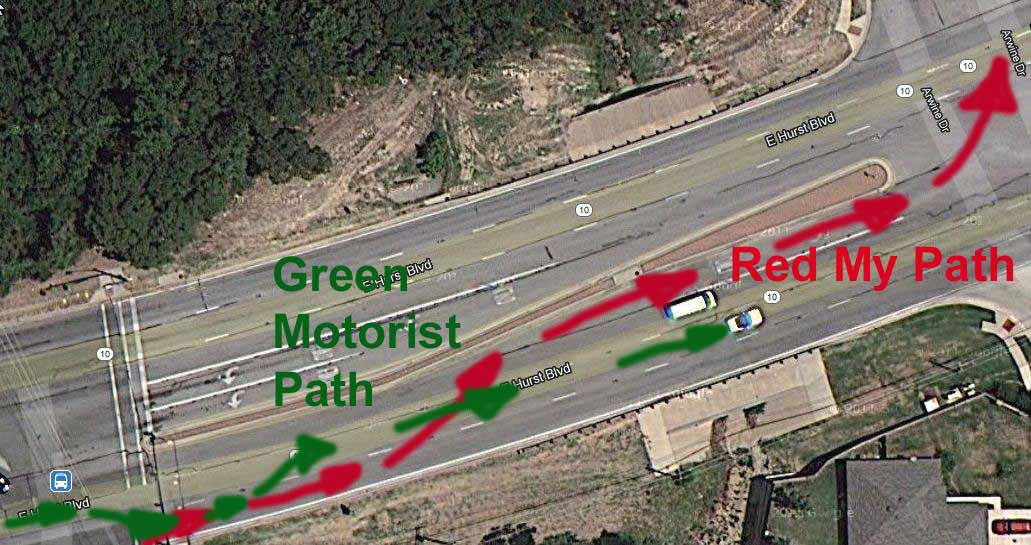
The second event was the rare "drama behind me." In it, seeing a motorist proceeding in the middle lane of three choices, and me planning to cross those three lanes prior to making a left, I initiated a right turn into the right lane (right turn on red). Normally, the motorist would have swept by and then I'd be up to speed and move over to make the left. I COULD have simply waited, but it seemed to be pretty simple. This time, however, the motorist swerved from the middle lane into the right lane - MY lane. What? Suddenly I was in a lane at about 10mph with a motorist directly behind, doing 50 and closing fast. I considered my options, not knowing exactly WHY this lady had swerved from a "clean and simpl pass" position into a "hit from behind" position; things didn't seem clear. As a result, I fell back on experience and hung a left turn signal while keeping close watch. If the lady was going to make a right, she'd see it and we'd be good. If she was wondering about my intent, she'd see it. Either way, I was definitely going to watch this motorist's wheels to see what would happen next. While my stress level edged up. At this point, anything other than "stay the course andO signal my intent" seemed to be a poor bet.

Well, as it turned out, the motorist then swerved left, back into her original lane, passed me with plenty of clearance (remember, I was signaling an intent to go INTO that lane she swung back into), and proceeded apace. After she passed, I exhaled, completed my leftward shifts and made my left turn; thinking about the safety pyramid and pondering how any mirror might have helped. Lest you think I'm simply being "dramatic," one of my engineers saw the event and said he was wondering if he needed to be calling 911. Lest you think I narrowly escaped death, the lady's closest approach was probably ten feet as she swept by in her original lane. I have no idea what the lady had in mind, other than she imagined I'd cross all the way across the street in front of her instead of following traffic protocol, and decided her best chance to miss the "idiot" was to swerve right. Assuming she was paying attention (she was NOT chatting on any mobile device), despite my concern, I was in absolutely no danger whatsoever UNLESS I'd done some ill-advised evasive maneuver at the last moment - mirror help or hurt? I guess my "proper" behavior simply fooled her. Who really knows. Regardless, as PM Summer once said: "no harm no foul."


Second Event - View from Google Maps - Arrows from Yours Truly
I'm neither a big fan nor opponent of mirrors. The one time I used one, it proved a useful added means to help in overall situation awareness. I think, however, that mirrors are a bit oversold, as are other safety things such as "high vis" and helmets. In the final analysis, our FIRST line of defense as road users (or on other public travel routes) is that our fellow road users know what we plan to do and what they in turn need to do to avoid disaster. That is the basis of traffic law.

Let us consider the actual USE of mirrors. Any mirror has three uses; the first is to see what is directly behind, the second is to see what might be developing in the lane to one's left when you might be considering such a shift, and the third is a similar function for a rightward shift. We'll consider them in order.

BEHIND
If you are looking to see what is going on behind you in a mirror, you are motivated by concerns about the general situation or you think you may want to send some message to following traffic. In the case of the "second event," what message would a mirror enable me to send? In reality, in such a situation, clear consistent operation seems to be the best principle when encountering another road user that seems to be doing illogical things. Even a wave or a "slow down" signal might confuse things for a distracted driver. What's more, for looking behind, we on bikes have no need for the "behind" mirror to keep from backing over people or stuff in the driveway. As you might see from the photo below. The rearview mirror is imperfect in that regard even in the MIGHTY LAND ROVER.


Mirror to Look Directly Behind. Mostly Useful for Backing Up
OTOH, a mirror is quite useful to look behind when one is wondering what happened to that motorist behind that should be ready to pass now. In the one day I had a mirror, it repeatedly answered such questions. No safety issue, but I, for one, dislike even short-term mysteries when riding. Score a point for mirrors.

SIDE (left or right)

LH Mirror - Aim it at the Lane to Your Vehicle's Left According to SAE
A mirror has definite uses when considering a left or right lane move in traffic. That is one reason that driver side mirrors have been required for cars starting in 1968 (prior to 1968, no side mirrors were required). They also became ubiquitous on the far (right) side of cars by the early 90's. In the case of a side mirror, it is "aimed" at the next lane over so you can see what will crunch you if you shift over. Such a mirror is clearly aimed differently than the "behind" mirror. Go HERE for a discussion on mirror aiming. Cyclists have an advantage in this regard over motorists because their head movements that effectively change mirror aiming are less than for their motoring brethren. Still, a mirror is either optimized to see behind or to one or the other sides. And THAT is a point mostly missed in the LAB discussions: if aimed behind, what action can you suddenly take that does not make you LESS predictable? If aimed to a side, how often does it really make a difference? While we are talking about SIDE mirrors, the reason RH mirrors came along much later is that they are a lot less likely to be really useful. Think about it. If you are on a bike (or in a car) and making a right turn, motorists on your right are a rare event. If you are making a lane shift to the left; much more likely. As for pedestrians, we on bikes really don't need mirrors to see them.

RH Side Mirror. Look HERE to Check Before a RH Lane Change. Objects are Closer Than They Appear!

OTHER FACTORS
If you are in a car, the side view mirror is much closer to the lane divider than it would typically be if you are on a bike - UNLESS you are riding a bit left of the LH tire track. This is simply due to the much wider width of a car. In my own experience, I get reduced passing clearance if I ride "close" to the LH lane edge. Things are much more congenial if I ride somewhere within the range of tire tracks. Personally, I like the "left center line of sweetness," but as with a lot in life, "it depends."

BOTTOM LINE
Very little of the mirror discussions I've seen address how mirrors are used for different purposes, nor exactly HOW you can reliably use a mirror for any safety purpose when considering traffic approaching from behind. For a movement you plan to the side - yes. From behind, not so much unless you are planning to jump on the brakes without warning.

MY VIEW (no pun intended)
A mirror can help in overall situation awareness. I'm going to get another mirror partly for this reason. What's more, it'll be a bar end mirror and NOT the one I already have that mounts on my helmet. A mirror makes a useful part of the "eyes moving" sequence of seeing what is all around (if that is any different than overall situation awareness) as long as it doesn't become an "end" in itself. A mirror can also help you prejudge a lane move. In this case, however, I'd never make a lane move without the "trust but verify" Ronald Reagan full head check. My kids were taught the same principle when motoring. NEVER change lanes without actually SEEING things are clear. In that regard, mirrors mainly help you know what to expect when the REAL look occurs.


"Trust, But Verify" Applies to Nuclear Weapons - AND Traffic (photo from Wikipedia)

ONE OTHER THING
All the above presumes you have normal vision or are farsighted. For those that are NEARSIGHTED, the mirror also helps them see what is happening back there and off to the side in conjunction with their eyeglasses. Otherwise, they are looking beyond the edges of their glasses.

JAGUAR CONSIDERATION
If you were wondering, NO, I have NO side mirror on my 1967 Jaguar. I have no plans to add one either - unless I find some of those that'll clip onto one's window but can be removed when one drives on to the show field. Just sayin'


No Side Mirror on THIS Vehicle!

Tuesday, June 26

Watch for Tricky People on Bikes

Approaching Bellaire Elementary from the North. Today's Subject Passed Through the Intersection About Where the Middle Car Is
Nowadays, There's a Traffic Signal Instead of the Stop Signs. At Least He had a Green for THIS Intersection
In any given situation, the safety of someone on a bike depends on his or her actions and the actions of other road users. This morning, on my commute to work, there was a guy on a bike going southbound down Bellaire a bit north of Bellaire Elementary School. He was hugging the right edge where the gutter pan meets the traffic lanes. Before long, he sort of wandered across the street, more or less in the middle of the left turn lane as he went into the intersection at Bellaire. He proceeded to ride down the street; now headed south in the northbound lane. After a couple of blocks, he zipped up onto the sidewalk, still headed against traffic. He rode along the sidewalk at about 18MPH; almost as fast as I was going on the road. It was fascinating to watch his driveway/intersection crossing technique –keep the head straight and keep going. Any motorist, however diligent, coming from one of the side streets, would have had no chance to avoid him. Any pedestrian approaching from the side would have gotten smacked. After a couple of more blocks I was far enough ahead that the show came to an end. Not long after, I arrived at the red light at Highway 10.
The Red Light at Highway 10. Back When it was Dark When I Got There
Today's Scofflaw Was ANOTHER Guy on a Bike. He Crossed on the Left Sidewalk
and Swerved Through the Highway Traffic
For an encore, while I was waiting for the light to change, along comes “clueless wrong-way sidewalk rocket guy,” who shot through the red light off of his wrong-way sidewalk, across three lanes of traffic and a left turn lane, threading through oncoming westbound motorists on Highway 10 that were naively expecting that their green light meant “GO” instead of “watch for a person running the red on a bike.” Though I knew it was NOT a teachable moment, I couldn’t help myself and yelled “it’s a red light!” in his direction. I admit it, sometimes I forget you’re supposed to watch for people on bikes, not yell at them. This guy then proceeded to ride eastbound along for the better part of a half mile on the left side of the left lane of a highway with a 50MPH speed limit before swerving across three traffic lanes in order to hop onto a sidewalk off to the side of the road. Lots of eastbound motorists got to watch this tricky guy. They all avoided him – THIS time. Cycling really IS safe!


One popular explanation for “safety in numbers” promoted by Jacobsen and many advocates is that motorists watch for bikes better when there are more bikes. I’d like to propose an alternate reason since I don’t see how ANY amount of added motorist diligence would help this tricky bike guy. Isn’t it more likely that with added bikes on the road, people on bikes have more opportunities to observe and simply ride less dangerously? Wouldn’t that result in lower crash rates? Motorists are trained NOT to run into things they see. That’s true whether that object is a bike, a parked car, a pedestrian, or even stuff floating in the wind. West of Amarillo, I was amazed to see motorists swerving all over the road to avoid running into tumbleweeds blowing across the highway. I suppose it is POSSIBLE that they were watching for tumbleweeds because there WERE a lot of them blowing across the road, but I doubt it. Avoidance training runs deep and it kicked in for the Motorists on Highway 10 this morning. Simply put, if the fraction of bikes shooting through intersections going the wrong way drops dramatically, the fraction of people killed doing such things will also drop. Maybe if people doing dim bulb stuff get yelled at by many more cyclists, they'll catch on.
Heading North, This Morning, the Guy on the Bike Would Have Been Headed Straight Towards Me
Certainly my loyal reader can think of other reasons for improved safety with added numbers – “with more bikes, traffic engineers stop ignoring bikes” is a personal favorite, but reduced DANGEROUS behavior seems more reasonable than others getting better at anticipating and avoiding that DANGEROUS behavior.
My Track This Morning, With Bellaire off to my Right. Rocket Guy was Headed the Same Way Two Lanes Over to the Left

Monday, May 14

TCS ATP and More

John Romeo recently made a post about what he called "Total Cycling Support" versus "As Traffic Permits." IMO, it was a thought-provoking and important post. Go read it if you haven't already. Clearly, based on THIS post, it provoked some thought at this locale. After consideration, I'll toss out the notion that, in reality, it isn't really one versus another. For TCS, simply look here. We might debate the relative importance of various elements under various circumstances. But I think we really pretty much agree. JRA noted the Netherlands as an example. I think the Dutch would mostly agree with the LAB link. Indeed, I just saw an interesting post about the role of education in Dutch cycling, here. TCS consists of many elements.

As for ATP, my own position was, perhaps, cited here or here. However, when you are out on your bike, on a road that you might prefer not to be on, what ARE you going to do? On such a day, the "IF" choice may be irrelevant as you look at that busy highway you HAVE to cross in order to get home. It matters little whether you prefer something else. Starkly, you either ride as safely and well as you can, or you find some way to slink home. Perhaps, if you are not unusually determined, you never ride again and, instead, commiserate with your fellow motorists about how dangerous things are. Yeah, I wouldn't mind if things were better for cyclists. But they're not. At least not today. Not in the good ol' USA. While I think cycling is fun and safe, I also don't think my knowledge is likely to become anything more than a "fringe" opinion. Certainly not in the near future.

And THAT is the fundamental difference between our blogs. JRA, in his blog, makes excursions into the world that never was and says; "why not." I, in my blog, more often stick to the world that is, and ask; "how." IMO, we need both. Perhaps the "how is less inspired than the exposition of how things SHOULD be and MIGHT become. Perhaps the focus on "how" is the curse of the engineer. On the other hand, where would the crew of Apollo 13 be without the engineers who solved the problem of surviving an explosion in deep space?

In the world, we need both dreams AND pragmatism.

For the first, I'll refer you to a speech, made on my birthday, by John Kennedy at Rice University. He epitomized the dream. Without the dream, we would never have made the attempt.

John Kennedy Expresses a Dream

For the second, I'll refer you to a desperate attempt to save the lives of men sent to the moon in fulfillment of that dream. Without that engineering, those brave men would have died.
Engineers Brought the Astronauts Back from the Brink of Death

In reality, the human race needs both elements. TCS is a vision of what we might wish and work for. ATP gives us a way to get back home - today. The choice, in my opinion, is not whether to favor one or the other. The choice is to use the other while achieving the dream.

Saturday, May 12

Walk Versus Talk

This Scene Captures a Sense of What FW is About - Strictly IMO
I Might as Well Have Used the PANTHER PIC - Foisted on FW by D
OR "A Tale of Two Cities"

To the outside world, "DFW" is all one place. However, it really isn't. Like many metropolitan areas, DFW has many individual cities within in it. To my "Yankee" eyes, the DFW Metroplex has a more, distinct, bipolar nature than other places I've lived or visited extensively. While Seattle, Everett, and Tacoma are all distinct to those that "know," they are clearly birds of the same species. Ditto for Los Angeles and the South Bay cities - or even Anaheim. In DFW, sometimes it reminds me of an echo of life on either side of the Berlin Wall. I was reminded of this yesterday when I happened to have to go into Downtown Fort Worth on the same day I checked into "Bike to Work Day" options. First, however, a few observations for my loyal reader to consider. Henceforth in this post, "D" will refer to Dallas and Dallas County while "FW" will refer to Fort Worth and Tarrant County.
Scene Captures What Dallas is About - Again, STRICTLY IMO
I'm Glad I'm NOT a Democrat that Needs to Recover
  • Up until recently, commuter rail (the TRE) charged extra to travel a single stop if it crossed the D/FW line
  • Each has its own separate branch of I-35
  • Politics in each is a bit sleazy, but totally different from each other
  • Cycling on roads are quite different in the two places. My regular reader KNOWS better than to ask my why I think this is so.
  • D has light rail nobody rides, FW has buses nobody rides - but the FW buses had bike racks on their YEARS before they retrofitted the D (DART) buses
  • Each has its own airport despite DFW, which was built to put an end to such nonsense
  • Each has its own newspaper, that are joined only in that each mostly doesn't report much about the "other" place
  • Each place has television stations - and you can tell them apart fairly quickly when you listen to news, weather, or traffic.
  • If I wanted to be really unfair, I could note that Oswald shot Kennedy in D, but is buried in FW (remember that per my shortcut, anywhere in Tarrant County is "FW")
  • And the list could go on, but here is one developing "Tale of Two Cities."
Prompted by what I thought were some incredibly cynical statements about the LAB-sponsored "Bike Month" and "Bike to Work" promotions, I resolved to definitely go to one this year. Cynics DO spur the rest of us to do things we might not otherwise do. I ride to work daily, so these events are more like encouragement and a celebration to me than actual "YOU ought to change something." After all, aren't we supposed to appreciate those we love on days other than Mother's or Father's Day as well? Last year, I got some loot at the Fort Worth Bike Day event, but lost my camera. What's more, I had to go to REAL work before the main festivities. Not all of us start work after 9AM, after all. This year, spurred on by the cynics, I briefly considered making the day an excuse to fly to an event in another state - which prompted my response to this post, but the logistics don't work. As a result, New Mexico won't see me. Not that the failure should be any real cause for concern. After the travel though, this year, I thought it still might be cool to "head east, young man" and link up with the D festivities. Yup, another famous Steve A "compare and contrast" post.

Searching for "Bike Week" Events on the LAB Site
Well, I got reminded once again that D and FW approach things differently. Both places have politicians that claim to support cycling, but I know that Fort Worth has some important ones that also "Walk the Walk." I do not know how often or whether the mayor of Dallas rides. I DO know that the mayor of FW, rides and actually leads rides around FW. I actually got to meet Betsy in 2010 before she ran for mayor. At the time, I was being awarded "Bicycle Commuter of the Year" and she was the Tax Assessor. When we talked, it took about 15 seconds to realize she was not a political cycling poseur. I don't claim to be a real quick study. At that time, she regretted that she could not often cycle to work because the Tax Assessor often had to travel to several satellite offices. At the time, having to occasionally have to move 30 miles from one work site to another, I understood what she was referring to. John Forester, in EFFECTIVE CYCLING, makes much the same point in his discussion of cycle commuting.

The difference was reinforced in NCTCOG pages about "Bike to Work" events. The head of the FW transit is leading a ride. Betsy is talking. There is loot getting handed out. When I was in FW yesterday, I was SHOCKED at the plethora of well-located sharrows and other cycling enhancements like REAL bike racks in place of the artsy ones that used to dot FW. I shall have to do a remake of the "bus lane" post. The rules have changed. If you get outside the central core of FW, the bike plan still consists of lines on a map that do not relate to any current or potential reality, but FW has made some real changes and I do believe those changes will result in better quality of life - even for the urban motorist. I pray that pedestrians may benefit at least as much as cyclists. Are some of these facilities suboptimal or even potentially dangerous? No doubt, and I will point out such features when I see them, so my loyal reader stays safe. But FW has elected to begin a process and they will get better at it as they move forward. Despite my own "cynic aspect," I say "YOU GO GUYS - LIGHT THAT CANDLE!"

Meanwhile, in D, the news is how they can't do anything. The flashy new bridge prohibits pedestrian traffic - and I suspect bikes and dogs are not welcome, either. As for "Bike to Work?" Well, look at the photos to see the contrast. In my strictly personal and unofficial opinion, Dallas remains even more mired in the failed politics of the past than ever. I can ride safely in either D OR FW, but why would I WANT to travel to D, when the coffee is cheaper in FW, the mayor of the city cycles, and there's a real chance I'll see a horse walking around downtown between the skyscrapers. Heck, now I hear that even a feature of FW I've sneered at - the fact that Sundance Square is nothing but parking lots (NINE, to be specific, along with related businesses), is going to change. Personally, I think DURANGO deserves the credit for the change in FW direction. Which points me to a future post in which I discuss the differences between advocates and engineers. But I get ahead of myself.

I guess, this year, I'll join the Bike to Work stuff in Fort Worth once again. Fort Worth may not be making the rest of the world "green with envy" the way it might like to believe, but it might well make the rest of North Texas do so.

One jarring note remains: I do know some really NICE people that live on the wrong side of the county line that divides D from FW. I guess it is a reminder that the Berlin Wall wasn't built to divide good from bad either. As in D versus FW, sometimes it is simply good or bad fortune. Chandra, let me know if you need some help moving! Ditto for all of y'all living in Richardson...

NCTCOG Encompasses BOTH Spheres - D and FW

Despite The Warts, Fort Worth Embraces Things the Cynics Despise. In this Respect, I'm WITH FW

The Dallas Morning News Mutes His Frustration with the LACK OF RESPONSE From the "Big D"
In CASE You Missed it "It's almost like ... are plugging their ears, going..." Perhaps the People that Didn't Like the Past
Bike Guys are Wondering "...New Boss, Same as the Old Boss" From the Rolling Stones?
Official Dallas Website Offers Little More than the Dallas Oberver Writer's Notes
In the words of the Verizon Guy, "Do you hear me now?"

A Search on the Dallas Bike Guy's Name Offers Little More


Maybe YOUR Google on Dallas Bike to Work Can Give me a Reason to Head EAST Instead of West?
In Summary, FW May not be Perfect, But the Bar they Have to Jump Over is Pretty Low.
Finally, one las time, Strictly in my PERSONAL and strictly UNOFFICIAL Opinion.
Yes, I'm GLAD I don't live in D County


Wednesday, February 29

Last Post of the Old Era

I'm going to go in a little different direction. If you happen to be my loyal reader, don't despair. I don't think this blog is actually going to GO AWAY in the near future. However, a little clarity has entered my life and I'll unveil it soon. For the moment, I'll dispense a little wisdom in the way I've been accustomed to do.

Dear, Departed Eugene Sloane
Today, I want to rant a little about the pure ignorance of traffic engineers where people that ride bikes are concerned. I'll start with a blast to the past. Specifically, Eugene Sloane's classic book on bicycling. In it, amongst other things, he ranted against drain grates that trapped cyclists. My own edition (actually, my wonderful wife's book) was published back in 1969. For those of you that are math challenged, 1969 was the year we first put man on the Moon, and it was also FORTY THREE YEARS AGO.

Well, some dips, er, traffic engineers haven't learned much in the last NEARLY HALF CENTURY.

You see, within a block of a "Safe Routes to School" project (supposedly to make things safer for kids), exists THIS TRAP.

What do you think would happen to a kid riding to school who hugged the curb. Yeah, me too. Fortunately, I ride WELL left of such dangers. It just strikes me how little progress we've made in impacting road design and drainage in the last half century...

Wowza, a Bike Rack Right in the Road! It's Been a LONG Time Since I Saw Such Egregious IGNORANCE

I Got a Little Nervous About Leaving the Bike Just Standing There. I Really DIDN'T Want My Expensive Wheel to Get Bent.
28c Tires Fit Into the Grate WITH ROOM TO SPARE

If You Needed a MODERN (Post 1969) Reason NOT to Hug the Curb, Look at THIS DRAIN Grate. It Could RUIN Your Whole Day - IF You're Lucky.
City of Hurst
Public Works
1505 Precinct Line Road
Hurst, Texas 76054
(817) 788-7076

Tuesday, September 20

Red Rage


This isn’t the post I was planning to write today. I was planning to write a post, entitled “taking the second left.” I even took some photos to help illustrate the traffic situation. It is one not taught in Cycling Savvy, though I think any of their instructors would recognize it. Instead, I got mad. UNREASONABLY MAD. I yelled at someone. Someone who might be a nice person most of the time. I knew it wasn’t a teachable moment, but I yelled anyway. And then I got really mad. The RED RAGE is not pretty.

Sometimes it takes only a minor incident to trigger it. It is a close relative to what we call ROAD RAGE; an affliction we tend to associate with motorists doing offensive acts that endanger others. Well, I can tell you that cyclists are not immune. What's more, since we are not insulated from the world by steel and glass, it's a lot more upfront and personal when it happens to one of us. Today, it was me. And it really wasn't anything major that set it off. I think a lot of road rage starts with something minor.

Bellaire Elementary School While Road Construction was Ongoing
Northern Approach to Bellaire Elementary Four-Way Stop
Not long ago, I reported how traffic engineers messed up the street of Bellaire in Hurst, where it goes past Bellaire Elementary School. Well, this morning, I left for work a little later than usual, and at the four-way stop just north of the school, settled in to a stop for the crossing guards who had their signs out so kids could cross. So far, the situation was pretty normal. You stop and WAIT, just like the rest of traffic, when the crosswalks are occupied and kids are crossing. The concept is pretty simple, and it is a penalty that comes with leaving a skosh late for work. This morning, I had plenty of stop time to take a photo of the crossing guards. They are nice ladies that take good care of their kids and there were quite a few this morning. While we never actually talk, they have come to know the guy on the red and white bike that rides down the middle of the lane.

Crossing Guard at Bellaire Elementary School on September 20
The Same Car is Stopped in Both These Photos. HE Didn't Blow Through the Intersection
The OTHER Crossing Guard at Bellaire Elementary School on September 20
You Can See Lots of Kids Beyond on the Sidewalk
On my right, an adult on a bike pulled up to the stop sign. I have no idea where he came from because I don’t recall passing him earlier, but I'd been stopped for a while since I had time to take some pictures. Bike guy actually stopped. Well, he almost stopped. Then he started forward and, I, still waiting patiently for the intersection to clear, forgot about non-teachablemoments. I yelled “You’re at a stop sign and there are kids crossing.” For those that do not know me, my voice projects VERY WELL. Some say that Steve can actually be quite LOUD. Bike guy yelled something back, somewhat tentatively. I think perhaps he was disoriented by a cyclist yelling at him. Who knows. I couldn't tell exactly what he yelled. In truth, there was nothing he could have yelled that carried any meaning unless he was going to simply obey the law and WAIT. Instead, he continued forward. I yelled again; even louder: “THE CROSSING GUARD HAS HER SIGN UP! THAT MEANS STOP!” The guy continued past the crossing guard (and the kids) and then down Bellaire past the school, riding in the gutter pan of the street. I did feel a bit better when the crossing guard waved to me and yelled out “thanks!” Her feedback helped, dropping the anger down enough that I did not feel any temptation to yell further at the scofflaw when I was able to proceed legally, and I blew by him within a half block. In contrary to my usual practice, I did not make a full lane change when I passed him. In reality, the guy was no worse than many people I see every day on bikes. Arguably, he was better than the lady that simply flew through a four-way stop yesterday afternoon without looking either way, with a trailer in tow behind her. Still, he was the one that set off the RED RAGE.

I do feel better because no embarrassing profanities (John Romeo Alpha would call such an "inappropriate term") escaped my lips in front of all those elementary school kids. Practicing and training for friendly cycling really DOES pay off. It is possible that some, reading this blog, don’t get irritated when they see people on bikes simply blow through signs or lights. While a person on a bike does not present the same magnitude of danger to other road users that the operator of a 6000 lb SUV represents, bike can and DO hurt people. Read THIS or THIS. Closer to North Texas, you can read THIS or THIS. I’d not go as far as Mr Christopher and cite such as the reason I’d never carry a gun while cycling, but I certainly understand where he’s coming from.

Just as not everyone driving a car is one of MY MOTORISTS, a lot of people on bikes should stay away from roads, paths, bike lanes, and sidewalks. Thanks for listening. I feel better now. We can go back to something OTHER than the RED RAGE. Heck, if you're riding in Hurst, you can probably blow through a stop sign right in front of me and I won't say a thing other than to offer first aid help when you cream some little kid.


Saturday, September 3

Traffic Engineers Distracting My Motorists

Mostly, I have a lot of respect for the various branches of engineering. Our lives have been enhanced greatly by the advances they've made. Just the very fact you can read this is due to engineers. Thank an engineer next time you fly and have landed safely. My respect is greatly tempered by engineering that attempts to mix psychology with science. A notable offender in this regard is traffic engineering. To a large degree, this is unavoidable, because keeping traffic from terminally clogging up and from crashing into each other requires understanding of what and why people do what they do while IN traffic.This is not just the idle observation of a structural engineer; the Arizona Department of Transportation, here, states: "Traffic Engineering applies engineering principles to help solve transportation problems, and brings into play a knowledge of psychology and habits of users of the transportation systems."

Bellaire Before the "Improvements"
The real problem is that traffic engineers tend to get a little wrapped up in the mechanical aspects of traffic. They start adding more signs and dots and other traffic gew gaws that promise to make traffic "flow" and "keep us safe." Pretty soon, the forest has been lost amongst the trees and we start getting zones where motorists can run off the road without damaging themselves and markings that are more distracting that helpful. What's more, they tend towards ever increasing "channelization" without regard to any useful purpose it serves and sometimes without remembering that creating traffic channels can create conflict between motorized traffic and the rest of the road-using traffic. Indeed, the same Arizona source linked above, forgetting that many road users are NOT motorized traffic, and getting tunnel vision, also states: "...chances of ...becoming involved in an accident are least when he/she is traveling at the average speed of traffic." Other than getting bikes and pedestrians OFF the road entirely, the document does not explain how this is to be accomplished other than also noting it is not a good idea to set speed limits too low. So we have an inherent conflict. A conflict, which, because most traffic engineers are mostly motorists and NOT cyclists, tends to get resolved in favor of a motoring-centric approach. This tendency is exacerbated because a lot of traffic engineers work for cities and their political masters want to go faster and with less delay from those poor and pesky pedestrians and idiotic people on bikes. Of course, being politicians, few would actually SAY something like this.

Protruding Dots Represent a Diversion Fall Risk for Cyclists
and are Worse in Front of an Elementary School Where Children Can Be Expected
I've posted about elements of this before. Traffic engineers created my nemesis road. They took a perfectly good and usable road and made it a stress creator for cyclists. They compounded the error by making something dangerous for cyclists under the cloak of "Safe Routes to School." What's more, any emergency response now finds itself unable to proceed due to traffic engineers not creating any way to pass at all. I offered special scorn for "the killer B's:" these are Bollards, Bott's Dots, and bricks. Especially offensive are situations where the traffic engineers ignore established guidelines and use an even number of bollards that create added collision risks. Or they use BIG dots as if they meant to create a fall hazard for cyclists.

Even Numbers of Bollards Lead to Head-On Collisions.
Bricks Make Things Worse
However, I really got a little hot this week (beyond the amount justified by our continuing heat), when I saw the local engineers get carried away with dots and stripes in a local school zone. Specifically, Bellaire Elementary in Hurst, Texas. Crimeny, this is NOT a freeway onramp. A couple of traffic calming devices would have done the trick admirably. Why, I might wonder, would anyone feel it necesary to put in left-turn only and two-way left turn lanes in front of an elementary school? Would you allow YOUR school child to ride down this street after the traffic engineers got done with it? I guess the traffic engineers think they have done their job. They got any bikes OFF the road and thus reduced speed differentials. I hope they're happy (he says very sarcastically). We really DO need to cut government waste! Better to have simply left bad enough alone than to spend a lot of money to make things worse.

Northern Approach to Bellaire Elementary, Looking Like it Did in the Olden Days. A Simple Four Lane Road with Sidewalks
Northern Approach to Bellaire, Where the Traffic Engineering Distractions Start. A Left Turn Lane at a Four Way Stop Onto a Local Residential Street?
You Gotta Be Kidding!
Another Shot of the Road Desert They've Created at Bellaire Elementary.
Would YOU Let Your Second Grader Cross This Gauntlet?
Temporary Traffic Cones - Ready for the Motorist Dropoff Rush. The New Road Features Makes the Rush Even Worse
Traffic Engineer Handiwork Across from Bellaire. Any Cyclist Hitting These Dots Will KNOW IT!
Before the Traffic Engineers, This Portion was Simply One Lane Each Direction with Wide Lanes
No Reflector in Front of this Fire Hydrant. Just a Splash of Blue Paint