Y'all know what corrosion is. In regular steel, it's referred to as "rust." Aluminum tends to turn to a whitish powder. Zinc is used as an anode to keep boat components from corroding.
Corrosion is not necessarily a BAD thing. It is galvanic corrosion that makes a battery work. Still, you do not want to try to use your expensive bike components to power your headlight.
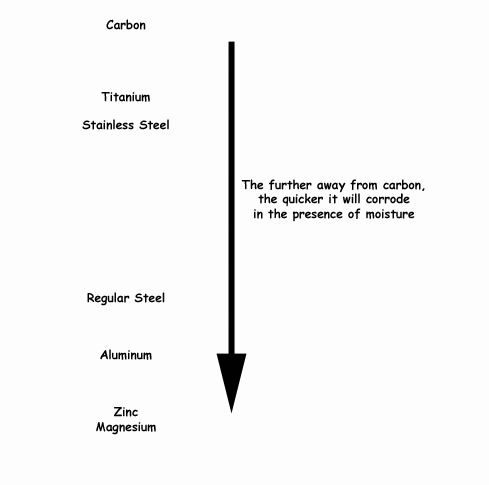
Enough of that, what about corrosion and composites, you might ask? I'd respond it is a reasonable question, given the title of this post. Well, there's good news and bad news. The first, is that your new carbon bike will NOT corrode away any time soon. In point of fact, it is THE most "noble" material used in bicycle construction. It is even more stable than gold. You see, materials are susceptible to galvanic corrosion in the presence of a conductor and a more noble material. If you look at the figure below, you'll see that carbon is at the very top (
I did not include materials such as gold which are only slightly worse than carbon). The "steel is real" crowd will be relieved to see that their bike material of choice IS, in fact, better than aluminium. Bringing up the bottom are things like zinc and magnesium. As I recall, a couple of years ago, Colnago built a bike with a Magnesium frame. Just because you CAN do something does NOT mean it is a good idea.
The Further Down the Scale, the Easier Carbon Will Make it Rot!
The BAD news is that your carbon won't rot away in front of your eyes, but those expensive aluminum and magnesium components ARE at risk. If, for example, you have an aluminum frame and a carbon seat post, for example, the potential exists for corrosion of the frame due to that contact. You have risk for corrosion to those cool dropouts that hold your wheel to your carbon fork.
Lest you think this is overdramatic, back when the F/A-18 fighter went into service, one went into the drink. They fished it out a couple of weeks later and the aluminum was basically GONE.
There are a couple of approaches to avoid trouble. First, avoid "intimate" contact between the carbon and metal that is more reactive than stainless steel. A rubber pad would suffice, or a swatch of fiberglass. Undamaged (no scratches or rock chips) paint and primer. Even WAX. Yay, WAX! Just keep the two apart so they can't pretend to be a battery cell. Hopefully, your bike manufacturer took this precaution in things like gluing the fork ends into the carbon. If not, you're still left with the second strategy.
The second strategy is to KEEP THINGS CLEAN AND DRY. Dirt and moisture in combination really get the galvanic action going. If it's dry, there is no medium for the electrons to zip around in. On the other hand, if you leave it out in a damp garage next to the pool chlorine tablets, you will have interesting things happening before you know it. Especially, if you have a cyclocross bike such as I do, do not wait a week before cleaning after a race.
Anyway, I don't think I have to tell you how to look for corrosion in the metal. You'll detect IT pretty easily. Clean it away until you get down to sound metal. Reprime and repaint. When you are out of sound metal, it's time for a visit to your LBS. Remember, keep that puppy clean and dry - and ESPECIALLY watch that carbon seatpost in that aluminum frame! Ham should be happy with THIS post. His carbon frame may outlast his grandchildren's grandchildren if he's lucky. They'll just have to replace the metal bits as they rot away.
I don't know if y'all can take a log of comfort in it, but I've now had Buddy for over a year and there is still sound aluminum in the frame, though I haven't attempted to remove the seatpost recently. Hmm...
A Carbon Seatpost In an Aluminum Frame is Not the Best Galvanic Combination
The Ti Rails are Not a Likely Problem


 Y'all know what corrosion is. In regular steel, it's referred to as "rust." Aluminum tends to turn to a whitish powder. Zinc is used as an anode to keep boat components from corroding.