Showing posts with label Jaguar. Show all posts

Saturday, July 17

Avoiding the Zombie Blog Situation

Despite not having posted here since March, things are cooking beneath the surface. I actually purchased a domain name. I'm also studying Wordpress. Stay tuned for further news, as I've not decided whether to and what to move to the new domain. I purchased 3 years of hosting and can have unlimited websites. I suspect I'm going to use subdomains rather than registering separate domains.

This is not my first foray into building a website. 20 years ago I wrote the website for the Seattle Jaguar Club. Thanks to "internet archive's" "Wayback Machine," a sample of it back in the day can be visited here.

Monday, May 21

Mixed Feelings


It really caught my eye. The first I saw, it was cited as something along the lines of newlyweds depart in "vintage" car. I thought: "Cool, this is an English tradition I can endorse!" My own E-type is the same age as the one Harry and Meghan departed in. The only thing I really noticed is that it seemed odd for them to be driving a left-hand drive car away from Windsor Castle. As it turns out, theirs is a bit different. They yanked the beautiful, three carb straight six double overhead cam engine and put in a boxy looking electric motor.

I suppose these are the times we live in. Perhaps this is the way the English attempt to change to a more modern way of life. Perhaps someone at Jaguar simply overloaded on Scotch one day. What will come next for this poor car; air conditioning and power steering? Perhaps, just as the French played "God Save the Queen" using the engine of a Renault as recalled here, this is an English attempt to be more humorous than the French.

They took a Milestone Car and Stuck a Washing Machine Motor in it?

You can see more on the electric E-type here. I suppose it is better than them yanking out the engine and sticking a Chevy engine in there...

Sunday, August 6

Plastic Fantastic

FAIL of the Plastic Tire Iron

The first thing I needed to do to the Univega was get the front tire to hold air. Accordingly, I removed the tire and tube. I found out the tire had an oversize tube, so I simply replaced the tube with a new one of the correct size. Along the way, I discovered that my plastic "tire iron" wasn't up to the job. Note to self: carry a plastic tire iron on the road, but keep the steel ones to use at home when a "real fix" is necessary. I guess there's a reason that steel "iron" was used back in the day instead of the plastic they give you nowadays.

Along the same line, our Jaguar car club had its annual show yesterday. One of the cars, a mid 1950's XK 140 emphasized the theme of this post. From a distance, it looks like the car has some gold trim. You can see it below.

Note Gold Color Around the Headlights and Turn Signals
However, if you look closer, you can see a statement is being made.

Some Things Were Done Differently Back in the Day...

Monday, August 18

Two Steps Forward and One Back


Toto, I Think We're in Kansas! Jaguar en Route from Texas
It seems things go “two steps forward and one step back.” Such has been the case in Ocean Shores lately. We recently drove up from Texas with one of the Jaguars in tow. Step forward.
I’ve also been riding more each week than I was able to do in the previous five months. It doesn’t even hurt very much. Second step forward.
Coming Home. The Jaguar Offloads from the Trailer
A new restaurant opened up this week in a location formerly occupied by an EXCELLENT taco stand. They went to the trouble of taking OUT a bike rack that didn’t impinge on motorist parking at all. Luckily, I'm not sure I would have been likely to become a patron even had they left the bike rack unmolested. Stay tuned for a future inquiry. What’s more, the Ocean Shores Farmer Market has been relocated from its attractive location at the library to the far end of a giant gravel parking lot. Apparently the motoring public wasn’t happy with the amount of parking. Myself, my enthusiasm for the local farmer market is lessened when I have to ride past the local IGA and across a giant gravel parking lot to pay quite a bit more for produce than I did last year. One step back…

Despite the Loss of a Bike Rack, Many People Cycled to the Ocean Shores "Woofathon" Last Weekend

Thursday, January 31

ABC Choices

Yes, That IS a Bulge. Illustrating the Value of the "A" Part of "ABC Quick Check"
Hmm, my rear tire's had a real SLOW leak for about three weeks now. Each morning, I pump it up from about 60psi to somewhere north of 100. Now, It's developed a "bump bump bump" with each revolution. The symptom isn't getting better.

Looking at it, there's a bit of an "owie" on the tread. Look at the picture carefully and you can see it - a reverse curve that represents a bulge in addition to the gray area that is perhaps coincidentally in the same vicinity. Ironic really, considering that Big Oak just got some new Continental Grand Prix 4 Season tires. THIS is the same tire, and it's only got about 4K miles on it. In the past, if babied, these tires will go nearly 6000. What has German manufacturing come to? Crimeny, these things cost almost half as much as good Jaguar tires!

Well, considering that I've been an "ABC Scofflaw" in the past, I'm considering three options:
  • Change the tire and tube (remember that slow leak) before tomorrow's ride. I do have an older, but still serviceable Conti in hand. Actually, I have two, but the sidewall weaving is coming off on the second tire while the first one is mere tired (no pun intended)
  • Pump up the tires on Frankenbike and simply defer the issue
  • Carry the extra tire along to work tomorrow "just in case" and hope that things will stay stable for one more day (our company will be shut down next week)
  • Carry the tire along and change it at lunch time, cutting the risk of a flat on the trip by some unknown fraction
My loyal reader will bet I take option 3. We shall see. Stay tuned.

Saturday, September 8

Stepping Down the Pyramid with Mirrors

My Own Dear Departed Mirror
In the last couple of weeks, I was prompted by a couple of events to think again about mirrors when using a bike. Namely, how might mirrors help a cyclist reduce unsafe ("at risk") behaviors; which are the base of the safety pyramid. Some of those behaviors belong to us cyclists. Other unsafe behaviorsbelong to our motoring companions. It isn't always easy to separate the former from the latter. To REALLY be safe, we need to find ways to reduce both.
The Safety Pyramid - You Want to Move DOWN IT!

FIRST EVENT
The first event was a long, drawn out discussion amongst Bike League cycling instructors about mirrors. One point that stuck with me was the inquiry by Khal of Los Alamos Bikes, namely:

"Question to those who strongly advocate mirrors. How often do you check mirrors in traffic, and does this give you adequate warning of a suddenly developing situation?"

It seemed to me that most of the ensuing discussion focused on feelings and faith rather than "what do we need to do."

SECOND EVENT
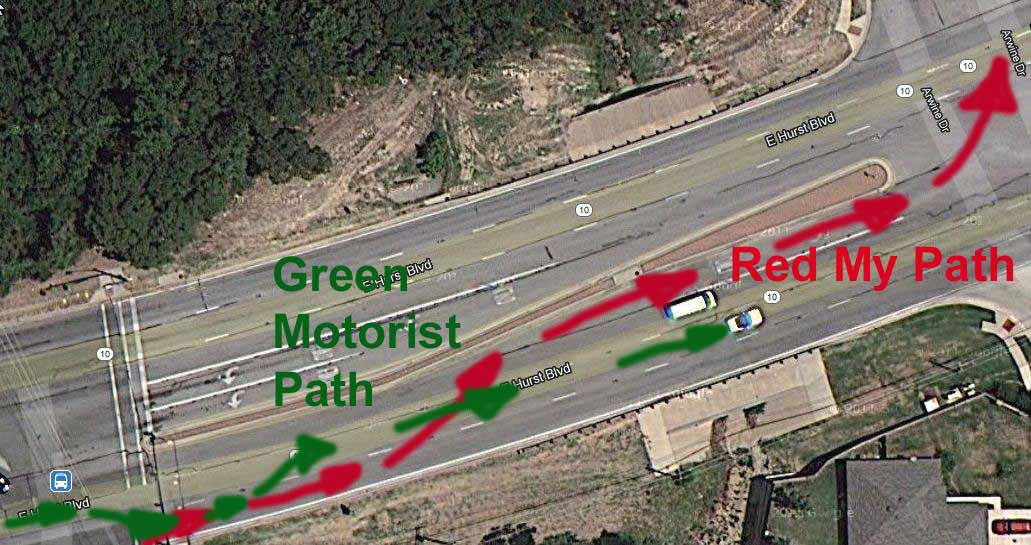
The second event was the rare "drama behind me." In it, seeing a motorist proceeding in the middle lane of three choices, and me planning to cross those three lanes prior to making a left, I initiated a right turn into the right lane (right turn on red). Normally, the motorist would have swept by and then I'd be up to speed and move over to make the left. I COULD have simply waited, but it seemed to be pretty simple. This time, however, the motorist swerved from the middle lane into the right lane - MY lane. What? Suddenly I was in a lane at about 10mph with a motorist directly behind, doing 50 and closing fast. I considered my options, not knowing exactly WHY this lady had swerved from a "clean and simpl pass" position into a "hit from behind" position; things didn't seem clear. As a result, I fell back on experience and hung a left turn signal while keeping close watch. If the lady was going to make a right, she'd see it and we'd be good. If she was wondering about my intent, she'd see it. Either way, I was definitely going to watch this motorist's wheels to see what would happen next. While my stress level edged up. At this point, anything other than "stay the course andO signal my intent" seemed to be a poor bet.

Well, as it turned out, the motorist then swerved left, back into her original lane, passed me with plenty of clearance (remember, I was signaling an intent to go INTO that lane she swung back into), and proceeded apace. After she passed, I exhaled, completed my leftward shifts and made my left turn; thinking about the safety pyramid and pondering how any mirror might have helped. Lest you think I'm simply being "dramatic," one of my engineers saw the event and said he was wondering if he needed to be calling 911. Lest you think I narrowly escaped death, the lady's closest approach was probably ten feet as she swept by in her original lane. I have no idea what the lady had in mind, other than she imagined I'd cross all the way across the street in front of her instead of following traffic protocol, and decided her best chance to miss the "idiot" was to swerve right. Assuming she was paying attention (she was NOT chatting on any mobile device), despite my concern, I was in absolutely no danger whatsoever UNLESS I'd done some ill-advised evasive maneuver at the last moment - mirror help or hurt? I guess my "proper" behavior simply fooled her. Who really knows. Regardless, as PM Summer once said: "no harm no foul."


Second Event - View from Google Maps - Arrows from Yours Truly
I'm neither a big fan nor opponent of mirrors. The one time I used one, it proved a useful added means to help in overall situation awareness. I think, however, that mirrors are a bit oversold, as are other safety things such as "high vis" and helmets. In the final analysis, our FIRST line of defense as road users (or on other public travel routes) is that our fellow road users know what we plan to do and what they in turn need to do to avoid disaster. That is the basis of traffic law.

Let us consider the actual USE of mirrors. Any mirror has three uses; the first is to see what is directly behind, the second is to see what might be developing in the lane to one's left when you might be considering such a shift, and the third is a similar function for a rightward shift. We'll consider them in order.

BEHIND
If you are looking to see what is going on behind you in a mirror, you are motivated by concerns about the general situation or you think you may want to send some message to following traffic. In the case of the "second event," what message would a mirror enable me to send? In reality, in such a situation, clear consistent operation seems to be the best principle when encountering another road user that seems to be doing illogical things. Even a wave or a "slow down" signal might confuse things for a distracted driver. What's more, for looking behind, we on bikes have no need for the "behind" mirror to keep from backing over people or stuff in the driveway. As you might see from the photo below. The rearview mirror is imperfect in that regard even in the MIGHTY LAND ROVER.


Mirror to Look Directly Behind. Mostly Useful for Backing Up
OTOH, a mirror is quite useful to look behind when one is wondering what happened to that motorist behind that should be ready to pass now. In the one day I had a mirror, it repeatedly answered such questions. No safety issue, but I, for one, dislike even short-term mysteries when riding. Score a point for mirrors.

SIDE (left or right)

LH Mirror - Aim it at the Lane to Your Vehicle's Left According to SAE
A mirror has definite uses when considering a left or right lane move in traffic. That is one reason that driver side mirrors have been required for cars starting in 1968 (prior to 1968, no side mirrors were required). They also became ubiquitous on the far (right) side of cars by the early 90's. In the case of a side mirror, it is "aimed" at the next lane over so you can see what will crunch you if you shift over. Such a mirror is clearly aimed differently than the "behind" mirror. Go HERE for a discussion on mirror aiming. Cyclists have an advantage in this regard over motorists because their head movements that effectively change mirror aiming are less than for their motoring brethren. Still, a mirror is either optimized to see behind or to one or the other sides. And THAT is a point mostly missed in the LAB discussions: if aimed behind, what action can you suddenly take that does not make you LESS predictable? If aimed to a side, how often does it really make a difference? While we are talking about SIDE mirrors, the reason RH mirrors came along much later is that they are a lot less likely to be really useful. Think about it. If you are on a bike (or in a car) and making a right turn, motorists on your right are a rare event. If you are making a lane shift to the left; much more likely. As for pedestrians, we on bikes really don't need mirrors to see them.

RH Side Mirror. Look HERE to Check Before a RH Lane Change. Objects are Closer Than They Appear!

OTHER FACTORS
If you are in a car, the side view mirror is much closer to the lane divider than it would typically be if you are on a bike - UNLESS you are riding a bit left of the LH tire track. This is simply due to the much wider width of a car. In my own experience, I get reduced passing clearance if I ride "close" to the LH lane edge. Things are much more congenial if I ride somewhere within the range of tire tracks. Personally, I like the "left center line of sweetness," but as with a lot in life, "it depends."

BOTTOM LINE
Very little of the mirror discussions I've seen address how mirrors are used for different purposes, nor exactly HOW you can reliably use a mirror for any safety purpose when considering traffic approaching from behind. For a movement you plan to the side - yes. From behind, not so much unless you are planning to jump on the brakes without warning.

MY VIEW (no pun intended)
A mirror can help in overall situation awareness. I'm going to get another mirror partly for this reason. What's more, it'll be a bar end mirror and NOT the one I already have that mounts on my helmet. A mirror makes a useful part of the "eyes moving" sequence of seeing what is all around (if that is any different than overall situation awareness) as long as it doesn't become an "end" in itself. A mirror can also help you prejudge a lane move. In this case, however, I'd never make a lane move without the "trust but verify" Ronald Reagan full head check. My kids were taught the same principle when motoring. NEVER change lanes without actually SEEING things are clear. In that regard, mirrors mainly help you know what to expect when the REAL look occurs.


"Trust, But Verify" Applies to Nuclear Weapons - AND Traffic (photo from Wikipedia)

ONE OTHER THING
All the above presumes you have normal vision or are farsighted. For those that are NEARSIGHTED, the mirror also helps them see what is happening back there and off to the side in conjunction with their eyeglasses. Otherwise, they are looking beyond the edges of their glasses.

JAGUAR CONSIDERATION
If you were wondering, NO, I have NO side mirror on my 1967 Jaguar. I have no plans to add one either - unless I find some of those that'll clip onto one's window but can be removed when one drives on to the show field. Just sayin'


No Side Mirror on THIS Vehicle!

Tuesday, May 8

Madeleine

Second try at this with the "new" Blogger. My first attempt went "poof!"

With one exception, all the bikes I've ridden have had names. That exception is my road bike. Also known as "the bike with no name."

I've written about my new bike. I indicated it was a Mercier S3X. It's a fixed gear, three speed bike. It is made in Taiwan, with a famous French name. After a bit of consideration, I came up with a name for it, after a short two rides of less than a half mile in total. We shall see if it "sticks," but I think it will.

Madeleine

Madeleine's a rather French name. Not Taiwanese at all. Still, Madeleine is appropriate. You see, Madeleine was a character in Hitchcock's "Vertigo." Played by Kim Novak, Madeleine was what she seemed but not QUITE what she seemed. She was also "Judy." Strangely appropriate for a "French" bike built in Taiwan.

The name is still more appropriate considering that I'm a fan of Jaguar cars and Madeleine drove a Mark VIII Jaguar. An almost identically visually similar Mark IX may be seen below.
Mark IX Jaguar at Mercer Island, Washington Concours. Dan King Observes
Madeleine is a PERFECT name for a bike that is all it seems, but still NOT what it seems. A good Mercier name. As you will see, it IS turning a bit French. In the trailer, watch for the Jaguar right before Madeleine tries to jump into San Francisco Bay, just before the halfway point.

Saturday, September 17

Car School Almost Gets Gumby

It is time to take a little break from bike school discussions. It may not be well known, but just as people that think they know how to ride a bike go to bike school, people that think they know how to motor go to car school. This morning, I made a pilgrimage to bring y'all secret spy shots of a motoring CAR SCHOOL in action. Since it seems that some people on bikes are sure motorists are out to get them, I focused on actions that might support their contention. Specially, I took a look at parking lot drills, and especially dooring practice, debris creation, and what, in less scrupulous hands, might look like a photo of Gumby about to be run down.

Without further ado, here is the story. I elected to write my story about the local Jaguar Club event. They call it a "Concours d'Elegance," but it really serves the multiple purposes of giving them practice opening their doors, arranging debris, and encouraging self loathing (it is an event where you PAY people to tell you how lousy your car is). Some say this fosters road rage, but I haven't ever seen a connection myself. Perhaps it is a motoring version of one of the cycling myths I occasionally talk about.

When the motorists arrive, they are checked out to ensure the cars meet minimal standards. This is called a "mechanical check." In the photo below, you can see a Jaguar XJS being checked out. Its motorist is asked by the mechanical judge to put her cell phone aside and do things like prove her horn and lights work properly. Contrary to what some believe, the motorist is NOT encouraged to yell at the judge to "get off the road," though I have read the rules very carefully and there is not any actual deduction established for yelling at a judge or even for running one over. As when dealing with a real judge, it seems most motorists err on the side of being nice to the judge. You might wonder about the ambulance in the background. It is possible the driver was merely interested in watching the car show. However, my own theory was that it was there in case any of the Jaguars with a V12 engine suddenly burst into flames. None actually did so while I was there, or I'd have included it with these pictures.

I did Not See Any Motorists Yell at the Pedestrian Judge. Lots of Smiling.
As you can see, some of the motorists don't have the dooring concept down properly. This Jaguar Mark 9 owner only had his door open on the curb side. Chatting with the owner, he got that Jaguar on the roof at a garage sale for $2. It keeps watch in case any show judges are lurking around nearby. The cone is near the boundary of the street side door zone if he'd wanted to open the door on that side. For those that have never seen one of these cars, they are very much like the Mark 8 car that is featured in the old Hitchcock film; "Vertigo," which starred Jimmy Stewart.

Big Cat Keeps Watch on Top of Another Big Cat
Other motorists elected to try all ways to get those doors out in the breeze. The blue car is a Mark 2. The Mark 2 was a more compact model than the Mark 9. In the UK, they were much favored by getaway drivers.

This Door Opening Strategy Would Catch a Cyclist on EITHER Side.
Some of the motorists adopted an entirely different approach. The owner of this XK140 didn't have any doors open at all. Instead, the debris, cleverly disguised as trunk contents and cleaning supplies, would be SURE to entrap any cyclist venturing too close to the left hand side of the car.

1955 Jaguar XK140
Now, some people on bikes like to ride closer to cars than would be prudent if a door actually opened. Perhaps they imagine all cars have tiny doors like the 1968 Jaguar E type Open Two Seater in the photo below. My own E type is a coupe version of the same car, though mine, being a year earlier has covered headlights, more power, and a tiny ding in the bonnet where a bike crashed into it. THAT will be a story saved for another day. Not that I pay any attention to such things, but I'd say that Jaguar looks an awful lot like it is painted Silver Opalescent Blue.

Notice How Visible The Spectator in Green is, Even Though She is Not in the Foreground
Some motorists decided to team up and have a whole ROW of open doors. Somehow, I think this tactic would not be very effective at snaring even a dumb person on a bike. I also think these guys lowered their chances by parking on the left side of the street. Even in North Texas, the majority of people on bikes ride on the RIGHT side of the road. Perhaps they were trying to remind the cars they originally came from the UK. It didn't occur to me to do an in depth interview on this phenomenon until after I got home.

Unlike Toyotas, Jaguars Seem to Hang Around FOREVER. The Ones on This Row, On Average, Would Be Old Enough to Vote if They Were People
However, completely unexpectedly, I saw a little green man on the pavement. My initial reaction was that, somehow, John Romeo Alpha's Gumby had migrated to Texas. Closer examination revealed that it was nothing more than an action figure that looked somewhat "Gumby like" from a distance. I named it "Almost Gumby."

"Almost Gumby." Smooshed a Little But Unbroken!
Careful perspective and zoom choice created an impression that "Almost Gumby" was about to get creamed by a powerful, late model Jaguar. No doubt, someone trying to sell cycling by scaring people (is that a real good marketing technique?), would claim this car was driven by a raging maniac. In truth, the driver was a very nice lady who was getting coffee before she got down to seriously preparing her car for the judges to tell her how she failed to measure up.

And such is one form of CAR SCHOOL. I have to say, those that tell you all vehicles are the same are NOT telling the truth! Cars really ARE different, and some cars are different than the rest.


Monday, September 5

Into the Breach AGAIN With Bike School

My First Bike Ed Course That Actually Happened. Richard and Dorothy, In Front of the Ginger House
My loyal reader may have noticed that I advocate that a cyclist wishing to ride from "Point to Point" should educate him or herself about the safest way to do so. Regardless of whether one is a fan of particular cycling facilities,or an opponent of same, it only makes sense to know how best to traverse the territory you have to cross. Or so I would suggest. My loyal reader may also have observed that I slip handy little snippets about how to ride safely in various situations and how to deal with the problems that cyclists face. Finally, I DO believe that bike school has things to offer pretty much any cyclist, regardless of age or experience, in the search for being able to confidently ride just a smidge safer than before, watching what other experienced cyclists suggest, I've made posts about bike school I've attended in the past, specifically here, here, here, here, here, here, here, here, here, here, here, here, and here. I probably missed a few links, but you also probably get the general trend: it's about 5% of my posts. As I stated, a significant part of the reason was outlined here. Quite simply, the Bike League was, and remains, the only national organization that takes bike education seriously. THAT should not be lightly discarded.

Even Before My First Bike Ed Link, I Tried to Take a Course. The Instructor Didn't Show.
Thank GOD for Forester's Book. It Saved Me.
Changing of the Wind
However, just as our near-record breaking Texas summer has yielded, at least for the moment, to a wind shift, bike education in the US is undergoing change. The long-time Bike League education director, Preston Tyree, has elected to take advantage of a well-deserved retirement while he's still fit enough to enjoy it. The new director, Alissa Simcox, has good education credentials, but we have yet to see how she will perform as the new Education Director. Gail Spann, the League Director with Education as part and parcel of her charter,  remains a constant throughout this. Personally, I think Gail's got good mojo, but there's a lot in front of us. What's more, Gail is a Texan and that counts for something.. But there may be another choice arising, and quite simply, I want to see what it really offers beyond "another choice." You see, next weekend, there will be a Cycling Savvy course offered in the DFW Metroplex, and I will be there. I think Chandra will be there as well. At least one of the teachers, called "CSIs," is Waco Moore. Waco took his Bike League LCI Seminar with Chandra and myself, so at one level this will be a reunion of sorts. What's more, Waco is only one of two in my LCI Seminar to become a "CSI." I've seen Waco ride and he's solid. He also sat beside PM Summer and myself at the Reckless Driving trial of Chipseal just about a year ago. On the other hand, this is a course offered under the umbrella of the Florida Bicycle Association. In Texas? In the words of Keri Caffrey; "WTF?"

Which Witch?
If There is to be a War, Let it Begin Here
So, why am I taking YET ANOTHER Bike Ed course? It costs $75 and the links above suggest this might simply be more "good money after bad." Assuming I like things, I'll have to dump even more money to become a "CSI." This is entirely on top of what it cost to become a League Cycling Instructor. Well, put simply, I'm curious, and I'm fortunate enough that the bucks are not an overwhelming consideration. The Cycling Savvy course pitches itself as an "all new" approach to cycling education. It uses the same riding principles I follow on a daily basis and, admittedly, uses the same operation principles as in Traffic 101 of the Bike League, but it strips away the "fluff" and the "hot button terms" in favor of focusing on behavior-changing instruction. For example, it eliminates the mechanical repair aspects of Traffic 101, noting that these can be easily obtained from LBS courses. It also eliminates the "test" that is part of Traffic 101, noting this offers no value to the student (duh!). As a result, there is more time to focus on "how to ride confidently and safely." Quite frankly, I can't argue with the premise of focusing on what the students really NEED and can't get elsewhere.. A course, modified and reduced from what John Forester originally came up with, might well be an improvement. After all, it's been over 30 years since Effective Cycling.

But, there is also a darker side. Or a brighter side. I'm not really sure which it is. Certainly there is change afoot. You see, Cycling Savvy is also a course that might offer "another choice." While the course was created by Bike League LCIs, and some of the instructors REMAIN LCIs, there is a definite "anti-Bike League" element to the whole thing. Both of the principals have publicly withdrawn from the Bike League. Others that support or publicize the course have either withdrawn from the Bike League or align themselves with "dissidents." Go to "LABreform" for details. I found it peculiar that Preston asked me if I was a member of LABreform; an odd question for a new LAB member. Some of the remaining members were those that tried to run for LAB directorships, but were rebuffed. Myself, I've heard their stories, but the Bike League has never indicated why it acted the way it did.

Preston Tyree: Recently Retired Bike League Education Director
Principles
Still, as Preston was clear to tell us in our LCI course last January, the principles of operating a bicycle safely in traffic are what fundamentally matter. He told us that the League insurance would cover courses such as Cycling Savvy, since they do not conflict with safe operation principles. Two of my fellow LCI seminar students are now CSIs. Stay tuned, and I would appreciate advice about what I ought to keep my eyes open to see.


Past Comparisons Back in the day, the UK Jaguar Club split into two factions. The first was the old-line "Jaguar Driver's Club." The second was the "Jaguar Enthusiast Club." I'm not sure the Jaguar owners are really better off than if they'd have found a way to work together. Jaguar Cars supports both, since both support Jaguar. OTOH, I imagine Jaguar would prefer a simpler situation. In the USA, a decade later,  the JCNA managed to avoid a split, precipitated by conflict over directors that were not elected. My take? We're better united than divided. OTOH, we in the US have spit asunder on principles before. What way for cycling? We shall see. If y'all are so inclined, let me know what I should keep my eyes open for. Let Chandra do the same. Personally, I pray that cycling people will find a way to come together. If not, I pray that God will grant me, and others,  the wisdom to choose wisely.

One of My Cycling Shirts - FROM FLORIDA. Robert (of Carbon Trace)Would be PROUD!

I Pray Cyclists Will Avoid Division the Way That UK Jaguar Owners Have Seen
Stay Tuned for Further Developments:
Steve A,
LCI # 3054

Tuesday, August 2

Scirocco, Jaguar, Bike

Today, it hit 110F. While that may be an all-time record for the day in North Texas, it has a personal meaning to me. It is the hottest it has ever been since I first arrived in North Texas from Everett, Washington. I found it to be a teachable moment. It taught me about the scirocco. This is an effect that people from places like Arizona have experienced, but isn't discussed in polite meteorological company.

Scirocco
According to Wikipedia, the scirocco is a hot, fierce wind that blows out of Africa. It blows hot. Like a convection oven blows hot. It isn't something most people experience very often, but it drives people crazy - or worse. What's more, the power of a heating wind is something that is usually ignored in heat index values and the National Weather Service, where it talks about heat dangers, here, largely ignores the wind, saying only "strong winds, particularly with hot, dry air, can be extremely hazardous." Exactly the condition people experience in a scirocco.

Our Jaguar in 1979, Ready to Go Home
Jaguar
We first experienced the power of a heating wind in a Jaguar. Specifically, it was a 1971 Jaguar XKE Convertible. It was, I think, 1979 and my sweetheart and I decided to drive to Las Vegas. After an unspecified incident involving our Alfa Romeo, we thought the drive would be pleasant in the Jag, and proceeded east with the top down. Soon, we would learn. Somewhere east of Barstow, we discovered that the wind was not going to be our friend. A couple of miles later, we'd put the top UP to keep the wind away in the fierce darkness. We didn't put the top back down until we were in Las Vegas. That was my first experience.

Bike
Today, in a milder form, I experienced the power of a heating wind on my bike. Unlike a Jaguar convertible, there is no top to put up on a bike. Also unlike the long-ago drive to Las Vegas, the sun was contributing its power to the heating. I suggest reading here to find out more about wind heating. I must confess that it was distinctly unpleasant to feel a combined wind and sun temperature rise of 15 degrees or so on top of the basic 110F. While it wasn't nearly so dramatic as in a Jaguar at 70mph, a bike at 25mph in the sun is still a shock.


Wind Heating When it Gets Hot - From Zunis
Wrapup
Personally, I think I might have to change my routine home from work if it gets any hotter. Instead of stopping for hot coffee at the coffee store a mile from my home, I'll detour and stop at the one that is half way in between work and home. LOVE that free, triple filtered ice water! If, on the other hand, it gets over 115F, perhaps I'll detour to the gym and take a cooling shower on the ride home. Yeah, that sounds good, eh? OTOH, our all-time heat record at DFW is 113F. Right now, we've still got three degrees to go and we're running out of time before things start to cool down. In the meantime, I'd just as soon not combine high heat, low humidity, and a long descent down a hill in the sun very often...

Tuesday, February 15

Frenchy Forgot to Mention Something

Mostly in this blog, I write about bike items. However, on occasion I mention Jaguars. I used to show them. Actually I also used to race them in Autocross. The Jaguar Club version of SCCA Solo 1 racing. In it, you run the car as fast as you can through a parking lot course marked by cones. It sharpens your driving skills and improves your understanding of what your vehicle will do at its limit. That understanding helps in normal driving as well. It's why my eldest daughter ran her first autocross while on her learner's permit. One basic technique is outlined in The Red Car:

"...Frenchy went into the corners...along an invisible line that slanted diagonally across the corner from outside edge to outside edge... The little car went so close to the inside...at the corner's point that...Hap could feel that a butterfly's weight of extra pressure...would break the car loose... But Fenchy never once gave it that extra butterfly's weight..."

Steve A, Cutting to the Inside of a Corner in Vancouver
Drive Smoother to Drive Faster
I don't drive my car that way on city streets, at least not obviously, but if you look at car wheel tracks on any road, you will observe that they move from side to side within a lane depending on curb and turn situations as well as the lane width. However, a bike is a lot narrower than a car, and I typically utilize more of the road when cornering than would be decent for my motoring companions. Coming to a right turn, I'll usually be riding roughly at the right side of the left wheel track in a position (the line of sweetness) where any following motorist will certainly not to have to watch extra carefully to notice my presence (SIN or no). As I near the corner, I will use the full lane available to me and move right within the lane as I approach the apex of the turn; finishing up in the new direction in about the same lane position on the new road. In effect, while I don't cut real close to the curb (after all, one doesn't want to ride through a debris field), I am doing exactly what Frenchy was doing on a closed course, albeit in a less dramatic fashion. Usually, this is perfectly safe and allows a fast turn while only yielding control of the lane at the sharpest point in the corner. A point at which I am invariably traveling faster than any following motorist.

Frenchy forgot one thing. He forgot to mention that cars and bikes have different turning characteristics because of the difference in width and wheelbase, and even cars turn differently when the road is slick than when it is dry. Usually, this doesn't matter, but we've accumulated a lot of loose road rubble due to the recent freezes and this has accumulated where motorist wheel tracks don't sweep it away the same way as usual. Like at the inside point of corners. This morning, making a turn I make every day at about 20mph, my apex was about a foot closer to the curb than normal (I've been leaving more room than usual in case I hit a patch of gravel) when my rear tire crossed gravel and swung out suddenly as if there was one too many butterflies applying pressure to the tire. No, I didn't fall, but I simply don't like my bike to do something unexpected while I'm on it on a public road. Maybe it's an "engineer thing." It was a reminder that the natural turning paths of bikes and cars are even more different than are the turning paths of skiers versus snowboarders. Frenchy was driving a sport car amongst other sport cars. His turn strategy would have been far different had he been driving an RV - or a bike. It was a good reminder. Bikes ARE different.

That Patch of Gravel Was Certainly Inconvenient for a Cyclist
Turning Smoother to Ride Faster


Monday, December 27

Bikes are Like Old English Cars Only Different

There was a period when we drove English Cars, mostly Jaguars, every day. One thing about older Jaguars (and other makes as well) is that they silently communicate to each other, enticing all but one to break down and become non-mobile. You could own four or five and find that only one would run. Alfa Romeos seemed to have the same characteristic.

Old Jaguars are NOT Real Reliable! Ours Occasionally Broke Down
In that way, it seems my bikes have gotten infected as well. First, unaccountably, Frankenbike got a flat tire, just sitting around the house. That was compounded by a reluctance on its owner's part to chop down the retention band on the Minoura Besso light holder. Not real hard to fix, but it requires a decision.

Next, for unknown reasons, the road bike's rear brake cable got sticky. That's an easy item to fix, but the road bike's rear cable will work well for the front canti brake on Buddy, which I haven't installed yet.

Third, Buddy displayed a little attitude (as if bikes could do such a thing) last weekend. The night before the ramble, I tried pumping up its front tire. No joy - psss. I had to put a new tube in (this was the tire that I busted the presta stem on a while back). Everything else seemed fine, including the new rear canti brake once I added a couple of extra washers to compensate for the brake difference.

I tried patching a tube that'd picked up a largish hole previously when it failed due to a rim strip break, but that didn't work. As a result, I put in a new tube. Everything seemed fine. A little sloppy, I didn't feel like cleaning the chain the night before the ramble, so I added lubricant without cleaning. Yes, it's not a good practice but it is better than riding with a dry chain. It's an "ABC Cheat."

SKS Fender Snapped for No Apparent Reason
On the ride, the chickens figuratively came home to roost. First, for reasons not determined, the SKS rear fender snapped on the way out. I'd hoped they would last longer than nine months. Then, the rear tire went flat on the way back. As I removed the tire, Doohickie wryly observed my chain could use a little cleaning. Thanks!

ON THE OTHER HAND, bikes may break, but unlike Jaguars, they're a lot quicker and easier to fix. Heck, for the price of a tuneup, you can even get a whole NEW bike.

Buddy, With Half a Fender and No Air in the Rear Tire

Wednesday, October 13

Management and Ownership and Nonprofit Corporations

NOTE: Don't read this unless you are a member of the League of American Bicyclists.

This year, I joined the League of American Bicyclists. I wrote about why in my post, here. The Bike League is a nonprofit corporation. Like many moderate to larger nonprofit corporations, the Bike League depends on volunteers for many of the jobs that need to be done, but also on employees that professionally manage and run major program elements. As in many other nonprofit corporations, ownership is vested in people that we call “members.” In most cases, the members are not the same persons that are employed by the corporation. This creates conflict and the Bike League is no different than many other nonprofit corporations in this regard.

One of the manifestations of the conflict is that management direction rarely aligns with all the membership. In the case of the Bike League, one ongoing conflict is over the relative corporate effort that should go into, for example, “bike friendly” versus legal battles versus bike education. Such conflicts are made more intractable by the overwhelming level of commitment and enthusiasm that the various parties bring.

I find one element of this disturbing in the case of the Bike League. It is an element I once found equally disturbing in the Jaguar Clubs of North America. That element consists of the level of power and discretion delegated by the owners (the members) to the management (the employees). Clearly and naturally, the employees tend to want to obtain greater freedom and latitude to make decisions they feel are best for the corporation without amateurs meddling. The owners, on the other hand, may be split between those that endorse the management direction and those that prefer another approach. The element that is disturbing is the maintenance of checks and balances through an elected board of directors; charged with overall corporate governance and keeping an eye on management in the interests of the owners (the members). Appointed directors dilute the influence and control that the owners (members) possess. A requirement for “approval” for someone to run for a director position also dilutes the influence and control the owners possess. Bylaws that do not provide for a means for the owners to directly change things dilute the influence and control the owners possess.

Why is this disturbing? Well, it’s very simple. Ultimately, a nonprofit must be a reflection of its owners. If, through excessive dilution of the ownership element of membership, the nonprofit no longer reflects its members, why should a member belong? And, as I noted before, in the case of LAB, "I Got Nowhere Else to Go!"

THAT is why I support a petition to allow Damon, Brooking, and Spencer to run for LAB directorship. Allowed to run, they will attract support (or not), to the degree that they reflect the voting membership of LAB. If they are NOT allowed to run, we’ll simply not know. I've corresponded with Khal Spencer and he's certainly worthy of consideration. I've not talked to the other two, but signing the petition merely gets them on the ballot as candidates. If you're a member and simply want to sign the petition, go here (make sure you have your membership number handy). If you want to read Khal's take on things, go here. OR simply email me and ask more, or tell me why I'm foolishly naive.

Sunday, August 22

Carbon Lacks Luscious Lugs

In the Olden Days, a Quality Bicycle Had a Lugged Frame and Reynolds "531" Tubing
In past “Carbon” articles, indexed here, characteristics of carbon, such as its low density and ability to be tailored, were highlighted along with many elements that present challenges to the designers and users of carbon bikes. If you weren’t reading carefully, you might have concluded that people should just stick with steel and avoid all those ways things can go wrong. You’d be wrong.

There remain many people devoted to steel bikes. Locally, in the DFW Metroplex, Southwest Frameworks will build you a custom steel frame made to the highest workmanship standards (they have a lot of good photos showing the process at their website). Indeed, I grew up under the influence of Eugene Sloane; believing that any good bike was lugged, while one with Reynolds “531” double butted steel tubing was a bicycle aristocrat. When Sloane’s book was published, my 1967 Jaguar XKE came without air conditioning or power steering, the windows went up and down via a winder, and side mirrors were an extra cost option. Nobody had heard of cassette tapes, much less MP3 or satellite navigation. Unlike less sporting cars, Jaguar had special mounting points for anyone wanting to install shoulder belts.
Reynolds Had it all. Even the Russians Used it in Their Track Bikes. Note How Sloane Spells "Columbus"
That was then. Things have changed.

Nowadays, steel remains an excellent material to make heavy bicycles from, particularly when the manufacturer wishes to avoid investing in facilities capable of competitively building high performance machines. That fact is the main reason why cheap bikes, like the Chinese Flying Pigeon, universally use steel frames. A traditional steel frame will weigh four pounds or more (sometimes MUCH more), compared to three pounds for aluminum, while a high end carbon frame weighs in closer to 2.5 pounds, and a few weigh even less. With modern analytical methods, the ride of steel can be closely matched, or improved on, with either aluminum or carbon. Certainly, if identical components are used, the steel bike will only weigh 2 pounds more than its carbon counterpart, but that is a world of difference for a performance bike, and particularly for a lightweight, high end bike, since most of the cost is in the components.

On the other hand, if you are looking for a utility bike, and plan to load it with accessories, 2 pounds is a minor consideration. In such a bike, esthetic considerations, such as lugs, may or may not be important to you, along with such creature comforts (all of which add even more weight) as double legged kick stands, chain cases, and internal gears. In these cases, the steel frame becomes more than just a material, it becomes part of the total bike experience, and those lugs on steel frames ARE luscious.

I still ride steel framed bikes where speed performance is secondary. Frankenbike was partly chosen for its combination of Reynolds tubing and lugwork, combined with its low cost. As I said, I like steel bikes, but remember I also like vintage Jaguars. I will probably always keep a steel bike around, just as I keep the Jaguar E type. Aluminum and carbon are the real present and future of fine bicycles, and designers are still learning how to exploit the full potential of each of these materials that have passed steel by. Nowadays, bikes such as the Gary Fisher Simple City and Civia Hyland are made of aluminum.

By the way, the 1967 Jaguar E type also used Reynolds “531” steel tubing, unlike new Jags which use aluminum. Aristocrats may be fading relics of the past, but they’re still proud.
The Front Subframe of Jaguar E types Used Reynolds "531" Tubing, Just Like Raleigh and the Schwinn Paramount

Sunday, June 27

Getting Better

Instructors Explain Extreme Stopping to Student
Some posts turn out differently than expected. This is one such. I went to Traffic 101 in Dallas today. This makes my third T101. Originally, I intended to discuss how BikeDFW has sharpened their Traffic 101 course, and how I find it interesting that the students are mostly women. Instead, it's about what they don't tell you about Bike Ed, and what it has to offer someone who knows how to handle their bike in traffic, as well as someone that understands how their bike works. The US Military and civilian aerospace both embrace what that is. In short, it's training for the emergency that may never happen. It's why my oldest daughter did her first Autocrosses while she was on her learner's permit, why my middle daughter got taken to a snowy parking lot in Colorado, and why I'm getting a tetanus shot this year (the track requires it).

Traffic 101 is oriented toward an inexperienced rider, but part of it that isn't well publicized are the bike drills. Some of these are the bike equivalent of learning to operate a motor vehicle under extreme conditions; resulting in the student better understanding what their vehicle can do. As in the case of high performance driving of a Jaguar or Alfa Romeo, this should not be done on public roads. Conveniently, bikes are different, and a reasonably sized parking lot suits them much better than Texas Motor Speedway.

If Those Guys Weren't Around, This Student Would be About to Fall Over as His Bike Stops Moving
Pretty much anybody likely to read this blog knows how to stop their bike. BikeEd students, however, learn how to stop their bikes a few feet quicker. If they're smart students, they practice many elements of quickly stopping to help out their muscle memory. It may never matter, but once in a rare while, stopping two feet quicker can be the difference between a close call and serious injury - or worse. The quick stop drill is one that I am unwilling to do on my own. My commute is made with clipless pedals and I find that I will often fall over at the conclusion of a quick stop. If I have to make that kind of stop in the real world, I will gladly accept falling over if it means I avoid a collision. I don't care if you are someone that wants to ride vehicularly in traffic or only on recreational bike paths. Someday you may need to stop a couple of feet quicker. Quick stop can do that and it's a hard thing to learn on your own, no matter how long you've been riding. If you're reading this blog, you're worth saving.

She's Starting to "Get It." With Practice, She'll Be Able to Hit that Inside Marker and Maybe a Bit More
 A second drill that is inadvisable to practice on the street is the instant turn. The instant turn is a maneuver designed to give you an option on how to deal with that Escalade that just made a right turn in front of you besides going underneath it. Again, there's a very good chance it'll never happen, but if it does, someone who performs an instant turn in an emergency might be able to just have a close call. This IS a drill I do on my own, using empty parking lots. If I ever need to do it for real, I do not want to have to THINK about how to deal with the emergency. BikeEd will show the principle, but the student has to make the decision to practice, practice, practice. You don't get that from regular riding. If you're reading this blog, you're worth saving.

One last word on the instant turn. In his book, Effective Cycling, John Forester writes:

You can't safely learn the instant turn on the road, and you will never do it right without practice. ... The only time I was hit was before I learned the instant turn. A car coming the other way turned into a wide driveway. I managed to get into the driveway, but couldn't turn sharply enough to outdistance the car.

Like Forester or hate him, he has credibility when it comes to a statement like that above.

There are a number of other drills as well, but most of them will do no more than teach you how to get a bit more out of your bike, and maybe avoid flats. Those have the ancillary benefit of allowing you to get more out of your cycling, but the ones above may save your life. Even if they don't, knowing you are prepared will improve your confidence on the road just a little bit. If you're reading this blog, you're worth it.

Actually, the Bike Drills are Also Fun. In a Way, it's Like a School Bike Rodeo for Grownups

BikeEd is Alive in Dallas. Thanks, Gail & Richard!

On this blog, I've often stated that bicycling is safe and fun. Well, it is, and that's true even if you never learn this stuff. Aviation is also safe. Partly that's because they practice for emergencies to make it even safer. Conveniently, bike emergencies are usually less dramatic than aircraft ones, but the principle is exactly the same.

You Practice so All the Passengers Come Home Alive! From Wikipedia