|
| More Ominous than Seeing Yesterday's Tire Tracks Was Seeing No Tire Tracks at All! |
When I was first learning to ski, more recently than you might imagine, a Boeing engineer who had skied since he was a young child explained to me; “if you’re not falling, you’re not learning.” Later that year, the same Boeing engineer broke a number of bones while skiing. Well I did a lot of learning today on my very first bike commute in the snow/ice. First tracks, so to speak. It was GREAT fun! Fortunately, I was able to avoid breaking anything real important or even expensive. As you might suspect from the intro, I fell a lot and learned a lot. When I was growing up in Seattle, it would never have occurred to me to ride a bike in icy or snowy conditions. Who says Texas isn’t progressive? Besides, at
LCI training, we were told that the SAFEST cyclists are those that ride every day, in all conditions. Apparently, they acquire skills that help them avoid crashes. Yeah, that’s it; I’m becoming a safer cyclist.
 |
| If You're Not Falling, You're Not Learning, Or So I Was Told |
When I went to bed last night, Northeast Tarrant County had a mixture of bare patches and slick ice. My commute strategy was laid out and even written down,
here. However, our weather forecasters got it all wrong and, instead of a trace of snow and a few flurries, we got snow accumulation. Now, you have to remember this is North Texas, so our accumulation ranged from a couple of inches to about seven, depending on the particular locale. Had slick ice not still been hiding beneath the snow, it would have been very simple and almost trivial to pedal the whole way in. Simply start out carefully, don’t make rapid course changes, and leave lots of room for stopping. I’d have easily have beaten my pre-ride time estimate for the commute.
 |
| I Went Back for Rain Pants |
As it was, things were more challenging. Leaving home, I rode without any trouble for most of a block. Suddenly, I was on the ground, conducting a test of whether my helmet would live up to its CPSC approval. At this point, I headed back to the house to get my rain pants. It was obvious that some water resistant layer would be needed to avoid soaking my pants if I was to continue as I was determined to do.
Snow/Ice Commute Pattern
In areas where the road had dried out before the snow, riding was easy and pleasant, though I found that, as in skiing moguls, you want to go the “right speed.”The right speed is “just right;” not too fast and not too slow. My “right speed” and your “right speed” would be different. On the other hand, in areas approaching intersections, and other places where slick ice underlay the snow, I found that it was sometimes problematic to stay upright. A WISE cyclist quickly learns to use extra caution when attempting to get back up AFTER a fall. It is one thing to fall, but it is quite another to fall a second time on top of your bike. OTOH, motorists, seeing such events, give an unusually wide passing margin if the cyclist managed to collect all the bits before they approach. Either that or they were amazed at bright yellow rainwear. Contrary to my test rides, each intersection posed a tradeoff dilemma. “Do I stay on the bike and fall down or do I fall down when I try to get OFF the bike?” For the record, in my current stage of expertise, I found that neither solution was entirely reliable. Intersections represent unusual problems for a cyclist, just as they do for our fair-weather brethren. About the only element of previous training I adopted is that I crossed wheel ruts much the same way as I would cross railroad tracks – at a 90 degree angle. That did seem to work. Maybe I was just lucky.
Toughest Commute Element
Surprisingly, I found that the toughest part of the entire commute was about a half mile along a separated multi-use path. Yesterday, I verified that the surface of the path was mostly bare and dry, and figured it’d be a snap to ride. Well, this morning, this being Texas, as you might guess, the path wasn’t plowed or sanded. In fact, I found that I was unable to tell where the path edge was and wound up walking my bike through scenic fields and eventually navigating based on recognizable landmarks. The path delayed my journey by about 15 minutes. It would have been worse but I finally encountered a stretch where I could tell where the path was, and that enabled me to make faster-than-pedestrian progress.
Surprisingly Nice Commute Element
I also encountered a pleasant surprise. Bedford-Euless road, a long uphill stretch, turned out to be the simplest part of the entire morning journey, obviating my planned snow route. I started up in the right lane and found that traction was reasonable. Better yet, all my motoring friends were unwilling to test the snow-covered surface in the right lane and stuck to the two ruts in the snow. No falls at all going up that hill in my twelve foot bike lane, and even had some motorist been braver than the rest, motorists are able to easily stop if necessary while going uphill. It is going DOWN the hills where they get in trouble.
Lessons
Helmets
I was uncommonly glad I wore a helmet this morning. However, I have a number of helmet suggestions for novice snow and ice bike riders. First off, learn with a helmet nearing the end of its shelf life. Second, ignore any advice to discard a helmet once you have crashed with it. Since it is impractical to carry a half dozen spare helmets along with you, wait until you get home again before retiring the helmet. I think I hit my helmet hard about four or five times. While it may not have saved my life, it certainly was a lot more pleasant and satisfying to hear that “whack” than to imagine a “thud” from my unprotected head. This is an argument in favor of using the cheapest and oldest usable helmet you possess in these conditions. I was glad I was wearing my “Wally World Special” and not my bike shop Giro helmet. I regret not wearing an older cheap helmet, but my Schwinn helmet got melted in the Land Rover last summer.
Routing
I had a snow route. It worked OK for the trip home, but was completely inappropriate for the trip in. To keep this lesson short, I simply recommend being adaptable as you discover how the conditions marry up with your particular skills (or lack of same) and bike. Be especially wary of a bike path, or even a bike lane, unless you have past bad-weather experience with that path. Even in such situations, bad weather has many variations so what works one time may not work later. Just as motorists vary their route when it snows, it makes sense for cyclists to do the same. Unlike motorists, cyclists need to consider the capabilities of their chosen vehicle, as well as shortcomings of the motor vehicles that are usually so predictable.
Other Equipment
In my previous post,
Justin cleverly commented about lowering the saddle and
Big Oak mentioned good points about clipless pedals and handlebars. Well, while I’m not sure lowering the saddle would help avoid fall situations, it sure would have reduced the stress and wear and tear on my rain pants. “Best efficiency” is not the main objective when riding in snow and ice. Kudos to Justin for that one. Who’d have thought such
wisdom about ice riding would come from Dallas?
 |
| Clipless Pedals Came from Ski Bindings |
As for clipless pedals,
Big Oak correctly provided the wisdom (of long Yankee experience) that locking feet in the pedals might avoid ligament damage in a fall. Fortunately, I avoided any such damage with my platform pedals, but a budding snow/ice biker should consider that clipless pedal systems are an outgrowth of ski release systems, which were specifically developed to mitigate skiing injuries. Also consider that
ICEBIKE seems to favor clipless pedals, though they also talk about the
Power Grip system that Velouria uses on her bike. In slippery conditions, these may be superior to more conventional toe clips and they certainly make shoe choice easier. In my case, I don’t think clipless was a real option, because I possess no cold-weather cleated shoes, and even heavy shoe covers would simply not last through “hoofing it” segments. In my mind, this remains an area for future investigation.
Big Oak also advocates keeping one’s hands on the handlebars when going down. I was fortunate in this regard, because I learned NOT to attempt to brace against a fall with one’s arm when I learned to snowboard. Snowboarders break wrists and skiers blow out knees. Roll with the fall. If you can do this, you are less likely to break bones and other valuable body parts. My take away from this is that learning to fall can be a useful skill for a cyclist. Once learned, it may also come in useful for a fall in more typical cycling conditions. Certainly learning to fall can do no harm.
Raingear is another area for attention. I use a yellow O2 rain outfit. It is light and compacts down well in a trunk bag. It is almost ideal for the occasional Texas rain storm. However, the pants are not going to work for you for snow/ice bike learning. Mine now look like they were run through a shredder. Between falling down and getting up and getting on and off saddles, these pants aborbed as much wear as they would in a decade of regular bike riding. If you’re going to learn to ride and fall, the pants better be able to take that. Shower’s Pass? The “
High Vis Police” will NOT be pleased. My O2 pants are yellow and the Shower’s Pass replacements come only in BLACK. OTOH, I found no damage at all to my yellow O2 rain jacket. I think you want pants that can use suspenders. I found that mine would droop and then get ripped when I got back on the bike. Showers Pass will accept suspenders. REI sells Showers Pass and I even have a coupon. Hmm. Black it is.
My headlight was more or less irrelevant most of the time. While the mighty P7 was very bright, it wouldn’t show me where the invisible bike trail was any better than imitating a bike ninja. What’s more, I discovered that in cold and snowy conditions, one should not expect as much battery life as usual. My P7 winked out about an hour into the morning commute, even though I’ve only made two full commutes this week, along with several test rides (normally, my light will last for a full week of morning commutes). The old Cateye was more than adequate thereafter. In future, if I encounter days of ice/snow, I’ll simply turn the P7 down a notch so it can make it through a full week of commutes. Remember that if you ride in the snow and ice, you’ll be using your lights longer, which should be taken into account if you have battery-operated lights.
Last year, I found that at 11F, ski mittens were too warm. This year, at 17F, in the snow, ski gloves were too cold – and later they got too warm. Regardless, keeping the damp out was the main objective and they accomplished that. I have not yet found an ideal hand solution. I brought my cold weather cycling gloves, but they’re simply not designed to be jammed into the snow.
 |
These Tires Would Have Kicked Butt in the Snow
Vittoria Cross XG Pro in 34c Width - And a LOT of Mud
The Tire Limit on this Bike is Generous |
Despite their names, 28c Continental Grand Prix “4 Season” tires are not optimum for the snow, though I think they’re better than Armadillos. My Vittoria cyclocross tires would have made the snow almost trivial and probably would have helped with the slick stuff, but I really didn’t feel like changing all those tires on my single set of rims. Based on what I’ve heard, for serious ice, you want studded tires but in North Texas, we get conditions like this only rarely. Short of studded tires, probably the best setup would be tubular cyclocross tires such as Justine Valinotti
talked about here. The advantage of such tires is they’re like snow tires for bikes and, being tubular, they can be run at VERY LOW tire pressure in the snow. Actually, if you are a cross racer with tubulars, just haul out your tubular cross rims and you’d be ready to go in the snow. While tubular are generally less puncture resistant than high quality clinchers, remember that there’s snow covering up many items that might puncture a tire.
Mounting and Dismounting
Over on Facebook, there is a thread about proper bike mounting/dismounting, with many amusing comments about me demoing ways not to mount a bike. Well, I wound up trying several different methods and found that “power position,” “scooter start,” “cowboy start” all had situations where they worked and others where they failed. All I can say is that one would be wise not to get overly enamored with any particular approach. Sometimes you’ll have to get the bike moving and then get aboard. Sometimes you’ll want to be aboard and then get the bike moving. Sometimes, you’ll test the conditions briefly via coasting along while you stand on a pedal. Sometimes you will be aboard and you’ll straddle scoot along a bit, trying to decide what the next action should be. In the snow, I vote for results over style or even what might be consistently successful in conditions where the bike wheels aren’t imitating sled runners.
Falling
I had some opportunity to contemplate the merits of falling to the right (drive side) versus falling to the left. Falling to the right puts expensive components, such as the derailleur, at risk of getting bent. On the other hand, falling to the right, in theory, puts you further away from any following automotive traffic, and the chain is less likely to pop off the chain ring. At my level of expertise, I found this is mainly of academic interest to one that uncontrollably falls in both directions often. If any expert readers have a preference, I’d LOVE to hear it. Chandra suggests carrying a latex glove to help rerail a chain, but I would not have used such a glove this morning. The ski glove will simply have some chain lube on it forevermore and the latex glove would certainly not have fit over the ski glove. Speaking of falling, on the way to work, I fell too many times to count. On the way home, I didn't fall at all. There's SOMETHING to be learned in THAT particular bit of trivia as well.
Walking
 |
Better Choices Were Available
Than Costco Court Classics |
Walking is not as reliable as one might imagine. Unless you are using clipless pedals, simply use the best traction warm shoes/boots that you possess. This is an area in which I could have done a lot better than the aging “Costco Court Classic” shoes I use to ride to work in most days, but hind sight is 20-20. If you are a lady, I suggest you forgo the stylish footwear for the snow ride and stick to sensible footwear. Remember, if it is too slippery to ride, it is probably not ideal traction for walking, either.
Wrapup
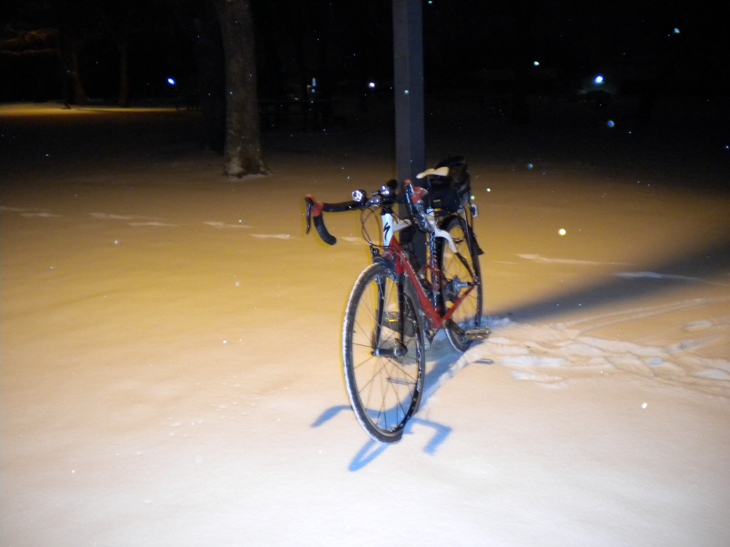
It was a good commute, and I took quite a few pictures that follow. Would I do it again? ABSOLUTELY, but I think some non-snow days next week are pretty sweet as well. I think I have to think about the rain pant issue in particular...
 |
Entrance to the Bedford Path. I Was Shortly to be Totally Lost and Reduced to Finding my Way Via Landmarks
There'd Been One Pedestrian Before Me. I Lost His/Her Trail in My Own Wanderings |
 |
Top of the Last Hill Before Work. Going Up the Hill Wasn't Hard. I Did Fall Trying to Get to Here from the Arterial as a Pedestrian - Twice
As You Can See, Traffic Was Not Real Heavy |
 |
| Motorist Wonders What the Crazy Cyclist is Doing Taking Pictures - Or Maybe She's Wondering if She'll Make the Left Turn |
 |
When You Turn Pedestrian, You Don't Worry About Newly Erected Signs Like This One
Interestingly, They Were Clearing Sidewalks at the Elementary School in the Photo, Even Though School was Cancelled
I Clipped an Amusing Earphone Story Associated with this Shot |
 |
A Plastic Bag Makes Sure the Saddle Won't be Wet at the End of the Day
The Lock Was My Mini U. The Lock I USUALLY Use Was Frozen |
 |
This Road was Difficult to WALK on in the Morning. I Fell Twice on It
By Afternoon, Riding it was Easy. Look, Ma, No Falls! |
 |
| Treacherous Spots Remained in the Afternoon, But They Were Localized |
 |
| Almost Home, Buddy Rests While I Get Some Warm Liquid |
 |
| Even the Smooth Conti Tires Accumulated Snow |
 BUT, that led to MORE Internet searching and THAT led to a product that sounded almost too good to be true. It is called "Tyre Grip," with a close relative called "Shoe Grip." EUREKA!
 Well, you know what they say about things that sound too good to be true, even if you DO read about them on the Internet. I saw one review of "Tyre Grip" on Amazon and it was positive, or at least the reviewer said it "seemed" to work. So I dug a little further, to see if anyone had tried it on a bike. Sure enough, I found a review here. Instantly, my enthusiasm began to abate. The reviewer had a theory that bikes are too light for the product to be very effective. Hmm, perhaps "Shoe Grip" might be better for bikes. After all, pedestrians are a LOT lighter than cars! So I looked a little further. There were no reviews of "Shoe Grip" on Amazon, but I did find that the American mass media still has faint sparks of investigative spunk and there was a review of "Shoe Grip" here. They even gave the manufacturer a chance to rebut their findings. Which tells you how well these reporters thought it worked.

 BUT, that led to MORE Internet searching and THAT led to a product that sounded almost too good to be true. It is called "Tyre Grip," with a close relative called "Shoe Grip." EUREKA!