Showing posts with label snow skiing. Show all posts

Monday, November 17

Texas November Snow

Our Street, in February 2010. "Snowpocalypse"
It snowed last night. In mid November. In North Texas. No, the photo above wasn't last night's snow, though it shows how it can snow on our street way down here. Rather, our latest frozen precipitation is shown below. The photo below shows our current snow dusting, along with a Fergus that seems to have gotten MUCH larger than HERE virtually overnight. I expect that the snow will all be melted by this afternoon, but November snow in Texas should not fall without comment, even if there wasn't enough to make a pretense of cross-country skiing. Perhaps on November 22nd, we'll break the old snowfall record of five inches, set back in 1937. Unlikely, but we shall see...

Fergus Discovers Snow at 7 Months. It's COLD!
The Snow is OFFICIALLY a Record According to the NWS Record Report

Thursday, September 25

New Mexico Quickly

Looking at Texas From New Mexico. Glenrio's Seen Better Days
Recently, we made a little road trip and spent time in New Mexico on the route. We mostly avoided freeways, except for a stretch where I-40 provides good access to remnants of Historic Route 66. Always a sneaky one, I suggested that we pass through Los Alamos, site of the legendary blog “LosAlamos Bikes.” Unfortunately, thunderstorms were passing through the area and so my wife vetoed the detour.

Back Before the Interstate, You Might Have Stopped Here Before Crossing into New Mexico
Going from Texas, the tour begins with the border town of Glenrio. One might have stopped at a cafĂ© or purchased gas on the Texas side of the border. The motel closest to the border was seen as the “Last Motel in Texas” if you were looking from the Texas side or as the “First Motel in Texas” if you were standing on the New Mexico side of the border. Apparently, all the gas stations were on the Texas side of the border because Texas gas taxes were lower. On the other hand, all the liquor was on the New Mexico side because it was a “dry” county on the Texas side. I was also somewhat surprised to hear about the “Glenrio Historic District” from the NPS website. One wonders how you have a historic district in an unincorporated town that has two inhabited houses and a dog.
 
San Jon Gas Station's been Long Closed Based on the Size of the Tree
Anyway, in New Mexico as you head west is the little town of San Jon. As you can see, some of these places have been declining for many years. The tree at the gas station was growing out of where they used to have a gas pump mounted. San Jon has held on better than Glenrio, with 300 souls remaining after the freeway bypassed it.
 
Tucumcari's Got Lots of "Still Open" Route 66 Architecture
Further west is “Greater Tucumcari.” Tucumcari was and still is one of the larger towns in eastern New Mexico. It was a rail stop, still is a county seat, and there are lots of “Route 66” sights. Still, the city has visibly declined in the last decade. When we moved to Texas, we stayed at the “Payless Inn.” It was not too wonderful a place, but “Tripadvisor” and “Yelp” and various other sites were not available on the road in those days before smart phones. As you can see, the motel never fulfilled its promise to reinvent itself as the Taaj, and it recently burned to the ground. What’s more, we saw two other buildings in Tucumcari that also burned down.
 
Motel We Stayed at on the Outskirts of Tucumari - It was Bad Then, but Worse Now
We also stopped in Las Vegas. Nope, we weren’t hoping to visit some “History Channel” reality show, but Las Vegas is an underrated place that has a much nicer central plaza than “Sundance Square” in Fort Worth. It has real history, as a(probably of several) place where Kearney proclaimed that New Mexico would henceforth be part of the USA. There used to be a water tower in the plaza where three outlaws were hanged/shot by vigilantes, but I didn't see it, so it is probably gone. It is a mostly well preserved and enjoyable piece of the “old west.” Las Vegas is fairly poor, based on the number of pawn shops and a continuing slow decline in population. For those that aren't really excited about seeing where outlaws got hanged, Las Vegas is also the locale where the motorcyclists met Jack Nicholson in Easy Rider, and it was INVADED in the original Red Dawn movie (I guess New Mexico looks more like Colorado than Colorado)!
 
Plaza Hotel in Las Vegas - Across the Street from the Plaza

Well Maintained Las Vegas Main Drag - with Someone Going Through a Trash Can - Probably NOT a Former Dodge City Gang Member
The “Star” of New Mexico for tourism (at least in summer when there's no skiing at Taos) is Santa Fe. Santa Fe is the capitol of New Mexico and has about twice the population of Olympia in Washington State. For those that are not familiar with its history, it was well established when the Dutch first stepped foot on Manhattan Island and when the Pilgrims came to New England. I found the St Francis railroad crossings to be VERY interesting and worse than Khal portrayed them on his blog. The first time I encountered the distance between the “place to stop” and the actual intersection, we were confused and had a discussion about whether we were properly stopped or if there might be another place to stop that we hadn’t been informed about. Railroad crossings at shallow angles are rare enough that I can’t say I’m totally surprised that people on bikes get whacked or trapped. I imagine motorist collisions are not rare either.
 
Some Crossings Aren't Good for ANY Road (or Trail Users) - Images from Google Maps
 
 
Cathedral Basilica of St. Francis of Assisi in Santa Fe - it is NOT near St Francis Drive!

We Stayed in a Very Nice Old Motel that Starred in a 1989 Documentary that Still Draws German Tourists
Motoring along further we went through the “four corners” area, saw the majesty of Shiprock (and the little town named same, and enjoyed the beauty of southeastern Utah and southwestern Colorado.

Shiprock in Northwestern New Mexico
 
Out of New Mexico and into Utah
 

Sunday, February 9

Snow


Typical "Cold" Morning in Ocean Shores. Frost Appears Even Though Air Temperature is well over Freezing
Usually, the weather is pretty boring around Ocean Shores, Washington. The temperature gets down to the low 40’s in the summer and into the 30’s in the winter. I’ve seen posts from around the country showing arctic conditions pretty much everywhere east of the Rocky Mountains. A touch of frost some mornings is about as frigid as things get. The winter weather is actually much milder than its North Texas counterpart. In truth, in January, the DFW low temperature was usually lower than Ocean Shores.

Still, even Ocean Shores experiences an occasional frigid spell. It started with temperatures dipping down to freezing, as shown here. Late last week it got colder yet. It got so cold that the local espresso stand I ride to each morning CLOSED due to frozen pipes. Rumor has it that this has not happened before in living memory and that we may be declared as a disaster zone.


FROZE PIPES!!!!!!!!!!!!!!! Oh, the HORROR!
BUT WAIT. It got even more dramatic. Last night it actually snowed. Things are, however, looking up since the espresso stand got its pipes thawed and reopened yesterday. While the roads were coated in white, mostly riding was not a lot different than usual except for one street, Albatross, and the gravel driveway shortcut that takes me past Ace Hardware and up to the espresso stand. You see, snow covers up the potholes. The drill was much as one would expect - don't make sudden starts or stops, or depend on doing any quick turns. Take it slow, and pretty soon the coffee will taste extra good. I noticed less than the typical motorist count at the driveup. Apparently those without 4WD stayed in bed, while "one-wheel drive" worked just fine.
Do You Have to Stop at a Stop Sign if It is Covered With Snow?
To keep the story short, our bit of snow simply got us into the mood to watch the Winter Olympics.       
The Raccoon Tracks Make it Look Like it was PARTY TIME! Bike Traction was Unimpaired (Mostly)

Doesn't Look Like Boating Weather...
 

Saturday, June 30

Ski Diversion

I do a lot of bicycle posts on this blog. If you'll read the particulars, however, snow skiing is one of the passions. Snowboarding too, but that is a later affliction. Someday, God willing, I'll learn to tele and maybe even flatlander skiing.

My all-time ski favorite is maybe not who you'd expect. It's not Jean Claude Killy as my wife's favorite is. BTW, my wife skiied down through the trees at Yodelin. It's not Spider Sabich or Tommy Moe. It's not one of the Mahre brothers.

My all time fave is Picabo. She was one of the instructors in a ski video when I was first starting to learn. Maybe I'm like one of those ducklings that imprints on the first experience. Picabo, and Mike McKinnon.

Mike is doubly important to me. Not only was he my first ski instructor. He was also my first snowboard instructor, purely by coincidence, though I like that coincidence. I think I progressed a lot quicker on the snowboard instruction. When I took skiing, I think the instructors had a pool about whether I'd ever show up for the second week. Most of them lost. The myth connection? There is no truth to the rumor that Picabo became a nurse who later was banned from the ICU/CCU unit because she answered the phone, saying, "Picabo, ICU!" Unfortunately, we're headed into summer. No endless winter this year...

Tuesday, June 5

Shameless Plug


The Family's Youngest, in a Tree Well at Stevens Pass, Washington. "The Pouty Skiier"
Mostly I write about cycling topics on this blog, but today I digress for a shameless plug. You see, a major family milestone was reached last week. Our baby graduated from Colleyville Heritage High School. I saw tears in my wife's eyes. Me too. Kudos to one we called "The Pouty Skier."

Three Sisters. The Youngest Just Graduated

YOU GO, GIRL!

The High Schooler Learns How to Pass Cyclists - "Make FULL Lane Change When It's SAFE!"
I Believe That Lesson Sunk Home and Will be With Her FOREVER

CHHS Drum Major

Graduates File In


Wednesday, March 28

Spring Snow


With all the talk about flowers, I noticed it is true what I was told about "not being out of the woods until Easter." Seen this morning outside my Quebec hotel...

Sunday, January 22

Imelda Marcos Rides a Bike

Skiing Shifted My View of Expensive Footwear

This post isn't really about Imelda Marcos, though it turns out the lady who was famous for her collection of over 2700 pairs of shoes DOES have some bike connections. For one, David Byrne (yes, the one who rides around on a bike and makes observations about what he's seen) wrote about Imelda. For another, there is at least one bicycle dedicated to her. However, Imelda, or at least her interest in shoes, IS the inspiration for this post, and both Cafiend of Citizen Rider, and Jason of The Plano Cyclist, pushed the shoe fascination into full blown flower. The always excellent Cyclelicious Blog provided inspiration for the title.
Found on the Internet

Some of this shoe frenzy was prompted several years back when I learned to ski. At that time, I weighed about 90lb more than at current, but I still wanted to learn how to ski. As I told the ski instructor, "I want to learn to ski well enough that I can ski down the blue square slopes with my kids." Well, that's a whole different saga and a lesson in unintended consequences involving terms such as "tucking trees," but I found that the second hand boots I'd bought made skiing almost impossible. So I doubled down and went out and spent $300 for the rather ordinary boots you see in the photo above.

Back to the subject at hand, Cafiend piqued my interest in the linked post above when he talked about "Snow Sneakers" that were made by North Face. Well, as it turns out, there is a whole subculture of what purport to be waterproof shoes, some of which are also insulated. The old wheels started turning and it occurred to me that such a beast would be PERFECT for my commute, because it really doesn't get really cold, or really wet all that often here in North Texas, and even in Washington that is true (it DOES drizzle a lot there, but it doesn't pour very often at all).

First, I perused the North Face Snow Sneaker. These beasts run about $100 and LOOK a lot like the Chrome shoes that Justin recently blogged about except they don't accept cleats. For a dozen or so rides a year, I'll forgo cleats. My pedals work as platforms OR with cleats anyway.

Then, entirely by coincidence, Chandra called. Pretty soon, we were chatting like Imelda and her friends about shoes. It turns out Chandra has another variant on the "Snow Sneaker" called "trail runners." His were made by Salomon, though I initially thought he'd said "Solomon." Salomon! Why they made the bindings on my skis! Pretty soon, I was coming across many different kinds of shoes that might work very well for the unusual cold and wet days we get on occasion around here.

I don't think I want a full on hiking boot, because I value ankle flexibility when I'm riding my bike, so I've ruled out some of those. I'm also thinking I want something a bit on the big side, as well as waterproof and comfy with regular socks down to about freezing. My theory is those would work in many conditions and I can still add wool socks and toe warmers if it ever actually gets down to zero Fahrenheit ( a real rarity in both North Texas and in Western Washington. In addition, while I might have paid $300 once for those ski boots (and it was money well spent), I think these shoes should be more affordable. Like in the $100 ballpark, though I've looked at $200 shoes that have spd cleat mounting. Those come from Shimano, Lake, and other manufacturers.

Some that look intriguing include:
  • North Star Snow Sneaker II or III
  • Salomon Contragrip and Deemax 2
  • Merrell Winter Moc
  • Koling AIR Hiking Shoes (like hiking boots, but cut lower)
  • and a WHOLE HOST of others! Adidas makes 'em, Nike makes 'em. Keen makes 'em.
What's a poor, shoe-addled cyclist to do? It seems that when you admit you don't need cleated shoes, the world can be a many splendored thing...

Thursday, January 12

Like Riding a Bike


I'm still in Montreal. Tonight, on the way home, there was a bit of snow on the roads. A caller in to a local radio station exclaimed: "Everybody's forgotten what to do when it snows!" 30Km later, I pulled into the hotel up in the Laurentians. Snow driving. Three times a week to Stevens Pass sticks with you for car control in snowy, winter conditions. Just like riding a bike. Time will tell if things are so sweet going back DOWN the hill. On a bike or in a car, I have found going uphill safer than going down. After all, going up the hill, you WILL be able to stop. As in skiing, an "oops" can result in a long slide. I just hope those AA pilots don't forget what to do in the snow. Luckily, expectations are higher for commercial airline pilots are higher than we expect from road users.

Sunday, November 6

Seen on the Internet

Sometimes, things you see on the Internet lead you to really cool items. Sometimes, they just lead you to things you thank your lucky stars do not wind up cluttering up your storage. I just got led to doing a "product some other person should review."

Case in point - WINTER TRACTION
Living in North Texas, winter traction is an occasional concern. It is occasional enough that bike stores around here don't carry much of anything to help cyclists deal with it. Studded tires are not really practical since you'd only get to use them a half dozen days at most and they'd be dry rotted LONG before they got any serious wear. Still, I keep my eyes open in the ever-present search to open the commute envelope just that last little bit to allow rides on those few days that eluded me last year. Slick ice. Conveniently, "bike commuters" just posted an article about bicycle tire chains. With a little bit of investigation, I quickly concluded they were not only awfully spendy for the product in question ($85-$95), but wouldn't fit my bike even if money were no object.

Kool Stop Makes Tire Chains in Addition to Brake Pads!
BUT, that got the Internet searching underway. Before long, I discovered that this "slipnot" item was not the first bicycle tire chain, and, in fact, Kool Stop makes or made such a product. I have no idea how much these puppies cost, and whether you need to call Kool Stop and tell them "Vito sent me," but they MIGHT work. Somehow, if I thought they were a mainstream solution, Kool Stop would at least mention their availability. Still, they are a real product, made by a real company, and "Icebike" talks about them here.

A Working Tire (or Tyre) Spray Would be Nice on Days Such as This
BUT, that led to MORE Internet searching and THAT led to a product that sounded almost too good to be true. It is called "Tyre Grip," with a close relative called "Shoe Grip." EUREKA!

Well, you know what they say about things that sound too good to be true, even if you DO read about them on the Internet. I saw one review of "Tyre Grip" on Amazon and it was positive, or at least the reviewer said it "seemed" to work. So I dug a little further, to see if anyone had tried it on a bike. Sure enough, I found a review here. Instantly, my enthusiasm began to abate. The reviewer had a theory that bikes are too light for the product to be very effective. Hmm, perhaps "Shoe Grip" might be better for bikes. After all, pedestrians are a LOT lighter than cars! So I looked a little further. There were no reviews of "Shoe Grip" on Amazon, but I did find that the American mass media still has faint sparks of investigative spunk and there was a review of "Shoe Grip" here. They even gave the manufacturer a chance to rebut their findings. Which tells you how well these reporters thought it worked.

NOW, some of you might go read these reviews. I think, however, that I don't have a strong need for something that will probably gum up my bike mechanicals and that I can find more economical wasp torches. STILL, loyal reader, if someone with whom I have had past contact (employees of "Tyre Grip" and their families are not eligible) wishes to try this stuff, I'd LOVE to hear your experiences. Perhaps one of our Canadian cousins? Just the name "Tyre" should make you feel all squishy and Commonwealthy even if you lot DO spell "tire" correctly, unlike all those "ou" words. HERE IS YOUR CHANCE TO BE A REAL CYCLING PIONEER!!!!!!!!!

Sadly, down here, the search for the perfect ice solution continues. My knobby tires are ready and perhaps I'll have better footwear this winter as well...

Sunday, May 29

Changed in Little Ways


Cycling and Skiing Have Both Changed the Way I Carry Stuff
Perhaps I've simply become more observant in recent years, but I've noticed that I change how I do things based on activities I engage in.

One example is that I now organize money in my billfold differently as a result of snow skiing. When I ski, I use a clip and carry only essential cards. I also started folding money so that the largest denomination bills are in the center of the stack. I figured that dragging a clip with money out at the lodge would be less conspicuous if dollar bills were what was visible. It also had the advantage that if money dropped, it'd be the little bills that went flying around.

Cycling has also influenced me, even recently. When you're cycling, carrying a large wallet around is somewhat of a pain, both because you are carrying around unneeded weight and unneeded bulk. I solved this problem by dividing my "stuff" into the stuff for the big wallet as well as items likely to be needed on a given trip, which go into the slimline wallet. On a daily basis, I'm not likely to need to haul out my original Social Security card, my PE License, or the security code to the Jaguar radio.

This has turned out quite well. In the photo, the top wallet weighs 60 grams and the bottom one weighs 130. Better yet, the top wallet can easily be carried in a front pants pocket along with an iPhone, in a jersey pocket, or even in a bike bag with room left over.

This is a practical application of what Chandra would call "CRM." For those not knowing every acronym around, CRM stands for "Crud Reducion Management."

Sunday, February 6

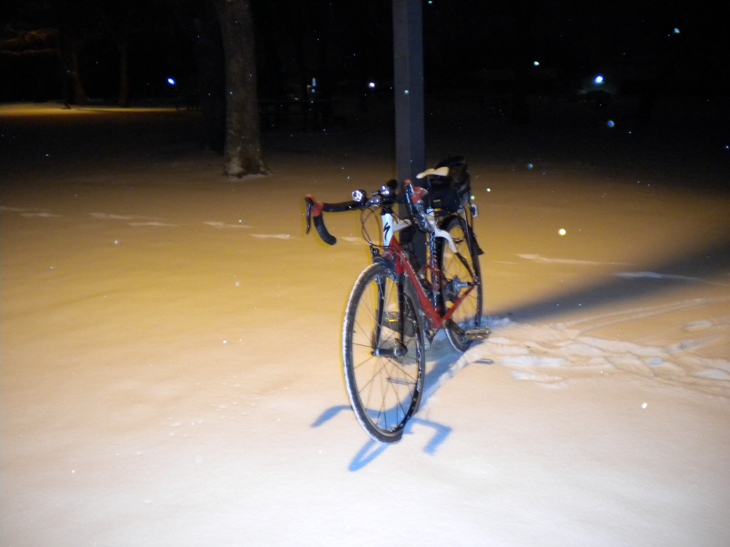
Thoughts About Snow Riding Comments

Doesn't Such a Photo Just Make You Want to Stop and Be Thoughtful for a Bit?
A few last nuggets of wisdom to capture points that might otherwise escape.

Big Oak: "Learning to fall is good. Learning to not get into conditions that lead to falls may be better!"
Take Away: Unfortunately, learning and falling go together at first, just as they did when we first learned how to stay upright. Just as when I first learned, I got better as I went along at recognizing the conditions that lead to falls and on staying upright whatever the conditions. If I lived somewhere that offered frequent opportunities for riding in such conditions, I'm pretty sure I could begin to regard them as "routine." Snow biking may not be as glamorous as freeskiing, but you don't have to buy lift tickets!

John Romeo Alpha: "The ideal hand solution for me was ... sniper gloves."
Take Away: I am gradually collecting more and more gloves. One thing I found interesting is that ski gloves worked fine for shifting SRAM road shifters. Mittens not so much. Gloves had more difficulty with Shimano shifting gear because both the lever and the brake lever do different things while with SRAM you just push the lever further and the brake lever keeps to the business of stopping. It's ironic that I bought new half-finger gloves at the Hotter 'N Hell 100 and haven't worn them other than to try them on - in Texas!

Apertome Item 1: "Personally, I generally use platform pedals in the winter (and always when commuting). Not because I don't think clipless offers any advantage (I think it does), but because this way I have a lot of flexibility in my footwear choices. Also, winter clipless shoes are VERY expensive, and I refuse to shell out huge amounts of money for them."
Take Away: I'm looking enviously at clipless pedals that also include a platform attachment. They seem to offer the best of both worlds - clipless when the weather is reasonable, combined with added footwear flexibility for when survival trumps mere efficiency. This winter has been easier than last partly because I've not been as constrained by using the shoes that'd work with my SPD pedals. Both Shimano and Wellgo offer such "convertible" pedal models. For the moment, my old Ritchie clipless pedals are back on Buddy, but I'm looking! I think the platform spd pedals might also help in better weather with the syndrome in which the third toe on my left foot tends to go numb.


Apertome Item 2: "MUPs are almost always worse than roads, in terms of conditions, I've found. They're usually not treated, or even if they are treated, they don't get as much, or as consistent traffic, as the roads."
Take Away: Look at the photo above - those MUPs LOOK so nice, just like a calm body of water, under which alligators await. While I'm skeptical about most MUPs even in the best of conditions, a snowy MUP is a trap for the unwary cyclist...

Apertome Item 3: "I strongly recommend wider tires, your 'cross tires would be great for these kinds of conditions."
Take Away: Since I got new rims for my road bike last summer, I actually have unused 700c rims that I could mount the cross tires on. When it's cruddy out, I'd simply say "Thank God for Quick Releases!" I'm not a fan of multiple tire changes, but my wife would look much more favorably on those extra rims with a set of tires mounted on them. What's more, it'd also encourage me to actually PRACTICE riding in real cross conditions.

Justin: "I will get some knobbies for next year - my MTB has a pretty non aggressive tread, and I was sliding around like crazy. It was fun."
Take Away: I think the last three words pretty much sum things up...

Friday, February 4

First Tracks Through the Snow

More Ominous than Seeing Yesterday's Tire Tracks Was Seeing No Tire Tracks at All!

When I was first learning to ski, more recently than you might imagine, a Boeing engineer who had skied since he was a young child explained to me; “if you’re not falling, you’re not learning.” Later that year, the same Boeing engineer broke a number of bones while skiing. Well I did a lot of learning today on my very first bike commute in the snow/ice. First tracks, so to speak. It was GREAT fun! Fortunately, I was able to avoid breaking anything real important or even expensive. As you might suspect from the intro, I fell a lot and learned a lot. When I was growing up in Seattle, it would never have occurred to me to ride a bike in icy or snowy conditions. Who says Texas isn’t progressive? Besides, at LCI training, we were told that the SAFEST cyclists are those that ride every day, in all conditions. Apparently, they acquire skills that help them avoid crashes. Yeah, that’s it; I’m becoming a safer cyclist.


If You're Not Falling, You're Not Learning, Or So I Was Told
 When I went to bed last night, Northeast Tarrant County had a mixture of bare patches and slick ice. My commute strategy was laid out and even written down, here. However, our weather forecasters got it all wrong and, instead of a trace of snow and a few flurries, we got snow accumulation. Now, you have to remember this is North Texas, so our accumulation ranged from a couple of inches to about seven, depending on the particular locale. Had slick ice not still been hiding beneath the snow, it would have been very simple and almost trivial to pedal the whole way in. Simply start out carefully, don’t make rapid course changes, and leave lots of room for stopping. I’d have easily have beaten my pre-ride time estimate for the commute.

I Went Back for Rain Pants
As it was, things were more challenging. Leaving home, I rode without any trouble for most of a block. Suddenly, I was on the ground, conducting a test of whether my helmet would live up to its CPSC approval. At this point, I headed back to the house to get my rain pants. It was obvious that some water resistant layer would be needed to avoid soaking my pants if I was to continue as I was determined to do.

Snow/Ice Commute Pattern
In areas where the road had dried out before the snow, riding was easy and pleasant, though I found that, as in skiing moguls, you want to go the “right speed.”The right speed is “just right;” not too fast and not too slow. My “right speed” and your “right speed” would be different. On the other hand, in areas approaching intersections, and other places where slick ice underlay the snow, I found that it was sometimes problematic to stay upright. A WISE cyclist quickly learns to use extra caution when attempting to get back up AFTER a fall. It is one thing to fall, but it is quite another to fall a second time on top of your bike. OTOH, motorists, seeing such events, give an unusually wide passing margin if the cyclist managed to collect all the bits before they approach. Either that or they were amazed at bright yellow rainwear. Contrary to my test rides, each intersection posed a tradeoff dilemma. “Do I stay on the bike and fall down or do I fall down when I try to get OFF the bike?” For the record, in my current stage of expertise, I found that neither solution was entirely reliable. Intersections represent unusual problems for a cyclist, just as they do for our fair-weather brethren. About the only element of previous training I adopted is that I crossed wheel ruts much the same way as I would cross railroad tracks – at a 90 degree angle. That did seem to work. Maybe I was just lucky.

Toughest Commute Element
Surprisingly, I found that the toughest part of the entire commute was about a half mile along a separated multi-use path. Yesterday, I verified that the surface of the path was mostly bare and dry, and figured it’d be a snap to ride. Well, this morning, this being Texas, as you might guess, the path wasn’t plowed or sanded. In fact, I found that I was unable to tell where the path edge was and wound up walking my bike through scenic fields and eventually navigating based on recognizable landmarks. The path delayed my journey by about 15 minutes. It would have been worse but I finally encountered a stretch where I could tell where the path was, and that enabled me to make faster-than-pedestrian progress.

Surprisingly Nice Commute Element
I also encountered a pleasant surprise. Bedford-Euless road, a long uphill stretch, turned out to be the simplest part of the entire morning journey, obviating my planned snow route. I started up in the right lane and found that traction was reasonable. Better yet, all my motoring friends were unwilling to test the snow-covered surface in the right lane and stuck to the two ruts in the snow. No falls at all going up that hill in my twelve foot bike lane, and even had some motorist been braver than the rest, motorists are able to easily stop if necessary while going uphill. It is going DOWN the hills where they get in trouble.

Lessons
Helmets
I was uncommonly glad I wore a helmet this morning. However, I have a number of helmet suggestions for novice snow and ice bike riders. First off, learn with a helmet nearing the end of its shelf life. Second, ignore any advice to discard a helmet once you have crashed with it. Since it is impractical to carry a half dozen spare helmets along with you, wait until you get home again before retiring the helmet. I think I hit my helmet hard about four or five times. While it may not have saved my life, it certainly was a lot more pleasant and satisfying to hear that “whack” than to imagine a “thud” from my unprotected head. This is an argument in favor of using the cheapest and oldest usable helmet you possess in these conditions. I was glad I was wearing my “Wally World Special” and not my bike shop Giro helmet. I regret not wearing an older cheap helmet, but my Schwinn helmet got melted in the Land Rover last summer.

Routing
I had a snow route. It worked OK for the trip home, but was completely inappropriate for the trip in. To keep this lesson short, I simply recommend being adaptable as you discover how the conditions marry up with your particular skills (or lack of same) and bike. Be especially wary of a bike path, or even a bike lane, unless you have past bad-weather experience with that path. Even in such situations, bad weather has many variations so what works one time may not work later. Just as motorists vary their route when it snows, it makes sense for cyclists to do the same. Unlike motorists, cyclists need to consider the capabilities of their chosen vehicle, as well as shortcomings of the motor vehicles that are usually so predictable.

Other Equipment
In my previous post, Justin cleverly commented about lowering the saddle and Big Oak mentioned good points about clipless pedals and handlebars. Well, while I’m not sure lowering the saddle would help avoid fall situations, it sure would have reduced the stress and wear and tear on my rain pants. “Best efficiency” is not the main objective when riding in snow and ice. Kudos to Justin for that one. Who’d have thought such wisdom about ice riding would come from Dallas?

Clipless Pedals Came from Ski Bindings
As for clipless pedals, Big Oak correctly provided the wisdom (of long Yankee experience) that locking feet in the pedals might avoid ligament damage in a fall. Fortunately, I avoided any such damage with my platform pedals, but a budding snow/ice biker should consider that clipless pedal systems are an outgrowth of ski release systems, which were specifically developed to mitigate skiing injuries. Also consider that ICEBIKE seems to favor clipless pedals, though they also talk about the Power Grip system that Velouria uses on her bike. In slippery conditions, these may be superior to more conventional toe clips and they certainly make shoe choice easier. In my case, I don’t think clipless was a real option, because I possess no cold-weather cleated shoes, and even heavy shoe covers would simply not last through “hoofing it” segments. In my mind, this remains an area for future investigation.

Big Oak also advocates keeping one’s hands on the handlebars when going down. I was fortunate in this regard, because I learned NOT to attempt to brace against a fall with one’s arm when I learned to snowboard. Snowboarders break wrists and skiers blow out knees. Roll with the fall. If you can do this, you are less likely to break bones and other valuable body parts. My take away from this is that learning to fall can be a useful skill for a cyclist. Once learned, it may also come in useful for a fall in more typical cycling conditions. Certainly learning to fall can do no harm.

Raingear is another area for attention. I use a yellow O2 rain outfit. It is light and compacts down well in a trunk bag. It is almost ideal for the occasional Texas rain storm. However, the pants are not going to work for you for snow/ice bike learning. Mine now look like they were run through a shredder. Between falling down and getting up and getting on and off saddles, these pants aborbed as much wear as they would in a decade of regular bike riding. If you’re going to learn to ride and fall, the pants better be able to take that. Shower’s Pass? The “High Vis Police” will NOT be pleased. My O2 pants are yellow and the Shower’s Pass replacements come only in BLACK. OTOH, I found no damage at all to my yellow O2 rain jacket. I think you want pants that can use suspenders. I found that mine would droop and then get ripped when I got back on the bike. Showers Pass will accept suspenders. REI sells Showers Pass and I even have a coupon. Hmm. Black it is.

My headlight was more or less irrelevant most of the time. While the mighty P7 was very bright, it wouldn’t show me where the invisible bike trail was any better than imitating a bike ninja. What’s more, I discovered that in cold and snowy conditions, one should not expect as much battery life as usual. My P7 winked out about an hour into the morning commute, even though I’ve only made two full commutes this week, along with several test rides (normally, my light will last for a full week of morning commutes). The old Cateye was more than adequate thereafter. In future, if I encounter days of ice/snow, I’ll simply turn the P7 down a notch so it can make it through a full week of commutes. Remember that if you ride in the snow and ice, you’ll be using your lights longer, which should be taken into account if you have battery-operated lights.

Last year, I found that at 11F, ski mittens were too warm. This year, at 17F, in the snow, ski gloves were too cold – and later they got too warm. Regardless, keeping the damp out was the main objective and they accomplished that. I have not yet found an ideal hand solution. I brought my cold weather cycling gloves, but they’re simply not designed to be jammed into the snow.

These Tires Would Have Kicked Butt in the Snow
Vittoria Cross XG Pro in 34c Width - And a LOT of Mud
The Tire Limit on this Bike is Generous
Despite their names, 28c Continental Grand Prix “4 Season” tires are not optimum for the snow, though I think they’re better than Armadillos. My Vittoria cyclocross tires would have made the snow almost trivial and probably would have helped with the slick stuff, but I really didn’t feel like changing all those tires on my single set of rims. Based on what I’ve heard, for serious ice, you want studded tires but in North Texas, we get conditions like this only rarely. Short of studded tires, probably the best setup would be tubular cyclocross tires such as Justine Valinotti talked about here. The advantage of such tires is they’re like snow tires for bikes and, being tubular, they can be run at VERY LOW tire pressure in the snow. Actually, if you are a cross racer with tubulars, just haul out your tubular cross rims and you’d be ready to go in the snow. While tubular are generally less puncture resistant than high quality clinchers, remember that there’s snow covering up many items that might puncture a tire.

Mounting and Dismounting
Over on Facebook, there is a thread about proper bike mounting/dismounting, with many amusing comments about me demoing ways not to mount a bike. Well, I wound up trying several different methods and found that “power position,” “scooter start,” “cowboy start” all had situations where they worked and others where they failed. All I can say is that one would be wise not to get overly enamored with any particular approach. Sometimes you’ll have to get the bike moving and then get aboard. Sometimes you’ll want to be aboard and then get the bike moving. Sometimes, you’ll test the conditions briefly via coasting along while you stand on a pedal. Sometimes you will be aboard and you’ll straddle scoot along a bit, trying to decide what the next action should be. In the snow, I vote for results over style or even what might be consistently successful in conditions where the bike wheels aren’t imitating sled runners.

Falling
I had some opportunity to contemplate the merits of falling to the right (drive side) versus falling to the left. Falling to the right puts expensive components, such as the derailleur, at risk of getting bent. On the other hand, falling to the right, in theory, puts you further away from any following automotive traffic, and the chain is less likely to pop off the chain ring. At my level of expertise, I found this is mainly of academic interest to one that uncontrollably falls in both directions often. If any expert readers have a preference, I’d LOVE to hear it. Chandra suggests carrying a latex glove to help rerail a chain, but I would not have used such a glove this morning. The ski glove will simply have some chain lube on it forevermore and the latex glove would certainly not have fit over the ski glove. Speaking of falling, on the way to work, I fell too many times to count. On the way home, I didn't fall at all. There's SOMETHING to be learned in THAT particular bit of trivia as well.

Walking
Better Choices Were Available
Than Costco Court Classics
Walking is not as reliable as one might imagine. Unless you are using clipless pedals, simply use the best traction warm shoes/boots that you possess. This is an area in which I could have done a lot better than the aging “Costco Court Classic” shoes I use to ride to work in most days, but hind sight is 20-20. If you are a lady, I suggest you forgo the stylish footwear for the snow ride and stick to sensible footwear. Remember, if it is too slippery to ride, it is probably not ideal traction for walking, either.


Wrapup
It was a good commute, and I took quite a few pictures that follow. Would I do it again? ABSOLUTELY, but I think some non-snow days next week are pretty sweet as well. I think I have to think about the rain pant issue in particular...

Entrance to the Bedford Path. I Was Shortly to be Totally Lost and Reduced to Finding my Way Via Landmarks
There'd Been One Pedestrian Before Me. I Lost His/Her Trail in My Own Wanderings

Top of the Last Hill Before Work. Going Up the Hill Wasn't Hard. I Did Fall Trying to Get to Here from the Arterial as a Pedestrian - Twice
As You Can See, Traffic Was Not Real Heavy

Motorist Wonders What the Crazy Cyclist is Doing Taking Pictures - Or Maybe She's Wondering if She'll Make the Left Turn

When You Turn Pedestrian, You Don't Worry About Newly Erected Signs Like This One
Interestingly, They Were Clearing Sidewalks at the Elementary School in the Photo, Even Though School was Cancelled
I Clipped an Amusing Earphone Story Associated with this Shot

A Plastic Bag Makes Sure the Saddle Won't be Wet at the End of the Day
The Lock Was My Mini U. The Lock I USUALLY Use Was Frozen

This Road was Difficult to WALK on in the Morning. I Fell Twice on It
By Afternoon, Riding it was Easy. Look, Ma, No Falls!


Treacherous Spots Remained in the Afternoon, But They Were Localized


Almost Home, Buddy Rests While I Get Some Warm Liquid

 
Even the Smooth Conti Tires Accumulated Snow