Showing posts sorted by relevance for query instant turn. Sort by date Show all posts

Sunday, June 27

Getting Better

Instructors Explain Extreme Stopping to Student
Some posts turn out differently than expected. This is one such. I went to Traffic 101 in Dallas today. This makes my third T101. Originally, I intended to discuss how BikeDFW has sharpened their Traffic 101 course, and how I find it interesting that the students are mostly women. Instead, it's about what they don't tell you about Bike Ed, and what it has to offer someone who knows how to handle their bike in traffic, as well as someone that understands how their bike works. The US Military and civilian aerospace both embrace what that is. In short, it's training for the emergency that may never happen. It's why my oldest daughter did her first Autocrosses while she was on her learner's permit, why my middle daughter got taken to a snowy parking lot in Colorado, and why I'm getting a tetanus shot this year (the track requires it).

Traffic 101 is oriented toward an inexperienced rider, but part of it that isn't well publicized are the bike drills. Some of these are the bike equivalent of learning to operate a motor vehicle under extreme conditions; resulting in the student better understanding what their vehicle can do. As in the case of high performance driving of a Jaguar or Alfa Romeo, this should not be done on public roads. Conveniently, bikes are different, and a reasonably sized parking lot suits them much better than Texas Motor Speedway.

If Those Guys Weren't Around, This Student Would be About to Fall Over as His Bike Stops Moving
Pretty much anybody likely to read this blog knows how to stop their bike. BikeEd students, however, learn how to stop their bikes a few feet quicker. If they're smart students, they practice many elements of quickly stopping to help out their muscle memory. It may never matter, but once in a rare while, stopping two feet quicker can be the difference between a close call and serious injury - or worse. The quick stop drill is one that I am unwilling to do on my own. My commute is made with clipless pedals and I find that I will often fall over at the conclusion of a quick stop. If I have to make that kind of stop in the real world, I will gladly accept falling over if it means I avoid a collision. I don't care if you are someone that wants to ride vehicularly in traffic or only on recreational bike paths. Someday you may need to stop a couple of feet quicker. Quick stop can do that and it's a hard thing to learn on your own, no matter how long you've been riding. If you're reading this blog, you're worth saving.

She's Starting to "Get It." With Practice, She'll Be Able to Hit that Inside Marker and Maybe a Bit More
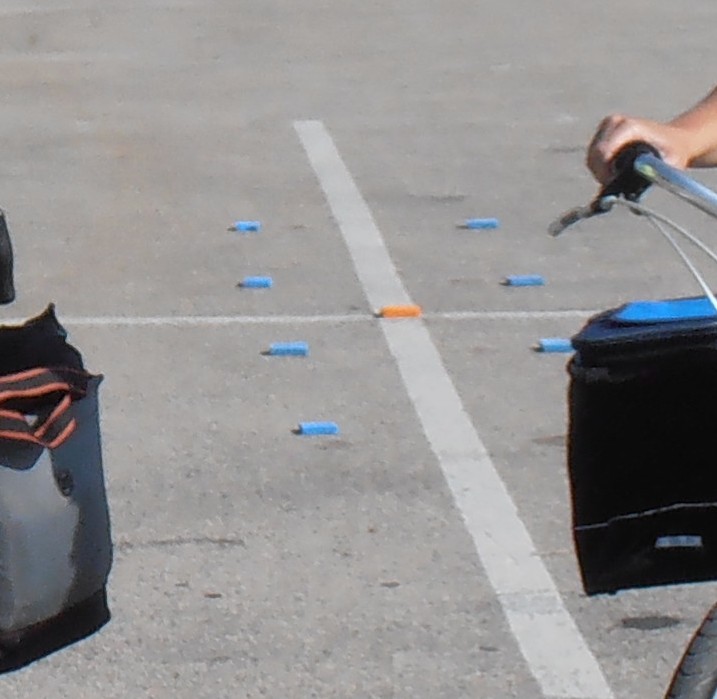
 A second drill that is inadvisable to practice on the street is the instant turn. The instant turn is a maneuver designed to give you an option on how to deal with that Escalade that just made a right turn in front of you besides going underneath it. Again, there's a very good chance it'll never happen, but if it does, someone who performs an instant turn in an emergency might be able to just have a close call. This IS a drill I do on my own, using empty parking lots. If I ever need to do it for real, I do not want to have to THINK about how to deal with the emergency. BikeEd will show the principle, but the student has to make the decision to practice, practice, practice. You don't get that from regular riding. If you're reading this blog, you're worth saving.

One last word on the instant turn. In his book, Effective Cycling, John Forester writes:

You can't safely learn the instant turn on the road, and you will never do it right without practice. ... The only time I was hit was before I learned the instant turn. A car coming the other way turned into a wide driveway. I managed to get into the driveway, but couldn't turn sharply enough to outdistance the car.

Like Forester or hate him, he has credibility when it comes to a statement like that above.

There are a number of other drills as well, but most of them will do no more than teach you how to get a bit more out of your bike, and maybe avoid flats. Those have the ancillary benefit of allowing you to get more out of your cycling, but the ones above may save your life. Even if they don't, knowing you are prepared will improve your confidence on the road just a little bit. If you're reading this blog, you're worth it.

Actually, the Bike Drills are Also Fun. In a Way, it's Like a School Bike Rodeo for Grownups

BikeEd is Alive in Dallas. Thanks, Gail & Richard!

On this blog, I've often stated that bicycling is safe and fun. Well, it is, and that's true even if you never learn this stuff. Aviation is also safe. Partly that's because they practice for emergencies to make it even safer. Conveniently, bike emergencies are usually less dramatic than aircraft ones, but the principle is exactly the same.

You Practice so All the Passengers Come Home Alive! From Wikipedia

Sunday, June 5

Bike Ed on the Daily Commute

Virtually nobody reading this blog would disagree that residential streets make transportation bicycle riding much more pleasant and relaxing compared with places like the Alliance Gateway Freeway. All but the most dedicated stop sign scofflaws would agree with me that this is particularly so when the street isn’t interrupted by stop signs. A less widely understood value of residential streets is that they can also facilitate the safe development and improvement of bike handling skills that can make the difference between a scary situation and something worse.

One prominent feature of bicycle school is the use of parking lot drills. For those so unfortunate as to remain uneducated, parking lot drills are structured to give a cyclist practice performing avoidance and emergency maneuvers so that “muscle memory” develops.

The Bike League course starts these drills by teaching basic bike starting and stopping, moving on to head scans and signaling, and then on to hazard avoidance. Regular riding, and particularly transportation riding on urban streets give lots of practice for the educated rider in starting, stopping, signaling and head checks (regular riding can also develop some bad habits). Hazard avoidance, on the other hand, is not often encountered in the real world (thank goodness!). If you encounter such things frequently, it might be cause to consider your riding technique, but that would be an entirely different post.

Residential streets give opportunities to practice emergency maneuvers without a special trip to a nearby parking lot. I practice these maneuvers frequently. Some of them I do daily. Since these maneuvers are being done on city streets, with no spotters present, some require “dialing back” from what can be accomplished in a parking lot with an experienced spotter.

Rock Dodge
In the Bike League rock dodge exercise, tennis balls are used to simulate a rock that the student is instructed to avoid. The purpose of this maneuver is to help the student avoid pot holes, debris, and other small hazards that are not seen well in advance. The technique is a quick “flick, flick” motion of the handlebar to steer the front wheel around the hazard without changing the cyclist’s path (I won’t get into the physics and principles today). On the street, between oil spots, local rough spots in pavement, and other references, the technique is to simply suddenly pick a spot on the road and treat it as a hazard. What could be easier? If the street is really boring and I’m absolutely sure that no motor traffic can be intruding, I extend my rock dodge practice into linked turns, using street references. This is actually fun, so my biggest problem is to avoid getting addicted into doing this in inappropriate conditions.


Quick - Miss That Pebble!
 Instant Turn
In the Bike League instant turn, the student is taught to use countersteer to get the bike leaned over and turning sharply. The situation simulates a situation where someone has cut you off and you either need to be able to turn right, right away, or you’re going to broadside the hazard. Such a bike education personage as John Forester related that he has had one collision with a car – before he learned to do instant turns. Instant turns are not quite so trivial to practice on city streets as the rock dodge, but ample opportunities exist all the same. Here’s the basic situation. Coming upon an uncontrolled intersection where I intend to make a right turn, I simply execute an instant turn. Since I’m doing this on a public road, I do extra scanning to make sure there isn’t some overtaking traffic sneaking up from behind, but that’s about it. The main reason I do the extra scanning is I have found that the pedals on my bikes are much more likely to strike the ground than when making a “non panic” turn. It simply wouldn’t do to fall over making a right turn and then have a motorist have to make an abrupt stop to avoid hitting me.


Stop Before That Little Spot!!!!!!!!!!!!!!
 Quick Stop
In the Bike League quick stop, the student is taught to use various techniques in combination to stop in the shortest possible distance. Among these is moving back from the saddle and dropping down. I have found that when I do these properly, I’ll fall over nearly half the time, because I usually ride with either cleats or with toe clips. It is not easy to disengage from the pedals when stretched back down and over the rear wheel. You’ll have to trust me on this if you haven’t tried it. In what I personally consider somewhat of a cop out, many instructors do not use cleated pedals when they demonstrate the drill. That is fine, except that emergencies follow Murphy’s Law.

Clearly, riding home from work, you’d not want to simply fall over with your feet still clipped to your pedals. Here’s what I do. While riding along fairly fast, in a traffic-free situation (usually on a fairly long, downhill segment), I will apply varying amounts of front brake, while deliberately paying attention to the level of weight remaining on the rear wheel. I will then combine front brake with rear brake modulation. I will also move my weight forward and backwards to improve my ongoing intuitive “feel” for what is going on with the bike and where the limits lie. The objective is to reinforce the understanding of just how much front brake can be applied with the weight moving back - without a spectacular “endo,” and without actually experiencing any of the other bad things that can happen in such a situation. One must remember that in the real world, in a real emergency, falling over (sideways) at the completion of a stop is a victory compared to hitting the broadside of a van at speed, or even of completing the stop several feet further into a potential follow-on collision situation. This is one maneuver that I have not found a way to fully practice in all elements on public streets. Still, the elements I practice will help if I ever need to stop that couple of feet quicker than humanly possible.

Emergencies in the Real World
Rock dodge situations are something most cyclists encounter. Improved ability to dodge small debris and pot holes reduce flats without unpredictable maneuvers that a following motorist might not expect. Certainly, running over a rock and getting a flat probably isn’t the end of the world, but it is much more pleasant NOT to get that flat or bend that rim. The instant turn and quick stop, on the other hand, are something rarely needed by a proactive cyclist that is paying attention to traffic. As a result, most cyclists do NOT know how to do these maneuvers. REGARDLESS of your views about bike lanes, helmets, high visibility, “bike culture” and so on, I think we will all agree trained cyclist will be better off than an untrained one if an emergency occurs. You might be wondering if this is something you need to work on. In answer, I’ll simply repost the photo below, and note that the pilot repeatedly practiced for a situation he was very unlikely to ever encounter. When the situation came, he brought all his passengers home alive. Your bike’s passenger(s) deserve as much.

Shameless Plug
If you live around DFW and conclude that your road or bike handling skills could benefit from guidance, BikeDFW offers courses fairly frequently. Or email Whareagle, Chandra, or myself, and we’ll get you hooked up.

Monday, April 30

Student Advice

Student Objective - ALSO Student Advice!
One aspect I like about the LAB program, despite its other warts, is the organized feedback it offers. Case in point: last weekend, a student inadvertently offered me some advice without realizing it. You can see that advice above. Yes, campers, teachers have bad habits every bit as much as any student. And, if Gail Spann is reading this, it isn't what she thinks. Even Warren would admit I was VERY well behaved about avoiding cyclocross mounts and dismounts. My recent fixie purchase should help further, but I have to drag THAT story out a while. For reasons that will become gradually clear in future posts.

It all started with Quick Stops and Instant Turns. For those not practiced in the bike handling drills common to LAB and Cycling Savvy, Quick Stops are the theory and practice of stopping a bike as quickly as possible in an emergency. You will NOT do a Quick Stop or Instant Turn every day. In fact, I cannot say I have EVER had to do a life or death Quick Stop. With luck, I never will. Still, should that day come, I hope I will be around to tell y'all how the three or four feet quicker I stopped, or the three feet quicker I turned, made a real difference. That is why we practice. Similar motives lead me to practice emergency motoring maneuvers. As in SCCA Solo Racing. What can I say, I'm an engineer?

But, bike ed has its possible downside. Today, I had one incident in which I considered initiating a Quick Stop. I also had a second incident in which I considered how ineffective the "back brake only" version of the Quick Stop truly is - and where you want to be wearing helmets the very most. Was this coincidence? I hope so. I'd rather not think that practice creates the need for the actions we practice.

Bedford Road. Scofflaw Motorist Was Off to the Right. No Cones Today...
First off, I was going down a slight incline on Bedford Road - IN Bedford, on the way home; headed towards a major coffee chain that creates a "most days" major homebound delay, when I saw a motorist and her vehicle off to the right at a stop sign. Following my usual policy, I watched the car's wheels. When they moved forward prematurely, my hands applied pressure on the brake levers and I considered potential Quick Stop options. An Instant Turn also was momentarily considered, but at close to 30MPH, was considered only as an adjunct to a Quick Stop after speed got scrubbed off. Then, the motorist recognized - or registered me - and waited. Recollections of last weekend flooded through. Once again, I didn't have to actually put any of that bike ed stuff to REAL use. Whew. The cycling equivalent of a reduction in the "DEFCON" level. Still, it was nice to know the recent practice was ready if needed.

The Offending Parking Lot. On a Day a Little More Slipperier Than Today
Before long, I was pulling into the coffee chain parking lot and exposing a BAD habit. Namely, I took off my helmet as I pulled in, which I often do to let my head cool down a smidge before I go inside. I do NOT want to start any helmet wars here, but in my experience, parking lots are one of the four situations in which helmets are the most useful. The other ones are: regular walking around or riding on slick ice, and crowded bike paths. All three situations have a lot of potential conflict and the helmet wearer is going slow. Simply said, if you wear a helmet on the road, do not take it off until you stop. That parking lot is a hotbed of potential conflict. Rantwick's mom is right.

My Dear, Departed Helmet. Killed in a Texas Summer. Still, Illustrative of Today's BAD Habit. The Helmet in the Photo Got ZINGED in Texas Heat
To make the story move forward, I took off the helmet, and held it in my left hand, leaving me with only rear braking. A car pulled out. Good thing I wasn't going fast, or I'd have made a good dent in the motorist's fender and we'd have had to argue why it was OK for him to run that stop sign when I didn't have one. I'd really rather not argue. BOTH HANDS available for braking. That's good practice. The premature helmet removal is a bad habit, and doubly so when it compromises one's ability to use the strong (front) brake. Nuff sed.

Those students learn. They also teach.

Warren Casteel Illustrates a Point in Parking Lot Drills

Renee Jordan Explains Instant Turns to TS101 Students

FOCUS!
Captain Picard Contemplates Steve's Habits...


Thursday, January 19

Danger From the Wacky Left (Turn)

WHY Do People Make BLIND Left Turns?
On Tuesday, in "Hard Right," I related how the vulnerable road user, namely one of those giant SUVs, put himself into a position to get squished like a bug. Somewhat conveniently, today's cautionary road tale involves a different danger, in this case, a"Wacky Left" turn brought back memories of getting hit in a very similar situation.

For those of you that may be nervous that either of these posts represent a sudden Steve political diatribe, settle down. I think this is probably the last "this sounds political" post title - unless I think of another one.

Today, I was an active participant and not a mere observer of two motorists having a close call. Anyway, here was today's situation:

I was northbound on Forest Ridge in Bedford, just a little north of the Airport Freeway. Forest Ridge is a sweet four lane road that I sometimes ride on the trip home. It represents a quarter-mile detour that avoids a couple of traffic lights that get clogged up frequently on the afternoon commute. You see, I really don't like to filter past my motoring cousins, nor do I like to sit through multiple light cycles just to show solidarity most of them would neither understand nor appreciate, though they WOULD notice me holding them up when they had to repass me.

I was in the right lane, roughly in the center of a 12 foot lane, perhaps a smidge to avoid the rough area and oil. Up ahead, in the left lane, I observed two cars that were stopped in the left lane. To all appearances, the second guy was waiting for the front motorist to make a left turn into the credit union parking lot. Being observant, I also noticed a third motorist a bit further ahead. Hmm. My antennae tingled just a bit. As I closed, I moved RIGHT in my lane. My loyal reader should practice that a little - "MY lane." But I digress.

Moving right, I also prepared for braking or other evasive maneuver. Nothing definite other than stopped motorists ahead and knowing that the DANGER IS AHEAD. Then I saw the reason. A fourth motorist was waiting to pull out from the parking lot and the other three were trying to be "nice," not realizing that the parking lot motorist, making the "wacky left turn," would CREAM anyone coming up in the right lane.

In fact, I was more worried about this possibility than the average road user. You see, I was hit in just such a situation in Everett, Washington. Luckily I was not injured by the wacky left turner, though the Jaguar I was driving sustained several thousand dollars of damage. Even today, I'm AMAZED at how many motorists will attempt a totally BLIND left turn simply because someone waves them on.

To wrap up, moving RIGHT in my lane, though somewhat instinctive, was precisely the right action because it gave me a better view of what was going on with all those strangely behaving motorists AND it gave me an instant longer to react should a conflict really arise. Today, the wacky left turn was merely a threat. The sort of threat that helps me guard against commute complacency. Well, more or less. You see, cycling really IS fun and safe.

Thursday, September 15

Cycling Savvy in the Parking Lot


Here, I reported on the classroom session of cycling savvy. Sunday morning, we collected for parking lot instruction. This is very similar to the parking lot session of the LAB Traffic 101 course. As a practical matter, it is almost IDENTICAL to the LAB Traffic 101 course parking lot session. Come to think of it, it has most of the SAME problems that the LAB Traffic 101 course parking lot sessions have. As a result, I’ll simply criticize both and compliment both as one body. IMO, most of the differences could just as easily be instructor-to-instructor variation.

Waco Moore and Chandra Look Relaxed, Neither Yet Knew About the Ants in the Dirt to Waco's Right Where My Bike (and helmet) are Parked
In both cases, the purpose of these drills are to build basic bike handling skills and to build student confidence in things like “looking behind to see if some car is going to squish you if you make that lane change you are contemplating.” Of course, rather than the wordy version, this is called a “head check” or a “scan.” Things start out showing us how to start out how to get on the bike and start out. That sounds pretty simple, but cyclists accumulate bad habits. Gail Spann, for example, caught me doing sloppy starts in my LCI Seminar that might cause problems for some riders. She even took photos, but I seem unable to find the link just now, so you'll have to do without examples of Steve riding badly. You might similarly suffer from bad habits that make things simpler for what you’re doing daily. I think the operative phrase is “do as I say, not as I do.” In the parking lot, bad habits get corrected and good habits get stronger. Why else would you spend all morning riding around in a single, empty parking lot?

From starting out, we advanced to practice shifting gears, and thence to turning, head checks, riding slowly, and we wound up practicing emergency maneuvers. Most of these drills are identical between the two courses. That really should not be a surprise, because the physics are independent of what course is being taught. Duh. One difference that I actually found a little disappointing was the "snail race." While Chandra proved once again that he is slower than me, I wonder if a better variant with stronger traffic application might be "how long can you take to go a single foot?" Same general idea, but staying behind a stop line without putting a foot down is something I do every day in traffic. I rarely try to go 20 feet (or whatever the length of the snail race was) as slowly as possible. In all fairness, if I had a brilliant alternative, you'd be reading about it here. Some things are simply BORING until someone comes along with the brilliant alternative everyone else wishes they'd thought of. Keri or Waco might well come up with that alternative some day, but it wasn't in Sunday's parking lot drills.

Keri Caffrey Chalks Out What Might Create a Need for an Emergency Turn, Referred to as an "Instant Turn" Soon, There Were Cones and Sponges
Sponges in the Rock Dodge Course - Nice Unless it Got Windy
On a personal basis, I found it interesting that Cycling Savvy used sponges to mark off the drill course, while the Traffic 101 courses I’ve experienced have used cut up tennis balls. Sponges seem like a good idea – AS LONG as it doesn’t get windy. I haven’t seen it done in person, but an idea I recently heard on the "LCI Mailing List" that seems better than EITHER approach is to simply cut up a colored bath mat and use it. Bath mats make less of a bump to a bike wheel running one over than a tennis ball, but they would not be caught so easily by the wind as a sponge. Yup, I’m a bike school geek!

One problem common to BOTH programs is that instructors seem to have problems holding the students to a precise schedule. I suspect the students are not as "parking lot schedule aware" as the instructors. Note to myself: try the "train and station" approach. I’d hoped that somehow, Cycling Savvy’s new approach would have found a miracle solution, but miracles are not always to be found. Well, at least it made things no worse in that regard, and a more rigid student limit kept things more manageable for two instructors.

Students Focus on the Instruction, but They Still Make Holding to the Time Schedule a Challenge
Honestly, Waco and Keri Did Pretty Good, Though All but One of the Students Was Pretty Good About Time
(and no, I wasn't the scofflaw, at least I don't THINK I was the scofflaw)
Students About to Discover the Ants. You'll Note My Helmet and Bike Were No Longer There, Only My Water Bottle

Tuesday, March 8

Jack of all Trades

Shimano PD-A530 SPD/Platform Pedals After the First Pedal Strike - Left Side Pedal
I've had new Shimano SPD/Platform pedals on Buddy for the better part of a month now, and some things are starting to emerge about them for anyone considering using them:
  • If you are used to using single-sided, clipless pedals, such as the Wellgo magnesium models I have on the road bike, these will work as well as any others for that purpose. They are not optimized for racing, however. Get eggbeaters or some other four-sided pedal with good mud tolerance for cross racing. THESE are pretty tolerably good commute pedals.
  • I experienced a pedal strike last week when pedaling through a left turn while using the pedals clipless. You can see where the aluminum was ground away due to the pedal strike at the outer right side of the pedal in the photo (the front outside lower edge when riding clipless). I can't recall the last time I struck a pedal on the ground except when making an instant turn. This is no doubt due to the generous platform area
  • I found the platform mode somewhat clunky. This is because I almost invariably ride with either toe clips or with cleats, so a pedal that doesn't simply move where I move my foot is unusual for me. Sometimes, I'd have to encourage the pedal up into the "power position" by nudging it upwards with my toe. Superglue would fix this problem with conventional shoes, but that cure might be worse than the problem. I have not figured out how to use it in platform mode with toe clips and that would no doubt make any tendency to strike the pedal in turns much worse.
  • Upon reflection, I cannot recall any time with these new pedals, in EITHER mode, that any of my toes has gone numb. I shall watch for symptoms, as the third toe on my left foot has tended to go numb with clipless pedals, AND with platform pedals. It's been worst with wool socks, but happens even with thin socks. Hmm, might these pedals contain magic?
All in all, I'm quite happy with these Simano SPD PD-A530 pedals so far. They work well with cleated shoes and work acceptably with whatever shoes I've happened to throw on. Unexpectedly, they don't seem to make my left foot go numb. Comparing them with the Ritchie pedals they replace; the double-sided Ritchies weighed 370g per pair. These new pedals, with their added flexibility, weigh 384g per pair. In real terms, that's just under a half ounce weight difference per pair. Actually, come to think of it, that weight difference was BEFORE I ground away part of the left pedal. Now, these puppies probably weigh just the same as the Ritchies and I haven't hit the right side yet. For comparison purposes, my "Costco Court Classic" shoes weigh 62 grams more than my Sidi shoes - WITH cleats.

Wednesday, April 25

Sponges and Tennis Balls


Rock Dodge - CS or LAB?

I've been very fortunate lately. I've gotten to help teach both a Cycling Savvy Course and a LAB TS101 Course. The CS course was in February and the TS course was last weekend. I expect to help teach another TS course this weekend, and will post about the GREAT DANGER facing cyclists today. But that is not what today's post is about.


Instant Turn - CS or LAB?

Today, I'll note that the difference is about a lot more than sponges versus tennis balls. What is that durn guy talking about? Well, it seems that the Cycling Savvy course seems to favor sponges to mark items in their parking lot drills. ON THE OTHER HAND, the Bike League seems to favor tennis balls cut in half for THEIR parking lot drills. As far as I can tell, neither curricula has made these dogmatic choices.
However, there IS a major difference, and in this regard, I would not mind seeing a middle ground. In the CS class I took, there was no test of any sort. Inquiring, I was told that student videos or other e-stuff were part of the eventual plan, but that taking tests was NOT why students took the class and the test time would be better spent in teaching road skills. That's fine, and actually really GOOD to minimize tests, but it is also ultimately an "open loop system" where students are not really encouraged to reach out for help. CS teachers look for such a message from students, but it isn't explicit.


NO Test in the CS Course. Absolute MAX Saddle Time.

In the case of the LAB course, there is a student written test AND an instructor detailed evaluation of the students. Last weekend, Warren and I were STILL filling out the evaluation forms a FULL HOUR after we got back from our ride. That was an hour we could have been teaching road skills. That was an hour students were standing around wondering if any of these guys had a clue. It was an hour totally lost to any possibility of positive behavior change.


LAB Instructors, Losing MORE Than a Full Hour of Instruction Time, Grading Tests for Why?

Fortunately, I think there's a better way for EITHER course, and Preston Tyree pointed it out.
WHAT DID HE/SHE/IT DO WELL?
WHAT COULD HE/SHE/IT HAVE DONE BETTER?
You repeat that three times (SIX total questions) and you'd cover the concerns of the students,the observation of the teachers, AND ways to improve the course itself. Heck, in email response to complaints about this post, I ventured I could be easily bargained down to TWO questions. Yeah, I paid attention, though it may not have been obvious to the instructors. Thanks, Preston. I hope someone besides me has been listening to you...


Preston, the Unheraded Guru of Cycling Harmony?


Friday, February 20

Bike School Student Again

MSF Course includes Reference Text Like LAB, but Unlike CS. Material is Also Available on Line
The Bike League requests that its instructors periodically take educational material related to bikes in order to keep "fresh" in bike ed. The principle is exactly correct and ought to be followed by all; ESPECIALLY by instructors. Recently, I took advantage of an opportunity to become a bike school student all over again through a Motorcycle Safety Foundation (MSF) course offered near my home in North Texas. There is an obvious (to me) synergy between how to safely ride and control a bicycle with how to do the same thing on a heavier and more powerful two-wheel vehicle. Indeed, I found MANY things that cross over directly, and it was fascinating to see the similarities and differences between the Bike League (LAB) and Cycling Savvy (CS) bicycling programs.

MSF Instructor Has a Pole to Help Cone Placement, With Marks on the Lot, Unlike Either LAB or CS
ALL Riding was Done in this Parking Lot
General Observations
The MSF course takes two FULL days, and there is at least one added follow-on course. Thus it is longer than either of the cycling programs. In addition, in many states, taking and passing the test obviates the requirement to take the state skills riding test in order to win a motorcycle endorsement to one's driving license. On both days, the course started with some classroom work that consisted of going through the MSF handbook and watching relevant videos. Late each morning, we'd go over to the parking lot for various drills. Unlike EITHER the CS or LAB programs, there was no on-street riding and, as you can see below, the school-provided motorcycles do not have licenses or turn signals installed on them, making them not street-legal. My own class was probably unusual because one of the three students already had his motorcycle endorsement, was a deputy sheriff, and was taking the class in preparation to become an instructor. The second student was taking the course to get his motorcycle endorsement and did not have much more motorcycle experience than myself. The third student was me. While my bike handling skills were probably better than most, I last rode a motorcycle more than 30 years ago. Fortunately, the course does NOT assume you know how to do things such as starting the motorcycle nor shutting it down.

Our Class Had Only Three Students, Like Many LAB and CS Classes. Instructors Only Double-Up With Larger Courses
Motorcyles ARE Different (in some ways)
The first, and obvious difference is that motorcycles are big, heavy, and fast compared to bikes. Our training motorcycles were Suzuki 250 models which are tiny by current motorcycle standards but even they seemed heavy and clumsy to me. The second difference is that rider compliance is NOT considered "optional" by the larger society and the education programs are specifically backed by major manufacturers. A corollary is that instruction recognizes that motorcycles are vulnerable road users, but also starts with the presumption that crashes are usually multi-cause events in which the motorcyclist is actively seeking a balance between risk and safety. That is a refreshing change from bicycles, where advocates often seem obsessed with distinguishing between which crashes are the fault of the motorist and which are the fault of the cyclist. The MSF course knows that if you crash, it will HURT. This being said, there is a LOT of crossover in principles with bikes, even though the motorcycle people use different terms for many of their principles. ONE OTHER THING - Motorcyles ALL "backwards brake."

For the rest of this post, I'll cover topics I found interesting that either differ from bicycle teaching, match bicycle teaching, or fill in blanks for me.

Ear Protection
One thing I found fascinating was the subject of earplugs, due to my past bike school experience. Gail, here, started this and I have made other posts on the subject, here and here. In the case of the MSF, hearing protection is STRONGLY advocated even for those with quiet motorcycles and full-face helmets. One reason why, which tracks with my own bike experience, is that outside noise is a problem. The MSF cites wind noise in particular. In addition, traffic noise adds to the fatigue aspects. The MSF instructor discounted engine noise as a reason for the earplugs and was unaware that some jurisdictions outlaw their use. I also found that some motorcycle helmets have built-in provisions for listening to things like music while riding. Myself, I think this is a situation where "it depends" is a guiding factor. If you are riding slowly, in a quiet locale, ear protection is probably extraneous. That's a major reason I do not wear earphones in Ocean Shores. OTOH, if you are going to be listening to loud and engaging music, earphones are probably NOT a good idea since the music itself, in addition to being distracting, can add to hearing loss.

Visibility
In the past, I've been somewhat dubious about the incremental benefits of wearing "high vis" since much cycling (and motorcycling) clothing is basic black and because the first line of defense is to have good lights and to ride where people WILL see you before it is too late. However, I have to admit the MSF makes good points that being visible adds incremental safety. As they note about motorcycles (and could equally be noted about bikes), "...are smaller and not as prevalent as cars and trucks, so they are more difficult to pick out in traffic and their speed may be difficult for others to judge." We should keep in mind that many emergency vehicles are rear-ended on roads, despite being covered with high vis and despite "move over" legislation. 'Nuf sed.

Lane Positions
The MSF teaching on this is simple, and virtually identical to what is taught as "best practice" in cycling. The "line of sweetness" rules! In an interesting difference of terminology, the MSF describes the "line of sweetness" as the "presentation position."

The "Line of Sweetness!" Also Endorsed by the MSF

Dogs
I don't recall much material from bike school about dealing with dogs, and DEFINITELY not about how to deal with larger animals such as the deer that abound in Ocean Shores. The MSF recommendation follows: "Once an approaching dog is spotted, a good rider response is to slow, including a downshift, then accelerate past the point of interception. Don't kick at the dog, because it will make controlling the motorcycle difficult."

Crash Chain
Two things that are talked about in bike ed, are "the danger is ahead" and ACE (which stands for Ability, Conditions, and Equipment). This is complemented by the "ABC Quick Check" which is more equivalent to something the MSF refers to as TCLOCS. The Crash Chain is an excellent way to view all the elements of ACE. With apologies to Preston Tyree, he ought to consider adapting the graphic view of the Crash Chain as it wraps together all the elements of ACE, though it separates "conditions" into "road and environment," and "other traffic."

Crash Chain Graphic PERFECTLY Illustrates the LAB "ACE" Concept
REMOVE Crash Causes to BREAK the Chain Between You and Crashes
Tests
As noted  here and other places, I feel the CS program does too little testing (this is only bad because it means less feedback to students) while the LAB program spends too high a portion of its course time in testing (better student feedback, but too much time spent on tests relative to the length of the course). I do not know to what degree the MSF course approach to testing is dictated by state licensing requirements, but I found that its written test wasn't much less of a PIA than the LAB test, and its riding test was "pass/fail" since a "pass" is required to eliminate the state riding skills test. Overall, I wasn't impressed with the MSF testing, since feedback was only offered upon request. In this way it was effectively somewhere in between the two cycling programs.

Turning and Braking
I think I've blathered on for almost too much here, so I'll end with turning and braking. The principles of turning on a motorcycle are the same as on a bicycle. I found it interesting that the instructor never used the term "countersteer," though he taught us the principles. The MSF Handbook mentions it once in the context of "Press" where you press forward on the motorcycle grip in the direction of the turn. Still, this is an area in which my past bike experience with "instant turns" and such allowed me to control the motorcycle more accurately than the other students.

Another difference in emphasis is braking. In bike school, we try quick stops with the rear, with the front, and with both brakes to illustrate things. In motorcycle school, we are simply taught to apply both brakes smoothly and there is less emphasis on letting up on one or the other brake should skidding begin. Principles are the same, but perhaps the difference is because it would be difficult to spot for someone on a heavy motorcycle.

All in all, it was a good learning experience and I recommend it to anyone who is interested in improving his/her cycling abilities. Since I've done it, I also guess I ought to go ahead and get a motorcycle endorsement. After all, "you never know..."

Monday, September 18

Balance and Power

Dallas Museum of Flight Supports the Popular Image of the Wrights and Their Cycling Company
This post is, more or less, a book review. Recently I read again about the effort that the Wright Brothers expended in order to make the first sustained human controlled flight in history. This book, by David McCullough, entitled "The Wright Brothers, recounts their journey. My loyal reader may recall the Wright Brothers as bicycle mechanics, but that serves only to minimize their accomplishments. In truth, their accomplishments were made possible by their cycling background, combined with the love of reading instilled in them by their parents. McCullough makes this point, but fails to emphasize some of the groundbreaking accomplishments these two brothers from Dayton, Ohio accomplished.


  • As cyclists, they realized that proper balance was essential to controlled flight. Any cyclist knows that balance is a prerequisite to movement. The Wrights realized early on that balance was even trickier for powered flight than it was for cycling.
  • Their learning led them to absorb virtually every book written on human flight. One of their sources was Samual Langley, the head of the Smithsonian Institution and an erstwhile competitor to be first in flight with his "Aerodrome." More on this later.
  • They realized that scientific research, whether peer reviewed or not, was sadly lacking. One example was the absence of any serious research into the principles behind propeller operation despite their having been used in ships for a half century. They had to develop the principles themselves. They achieved far better efficiency than the best ship propellers of the time.
  • Similarly, stability and control laws were lacking; this led them to build their own, homemade wind tunnel. One of their first conclusions is that the big problem in flight was the learning of how to control the aircraft, not in the basic principles.
  • The Wrights were far more than sinple mechanics. According to McCullough, before the turn of the century, they were turning out close to 200 machines a year when they started working on building a flying machine. The photos above make it look like they were a couple of country hicks working with tools one might have seen in the American Revolution. They don't look like an outfit that had a wind tunnel in the back room.
  • As they developed the scientific principles needed for flight, they asked all the auto manufacturers of the day to provide them with an engine. They asked for an engine that could develop at least 8Hp and weighed less than 200Lb. Nobody offered to meet their specifications. So they put one of their employees, Charlie Taylor to work. He built one that weighed 150Lb and put out 12Hp. Score another for the cyclists. For comparison, the 1912 Model T engine weighed around 300Lb without transmission and put out 20Hp.
  • Their choice of Kill Devil Hill was also not accidental. They researched all the potential
    From Wikipedia
    locales, looking for one that was relatively unpopulated, with consistent wind, and with lots of level and hilly locales for launch/recovery sites.
  • Somewhat strangely, considering the almost instant spread of news today, the first accurate eyewitness account of the Wright Brothers flights didn't come out until January 1905; more than a year after their first flight. The publication: "Gleanings in Bee Culture."
  • The editor of the first accurate article on human flight (the same "Bee Culture" guy) sent a copy to Scientific American with an offer of free republication. Far from taking him up on the offer, Scientific American ignored it and, instead, a full year later, ridiculed the notion that the Wrights were capable of something they'd been doing for over two years. Wilbur Wright opined: "If they will not take our word and the word of many witnesses, ... we do not think they will be convinced until they see a flight with their own eyes." By that time, the Wrights were negotiating the sale of the Wright Flyer III to the French Government after receiving no interest from the US Government. Three years later, they were making their famous flight over the Statue of Liberty.
  • Oddly, even long after this, in 1928, the Smithsonian turned down a Wright offer to donate the original Flyer. Instead, the Smithsonian falsely claimed that Langley produced the first machine capable of flight. They even had Glenn Curtiss modify it so it COULD fly. As a result, the original Wright Flyer was sent to England to reside in the London Science Museum. It stayed there until after Orville's death in 1948. I guess we're lucky it wasn't hit by the Germans in the Blitz.

I guess the US Government has reconsidered. After the Flyer went to England, the Smithsonian board recanted their denial of the Wrights being the first to fly. Perhaps final vindication came in 1969 when a piece of the original Wright Flyer went to the Moon with Neil Armstrong. One Giant Step indeed!


Sunday, April 25

Eyes of a Motorist

Even Standing on the Corner, I Couldn't See Those Eyes!
I frequently see cyclists advised to “make eye contact” with motorists. I also see cyclists relate stories of a collision that occurs immediately after “the motorist looked straight at me.” Personally, I think “eye contact” advice is in the pretty useless category. Collisions occur because two objects have a course that intersects a given point at the same instant. Should such a situation occur, whether the two parties are making eye contact is irrelevant.

Considered carefully, this would seem to be pretty obvious. All good road users look at LOTS of different things as they proceed down any road. We look at the car ahead, we do head checks and mirror checks. We scan the side streets and the occupancy status of parked cars. There is a lot going on, and it behooves us to be aware to be safe. When I took driver’s ed, I was taught to keep my eyes MOVING.

Because there is a lot going on, IMHO, one should not depend on the results of an apparent “eye contact” as a primary indication of what a motorist intends to do next, and especially not if you are moving along the road when this “eye contact” occurs. Certainly, I try to pay attention to what the eyes and heads of motorists that may affect me are doing, but I find it is usually only one indicator, among many, of what the motorist is going to do. When it’s dark, or I’m moving quickly, it is not usually even that. If I were to come up with my own oversimplified advice, I’d say “watch the wheels.” It’s much easier to tell if a car’s wheels are turning and moving, than to glean similarly useful information from a motorist’s glance. Best, of course, is to look at the total situation, and adjust your actions to protect against possible choices that can put you or your motorist at risk.

PS: Had I actually been riding, instead of standing and taking photos, this might have been a situation in which a "Quick Turn" might have come in handy. "Quick Turns" are a skill which can be acquired in Traffic 101, but which isn't used in daily riding. You might never need to make one on the road, but it is a skill that might save your life. I periodically practice "Quick Turns" in an empty parking lot.

Tuesday, May 4

Shoulders Make a WORLD of Difference

Texas Highway 170 as it Exists - Eye Line is About Where
I Ride - Following "The Land Rover Rule"
This Riding is OK? It's Either This or a Hike Through the Buffalo Pasture!
I see a lot of discussion about the shoulder on Texas 287, and whether or not Reed Bates AKA “ChipSeal” should have been riding on it. These discussions neglect the way Texas and its citizens treat these highways and “Farm to Market” roads, many of which are built to similar standards. In truth, the presence or absence of a shoulder makes a difference to any cyclist traveling on a high speed road right of way, regardless of his or her choice about where to ride within that right of way. This post does not address whether a cyclist should ride on the shoulder or in the traffic lane, on a high speed road, when that road HAS a shoulder. My personal opinion is that circumstances vary, and the safety call should remain with that of the person whose butt is on the seat. THIS post addresses how the presence or absence of a shoulder changes things in a real and tangible way.

I ride the Alliance Gateway Freeway each day to work. Texas Highway 170. The portion I ride is much like the high speed portion of Texas 287 Reed was ticketed on, except that it has evolved beyond where Texas 287 is today. Texas 170 has THREE lanes in each direction because its shoulder was converted into a third traffic lane.

Texas Highway Planning Includes Shoulders
Many suburban and rural roads in Texas, like Highway 287, are constructed with two traffic lanes in each direction, but with an improved shoulder wide enough that the road can be easily converted to three lanes in the future if traffic patterns make it advisable. This is frequently done on FM roads in suburban areas. For example, FM 1709, in Keller, has three lanes in each direction. It was converted from five lanes with a wide shoulder to seven lanes around 2007. FM 1938 was converted in 2008. Both are on my commute route, but both were converted before my new commute started so I can’t provide a clean “before/after” narrative.

If Ellis County continues to grow, and traffic outgrows the four-lane 287, it might be converted to six lanes in the future. If that had already happened, Reed would ride in what is now the shoulder without complaint, he would not have been ticketed, and there would be no heated Internet forum discussions. So, what’s really different? It seems illogical to presume that Reed would impede traffic LESS if there were no shoulder; it also seems illogical to presume that what USED to be a shoulder has suddenly become safer for him.

Four Reasons Why Shoulders Change Things for Cyclists
The first is that motorists are much more accepting of ANY cyclist (or other slow traffic) riding in a traffic lane if they do not see a “nice” alternative. I have NEVER been harassed in any way or honked at while riding on Texas 170. I have NEVER experienced a close pass while riding on Texas 170. There are two other bike commuters in my building that also ride that road. Their experience is identical. If the road suddenly acquired a “nice wide shoulder,” does anybody think I’d be able to say that if riding the traffic lane and NOT that shoulder? I never claimed my motorists are entirely rational.

So, what ABOUT that shoulder/lane? At the instant the shoulder is converted to a traffic lane, changes take place. The most obvious is that motorists start to legally use the new lane. These motorists keep it swept free of debris. It also causes some cyclists to experience nostalgia for the “good old days” if they previously preferred to ride ON that shoulder. Given a choice, some might decide to take alternate routes.

The third change is less obvious – at the moment the shoulder is converted to a lane, it enters the primary attention zone of crossing and overtaking traffic as PART of the roadway. If you are a motorist looking to cross such a road, your strongest attention will (and should be) focused on the traffic lanes, because those are where the danger lies. Any shoulder gets less attention, because traffic is only rarely ON the shoulder. In truth, this affects ANY cyclist riding on a right-of-way with a shoulder, because he has a choice between riding on the shoulder, where people have a reduced attention focus, or the lane, which people pay a lot of attention to but where they have been conditioned to expect a cyclist will not ride given a “nice” alternative. The perception of these relative risks, along with the debris, is why different cyclists will make different choices and why those may change with differing traffic situations. In truth, there truly is NOT one answer that is correct for all situations, which is partly why the law provides discretion TO the cyclist. I hate to say it, but Texas lawmakers DO get things right some of the time. It’s also why veterans survive better than new cyclists.

The fourth change is subtle. When a shoulder is converted to a traffic lane, maintenance changes as well. The traffic people now must keep that former shoulder up to a standard compatible with the rest of the road. Road users get really NASTY if two lanes of a three lane road are smooth and nice while the third lane shakes their teeth out, or it suddenly becomes a turn lane with no warning signage. Cyclists riding between Waxahachie and Ennis are rare enough that flats and discomfort on a shoulder do not get politicians thrown out of office. While I have not done any formal study, I suspect shoulders used in the HH100 receive a LOT of attention in the weeks prior to that event.

Aggies Say “Break ‘em Off!”
So, how might Texas “fix” Highway 287 and make it safer for cyclists? Well, one solution would be to simply amputate its shoulders by converting it from a four lane road to a six lane road. Texas does not do this for one simple reason – traffic volumes on Highway 287 south of Waxahachie do not justify that expense. Given the distances in rural Ellis County, dedicated cyclist infrastructure is not a real practical notion. I guess the other solution would be to figure out how we can all share the road harmoniously. I will leave THAT to the cycling forums!

Texas 170 if it Were Striped the SAME WAY as Texas 287
Where ChipSeal was Ticketed - Exact Same Riding Position
In What Way is Traffic Impeded Differently by the Cyclist?