Showing posts sorted by relevance for query frankenbike. Sort by date Show all posts

Thursday, September 17

Frankenbike Goes to Work

Frankenbike, my oft-tweaked Falcon, went to work today. It was wet and my cycling shoes hadn’t dried out from yesterday’s trip home. NO problem with toe clips on the Falcon. Buddy looked like it’d picked up a half pound of grit. Frankenbike’s fenders looked WONDERFUL. And the trunk would allow me to keep stuff dry without resorting to Rantwick-style camera covers.

Bikes will work almost forever if they’re not crashed or abused, and are minimally taken care of. Many times, old ones work better than new ones. This is NOT something your typical LBS will emphasize. Frankenbike, at 40 years of age, is better suited to rainy transport than Buddy. Its fenders and trunk allow stuff to be kept dry, and the internal gear hub is pretty well immune to road grit. As it turns out, optimizing for local utility riding comes in handy for a longer haul when the weather’s not its usual sunny self.

I’m not considering making Frankenbike a regular part of the commute – Frankenbike takes 10 extra minutes over the 20 miles to work compared to Buddy. That’s only a few seconds loss for local rides, but it’d be over 1 ½ hours a week, on top of an already long commute. On the other hand, Buddy would slow down if I added all that stuff, and the commute might consume too much time to manage.

ON THE OTHER HAND, on an occasional rainy-day basis, or for possible laundry recovery chores, Frankenbike is better than Buddy. I’m not sure why, but I find that notion comforting. Maybe it’s because I’m getting a little older myself.

PS: That trunk has three shirts, a pair of pants, a cycling jacket & all sorts of small stuff in it. I suspect that with the right bungee, I could use my clothes carrier which supposedly can carry 15 shirts/pants, but which can actually carry 20. Of course, loaded down this much, I fear Frankenbike would be prone to doing wheelies at the slightest provocation...

Monday, September 7

England Made Me

Frankenbike is not a respectful bike name. In some ways, Frankenbike is misnamed. You see, Frankenbike is a Falcon. Falcon made their reputation when Ernie Clements designed their bikes and managed the company in the 50's through the 70's. It was from Ernie that Falcon derived its logo of a Falcon flying underneath Olympic Rings (Ernie won a silver medal at the 1948 Olympics). Among other things, Falcon built race bikes for Eddie Merckx, arguably the greatest racer of all time. Falcon still exists, though they mostly build low end stuff nowadays.

Frankenbike was a "middle of the line" Falcon, with Reynolds 531 plain gage tubing, Cinelli handlebars, and low end Campagnolo shifting equipment, along with a steel crank, half step gearing, and tubular tires. It was quite light when so equipped (about 23 lb). Unfortunately, while tubular tires have a sweet ride, and are tougher than their reputation, they're expensive, there's not much help at the LBS, and I'm not good at repairing them. Armadillo clinchers are much better for going to the store.

Frankenbike may not have quite been an aristocrat in the bicycle world, but it had aristocratic relatives, and has nothing to be ashamed of. And that makes a difference. I know where to find new decals, and I've got Campagnolo tubulars and toe clips waiting for it. With quick release couplings (not easy to find) and fasteners, I'll be able to convert it back and forth from internal gear utilibike to quick single speed in minutes. In that form, with a light alloy crank, it'll be just under 20 lb.

As I write this, I can almost hear Rantwick singing "God Save the Queen." It's a Commonwealth thing, and an entirely different British bike approach than that represented by Pashley...


The Falcon head badge incorporated Ernie's name into it, along with the Olympic Rings in honor of his silver medal as part of the British road race team in the 1948 London Olympics. Bob Maitland was another notable member of the team. While, sadly, Ernie passed away in 2006, Bob is still alive, having won the Master's World Championship in 1989 at the age of 65. It seems that cyclists hang around a good long while.

Falcons used a unique "wraparound" seat stay. It's one way you can recognize a 60's or 70's Falcon from any other bike, regardless of how it's been repainted. The Falcon Merckx bikes used this feature, though they were painted in Orange and not identified as Falcon frames.

Often mistaken for a model name, "San Remo." It may have started as a model name, but Falcon stuck it on many distinctively different models ranging from low end up to top of the line. Just as Bianchi has "Celeste" as "their" color, the quintessential color for an old Falcon is a Robin's Egg Blue color. Personally, I like the red and it turns out that, purely by accident, all the bikes I ride regularly are that color. Still, the blue IS pretty.

GB was an English component supplier of the period. See here for more details. GB stands for "Gerry Burgess," not "Great Britain," though that'd be apropos as well.

Frankenbike used Reynolds 531 plain gage (not double butted) tubing. There's not much of the sticker left, but that'd be what it would indicate if you could read it. In the days of steel bikes, double butted 531 was the HM carbon of its day, and, along with the hand lugwork, indicated the bike was a true aristocrat. It also forges a Jaguar connection. The Jaguar XKE used Reynolds 531 tubing in its front subframe. There's more about 531 tubing here. You'll note there's not really any rust on Frankenbike's frame (there IS rust on things like the crank and braking steel components), despite the paint having seen better days. It's ready for another 40 years of faithful service. A little paint & polish, and it'd be a thief magnet.

Monday, December 28

Air

In bicycle school, AIR is the first of the "ABC's" you get taught. You're supposed to check the air in your tires every time you ride. In my case, that'd mean pretty much every day. I don't follow this rule very closely, but I have adopted a routine that works well and accomplishes the desired result.

The FIRST THING is GET A FLOOR PUMP! In this regard, I agree with "BikeSnob NYC," here, in concluding that you cannot be a cyclist without a floor pump  (that post also explains part of my prejudice against triathletes). I used to use a little electric pump. No more. The floor pump is easy, quick, and portable. It sits right next to Buddy. I suggest you get one, with a gage, that'll pump to 160psi. Get that kind even if you have a cruiser you only pump up to 30psi. It'll take less strokes to get that 30 psi than a lower capacity pump. I'd ignore the dual action models unless they're not more expensive. Those are easier but you're into diminishing returns on your investment. ON THE OTHER HAND, if you read too much "Buycycling Magazine" and have gotten attracted to a carbon body pump, just send me a check instead for half the difference and I'll paint your pump black. It's a FLOOR pump, for crying out loud. I keep a second floor pump at work. It's a cheap Walmart floor pump (Bell) I originally purchased when I discovered about Armadillos and hook bead rims. It's better than nothing, and has occasionally proved handy to have around. I would not want to use it regularly. It would not last. A coworker told me the gage exploded on his.

When it comes to tire pressure, I've been influenced by Jaguar autocrossing, using high aspect ratio concours tires. In that regard, I use the maximum tire pressure provided on the tire sidewall as a starting point. In a Jaguar, you do this so you don't scrub the sidewalls right off the front left tire in the corners. On Buddy or my road bike, in the case of the more highly loaded tire (the rear on bikes), I'll often run about 5psi over that specified maximum pressure. What that means is that on my daily commuter, Buddy, with a maximum pressure of 116psi (8 Bar), I run with the front tire at 115 and the rear at 120psi. Some of you may wonder if I'm courting disaster by running with an overinflated tire. I suggest you read Sheldon Brown's page on tires and tire pressure, here. If you're a flyweight, you might want to run a little lower pressure. If you're carrying a LOT of stuff on the back, you might want to go a tad higher. If the ride is too harsh, back off on the pressure a bit.

Anyway, on my commuter, I rarely check air pressure. I've learned what the proper pressure feels like, and it's part of my Monday morning drill to pump both tires back up to the requisite pressure. It takes between three and six strokes of the pump, depending on whether I lost air when attaching the pump to the valve. If it takes more, something's wrong. Monday's easy to remember.

On Frankenbike, I follow a different routine. Frankenbike has Armadillos, and they don't take kindly to high pressure. I run Frankenbike at 80psi and use the floor pump every few weeks, or if it seems something's low, whichever comes first.

On the road, both bikes also follow a different pump strategy. Buddy and the road bike both carry lightweight pumps. When I commute with Buddy, I carry a CO2 pump (which I now know how to use) and a Topeak pump. I also carry a Presta/Schrader adaptor in my patch kit. In the case of Frankenbike, I do not carry a pump unless I'm going a long way. Frankenbike has Schrader valves and air can be obtained at almost any gas station as long (so, tell me again why "Presta is Besta?") as I have a tube and patch kit along. If I have a flat on any bike, all the stuff above about tire pressure goes out the window. I no longer care about any of that stuff, and my objective is merely to get enough air into the tire so the bike is rideable to someplace I can be pickier about such things. I'll just be extra careful over rough pavement.

Why should all this matter? I don't like fixing a flat out in the middle of nowhere, and especially not out in the middle of nowhere when it's cold and dark and maybe raining. I like to buy bike stuff as much as anybody, but I'd rather not buy things more often than necessary. I expect to get 6000 miles out of my Continentals on Buddy. I think the Armadillos on Frankenbike may survive the next ice age.

Monday, January 3

Blowing Air


Venus, the Symbol of Friday, or, in "French Canada-Speak," Vendredi. From Wikipedia
 Over the Holidays, I went and fixed all the family bikes. While bikes may have some of the same DNA as old English cars, they’re a lot easier to fix. Unlike old English cars, bikes have a greater propensity to lose air from their tires unexpectedly in a rapid fashion. This has caused a reassessment and an actual RESOLUTION to modify my bike commute routine for 2011. It is ironic that, only yesterday, I sorta sneered at the whole practice of New Years Resolution making.

Sleeping, From Wikipedia
My past commute routine has been to top off the air in my bike tires Sunday night or Monday morning. Typically, each tire will require about four strokes of the floor pump to reach full pressure. On occasion, something will go wrong, like the tire will be flat when I go to pump it or it will clearly have lost an abnormal amount of air. Of such events are part of why the “ABC Quick Check” is a recommended routine action. Well, last night, to get a jump on the New Year, I pumped up the tires on my commute bike a little early; Sunday night. As I put the pump head on the front tire valve, came a “psssss” sound that clearly indicated a problem. Since it was SUNDAY NIGHT and not MONDAY MORNING, there was no rush or panic. I simply took off Frankenbike’s recently repaired front tire and put it on Seth. No need to even disturb my spare tube. No fuss, no muss. Oddly, this caused me to double check the Planet Bike backup light and, sure enough, its batteries had died. Had I forgotten to recharge the P7 Light’s batteries, I could have been lightless (well, I would have been reduced to using a Cateye light, anyway). Since I overslept this morning, the temptation to drive would have loomed. Even with the v3 commute, it’s still quicker in raw time to drive than to ride, because I can dispense with having to listen to the weather report before departure.

This serendipitous failure caused me to resolve to revise my commute routine. Henceforth, I resolve to top off the air in my tires and recharge the P7 Light’s battery at the end of the week's commute (FRIDAY) rather than waiting until Monday morning. This routine change has the advantage that if “unroutine” occurs, I do not have to scurry around to fix it quickly for the Monday morning commute. I can even pick up a replacement item at the bike store if need be, which Sunday night checkout does not support.

PS: In retrospect, since Frankenbike is all fixed, I could have taken Frankenbike today, but that would have involved a bit of changing around of lights. Those tool-free brackets, despite what the manufacturers would like us to believe, are NOT trouble-free. It is also odd that, despite sleeping an extra 40 minutes, I actually arrived at work at the same time as usual without skipping things like the morning shower and shave...

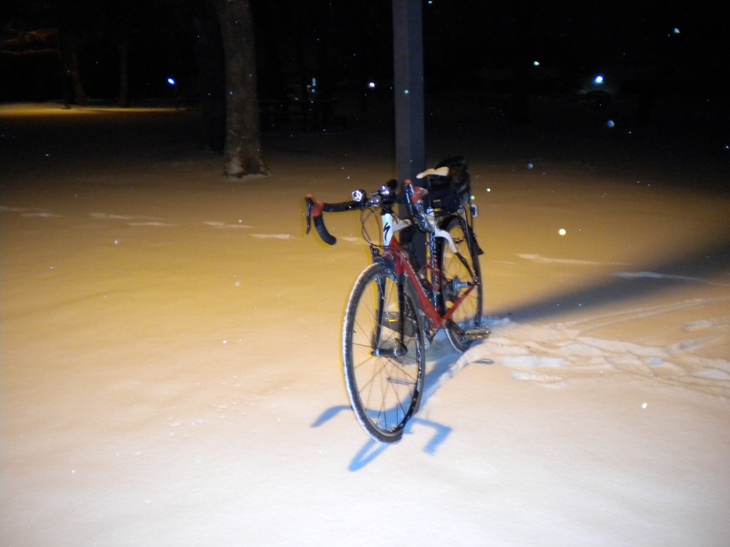
Frankenbike, Innocently Resting, Showing Why Kickstands are Often Extraneous

Thursday, February 17

Buddy Gets Urbanized

One Side of These Pedals are Platform, the Other is SPD. Good for a Longer Clipless Ride but Still Gym Shoe Friendly
Frankenbike is an assemblage of mixed parts from all over the world. However, Frankenbike is also a more obvious manifestation of what seems to happen to ANY bike I use a lot. Buddy mutates and changes just as Frankenbike does, despite being only two years old and considerably more up-market. In two years, Buddy has grown and shed knobby tires, sported various light and reflection accoutrements, grown fenders and busted them and regrown them. Buddy has also completely changed its braking, up to and including switching which lever operates which brake.


Now, Buddy’s gotten a little more urban. My recent experience with ice biking and daily cycling (even on the least torrid days in North Texas) has combined with my strong objection to carrying extra shoes along on a bike trip, like to simply ride my bike to the gym. A clipless approach works well for a transportation cyclist when the ride is long, traction reasonable, and there are appropriate shoes at the destination. On the other hand, platform pedals add flexibility. The reason I don’t like them for longer commutes is platforms are less efficient and don’t give me the security of knowing my feet will remain in the right place relative to pedals.

The solution has proven to be ridiculously simple. It’s shown in the photo at top. The illustrated pedals have SPD cleat retention on one side of the pedal and are a platform style on the other. Mostly these are available in a silver color, but I scored a pair in "high vis" black that fits the black and white and red themes that run throughout Buddy's frame and components. While I might have to do without the toe clips that are installed on Frankenbike and my wife’s bike, these new pedals allow me to ride buddy with shoes I’d otherwise have to carry separately, while retaining the clipless option. For my shorter commute and associated utility tasks, this makes sense. The road bike will retain its single-sided, magnesium SPD pedals. For cross racing, I’ll change back to double sided clipless pedals. If I ever got serious, I think I’d look at something like the “eggbeater” system.

I’ve also made other adaptations associated with the new commute. I’ve acquired some new bags and plan to put them to a thorough test when the weather gets to being warm instead of somewhere between frigid and pleasant. Still, I fear that I’ve gotten carried away for commuting purposes and risk getting into serious shopping territory. Still, in the words of the “Mythbusters” cable show, “If it’s worth doing, it’s worth OVERdoing.”

Buddy With Platform Pedals
Buddy With Double-Sided SPD Pedals and Knobby Tires
PS: Looking this all over, it struck me "YOU GOTTA GET PAST A BICYCLE FRIENDLY AMERICA. WHAT WE REALLY NEED IS A GYM SHOE FRIENDLY BICYCLE!" Hmm, maybe that would not be well received by people without a sense of humor...

Saturday, July 4

Frankenbike, Weekend Warrier

Frankenbike is an odd fish. It started out as a low-mid circa 1970 Falcon, complete with tubular tires and low end Campy components. Then it mutated. Currently featuring Shimano 7sp Nexus gearing, it features components from Belgium, China, England, Italy, Japan, Korea, and the United States. It also has different size wheels just to keep things from getting boring. Both tires do use the same size tube, however (I may be dumb but I'm not stupid!).

I've thought about a rack for Frankenbike, there's one out in the garage and it'd certainly be convenient for runs to the gym, but the Nexus drivetrain already weighs a ton & with a rack, there'd be little reason for me to give my wife's bike any exercise. Still, reading some of these other blogs, I may be seduced into yet another Frankenbike mutation. What do they say, wire is real?


Saturday, October 16

Nearly Got Away

Swap Meet was Held at LBS
Contrary to what I might like to believe on occasions, there are bicycle happenings around my location that are a surprise to me. As it turned out, I discovered yesterday there was to be a swap meet of old bikes this morning.

I don't often go to bike swap meets, but I do find it a joy to walk by old bikes and see the various ways people have preserved them and the different approaches the makers took to solve problems.

I took Frankenbike; the Falcon seemed in tune with the spirit of an old bike swap meet. The announcement may be found here.

Lots of Schwinns for Sale, Along With a Variety of Other Bikes
We walked through the parking lot and looked at all the bikes. While there were lots of interesting ones, all were either not what I was interesting in adding to the fleet, or were the wrong size.

Buckets of Interesting Parts
 Even the parts bins, while loaded up with cool stuff, didn't have anything I particularly need for any of my bikes.

Freewheel Crank!
Not to say there weren't things I didn't think about. Above was a bike that used a freewheel crank. The advantage of a freewheel crank is that you can change gears while coasting with derailleurs. No, this idea never did sweep the world, but it was interesting to see one.

Frankenbike attracted some interested looks as well. One vendor asked if I might be wanting to consider a trade for the Falcon, but I opined that Frankenbike was a "keeper." He nodded knowingly, but the Team Raleigh WAS a very sweet bike, as was a Cannondale. Both were quite affordable, but both were a skosh large.

Sweet Raleigh was just a Bit Large
 Anyway, after a few trips around to make sure I wasn't missing out on "must have" items, Frankenbike and I departed the old bike swap meet without having purchased anything. I thought I'd gotten away.

Tanks for Tank Bikes. Lights are Behind
And so it might have gone if I hadn't gone to our local non-chain coffee shop with my daughter. I'd gotten a little ahead and stopped to look at a garage sale. I saw a really cool Cannondale helmet, but it was too old (1996 vintage). ON THE OTHER HAND, that laser printer for the princely sum of $5 was irresistable. As a bonus, I got to ride the Gary Fisher for the rest of the trip. Those bikes with baskets don't handle real well with laser printers aboard, but we got it home without incident. Yup, we nearly got away. Now, we have a "new to us" laser printer as a result of visiting a bike swap meet.

Snagged by a Garage Sale on the Way to Get Coffee!

Saturday, July 25

Caution on Armadillos

In my previous post, I forgot to mention one downside to Armadillo Tires. They have trouble staying on old rims that don't use a "hook bead" configuration - and their pressure advisory specifies "with hook bead rims." No other tires I have say anything about hook bead rims. Most any bike that Doohickie gets by dumpster diving will not have "hook bead" rims. An old Motobecane, such as discussed here will probably not have "hook bead" rims. Most any bike built in the last 20 years will have hook bead rims. Frankenbike, true to its nature, has one wheel with hook bead rims and one without. ChipSeal's bikes certainly have hook bead rims.

There's a good discussion on "hook bead" rims in Effective Cycling. I have never had a puncture with Armadillos due to road debris or anything involving riding. I have, however, had three blowouts with them on non hook bead rims. The most recent occurrence was with a tire that had been mounted for several months, and had over a thousand miles on the tire. This failure is distinctive, since it typically occurs when the bike is not being ridden and the bead winds up outside the rim when the failure occurs (which sounds somewhat like a small caliber gunshot). It usually occurs soon after mounting if the tire isn't fully seated. I am extra careful when mounting any tire on such rims because of this.

I'm building up a new front wheel for Frankenbike. I saw more of sidewalks this morning on my return from a visit to Dallas than I want to see for a long time to come. Frankenbike will no longer have any non hook bead rims, but it will have acquired a French front hub.

Sunday, August 30

Frankenbike Mutates Some More

Frankenbike. The name is an inspiration to continually tweak. I've added some French and Swiss touches, in the front hub and the rack. In addition, all this rack & fender stuff caused me to add the English fenders, originally used on my French bike.

A note on the fenders, for those nostalgic for old bike things. These are "Bluemels Popular" fenders; made in England. They were quite popular in the bike boom era. Made out of plastic, most have succumbed over the years, though you can still get new Bluemels fenders, at least in black. Old ones are often on eBay. However, give me a good set of modern metal fenders. In this case, "free in the garage" beats buying new stuff. Other than the plastic, one negatory on the fenders is that toe clips can foul the front fender if you're pedaling when making a sharp turn. I'd forgotten that.

A note on the reflector. It's an SAE, from an era when inferior CPSC reflectors had not taken over. I plan to replace it with a 3" amber SAE reflector that I'll pick up from an RV place. You can't get those at your LBS, but they're MUCH brighter than official bike equipment when illuminted from any direction from which it might make a difference. At night, I'll run Frankenbike with a rear blinky in addition to the reflector.

A note on the rack. This is a Pletscher CS rack. It's got a spring, which is convenient for holding stuff like the lock and my bike bag that's got my gym clothes in it. I'm undecided whether to get a rack with a spring in it when I get one for Buddy. The spring adds about 0.4lb, which isn't a lot, but the spring is only useful when you don't have a bag on the rack.

Now I've got utility for the weekend, even if the roads are damp. And yes, my behind was a little tender this morning (somehow, I think Chamois Butt'r would not have helped - visit the blog here), but it was GREAT to be back on real roads...

Saturday, August 22

ABC Off!

Armadillo Still Mounted on Frankenbike's Rear Wheel. Sidewall Was SAD, but Tread Separation was the End of the Tire
I’ve been an ABC Quick Check Failure for many years. It isn’t that I don’t DO ABC Quick Checks, but rather that I typically make a mental note to “fix that later” as long as I decide it will not keep me from completing my immediate trip. Sometimes, that approach proves less than satisfactory. Sometimes, it merely allows one to combine multiple fixes into one session. I’m fortunate enough that this time, I got to do the latter.

This all started back in late spring. My rear tire on Frankenbike was flat one morning. Adopting my usual approach, I pumped up the tire and it held air just fine for my morning journey. The next morning it was flat once again. I pumped it up again and this time it stayed inflated for an entire week. After about four episodes, I decided that my wife’s bike needed exercise (she rarely rides it) and I’ve been using it for the entire summer. After some experience with it, I’ll make a future post about my summer with “modern” bike technology. Needless to say, while I was going through these gyrations I was making mental notes about truing my front wheel and adjusting the brakes, not to mention cleaning and lubing the chain. I also picked up a new tire; a low-cost Kenda.

This all came to a head this week when my three daughters came to visit. Suddenly, Frankenbike was needed for transport once again. I pumped up the tire, but unlike past episodes, this time, the tire went flat within a couple of houses and the kids were not really enthused about riding “Madeline.” Apparently, fixies are not everyone’s cup of tea.

To make a long story short, the family wanted to motor in to the big city (Aberdeen and Hoquiam) to go shopping. My request included four spokes and some rim tape. I already had bike chain lube handy. I provided the old, broken spoke so they could be sure to get the proper length. In due time, I had the parts, including an extra roll of rim tape (for reasons unknown). I set to work and discovered just how pleasant truing an old rim can be when you have a bike stand, a comfortable chair to work with, and you are not in any rush.

Now there ARE a few extra items that don’t entirely fit within the narrative. They include:
  • This is my second Armadillo tire that failed by separation of the tread from the casing. I am now “Armadillo-free” in Ocean Shores.
  • I discovered that rim strips, such as the Origin 8 I have onBuddy, are much less universal than rim tape such as the Velox I used in this repair. The Origin 8 does not come in a 27-inch size and I don’t know if the 700c strip would fit. I’m guessing it’d work fine since the rims are not that different in size, but when the “LBS” bike shop is 30 miles away, I voted for rim tape that’ll fit ANYTHING.
  • I used an ultrasonic parts cleaner to clean the chain. It worked OK, but I was wishing I had either my Park Chain Cleaning tool, or my trusty can of carburetor cleaner.
  • Shiny new spokes really make their 30-year old ancestors look LAME
  • I'm not sure if this is typical, but my new Kenda was MUCH easier to fit to the rim than any Specialized, Vittoria, or Continental I have recent experience with. No "must use hook bead rim" nonsense, either. It also seems that 28c wide Kendas are wider than 28c Armadillos.
  • While I was fixing stuff, I fixed my second floor pump as well (it had a failed pressure head) using the head from my lousy third floor pump. My favorite floor pump, shown here, is still in Texas.
  • Aberdeen, besides being the hometown of Kurt Cobain of "Nirvana" fame, was also the home of America's most prolific serial murderer; Billy Gohl. While there are no records of Billy's first six years of operation, 41 bodies were recovered in his last three years in Aberdeen.

Armadillo Tire as Removed and Ready for Trash. Note the Separation Between the Tread and the Still-Intact Casing
I'm Not Sure WHAT that White Spot is, but it was on the Inside of the Tread When the Tire was Removed


Monday, December 21

Elegance Counts Too

During the course of the last couple of years, I've seen lots of stuff on the Internet about bicycle commuting and transportation. Some of it extolls urban transportation riding as the apex of bicycle culture, some of it sneers at "casual urban" cyclists. I've seen claims that cycling will cost you under 10 cents per mile, with corresponding large savings over automobile travel. On the other hand, I've suggested myself that cycle commuting isn't something you do for purposes of saving money at all. If cycle commuting is for saving money, trash bin bikes, run on a shoestring, using replacement parts from Wallyworld and thrift stores are the order of the day. Its what I'd run if I were trying to absolutely minimize outgo. A step up for those not wanting to deal with getting a relic back on the road are big box stores. It's what you can see any day of the week, chained up at the back of restaurants almost anywhere. However, even in a transportation bike, elegance counts.

Before you read any further, this post is a Steve A foray into "bike culture." As noted in that post, I tend toward bike culture stuff when I haven't been riding enough. Commuting is over for 2009.

Bike Transportation Secret
In truth, the ideal transportation bike is quite simple. It's the bike that will make you dream about riding it to work, or to the store, or to go work out at the gym. It's a bike you'll just go out to gaze on before you got to sleep, just to look at it one last time. For some, it's a traditional style touring bike, such as a Pashley. Sometimes their enthusiasm even makes me feel a bit tempted. For others, it's a modern bike, or a mountain bike. For a few, it's a Bakfiets or Xtracycle. For me, it's Frankenbike and Buddy, but Buddy's the serious transport bike I take when I need to do the miles to work daily, in darkness or light, in all weather (even though I'm just a fair weather cyclist at heart).

Background
I first started riding to work in Texas back in 2004 (I moved here in 2003), using my road bike. It was a 19 mile commute to Vought in Dallas, and I only did it a couple times of week, and only during the longer days of the year. In 2006, I changed work locations and then began riding to work occasionally to Haltom City, using mostly older bikes. Starting in 2008, I got more serious and began to consider what I really wanted for transport. KEEP IN MIND that my transport considered only what I needed to make the trek of well OVER 10 miles each day to work. Had I been going a mile or two, or five, the criteria would have resulted in a different choice.

My Ideal Transportation Bike - First Element
There are two cycling books that have most influenced my attitudes toward cycling. Effective Cycling is one that I've talked about in this blog before. When it comes to how to ride safely, I've never seen anything that would cause me to criticize the opinionated old coot that wrote it. I've never seen any serious criticism of him in this regard elsewhere, either.  But there's another cycling book that has been at least as influential on me. To this day, I read it, though much of its advice is laughable and hopelessly outdated. That book is The Complete Book of Bicycling by Eugene A Sloane, 1970 Edition. My wife also got a copy. We keep hers, which is autographed. Eugene Sloane passed away just last year - of causes unrelated to cycling (cycling IS safe and fun), at the age of 90. My favorite chapter is "So You Want to Buy a Bicycle!" It's a window into a different time, when bicycles were more primitive, but more elegant at the same time. It predates mountain bikes. It's why I still have a French bike in my garage that I bought new in 1971, though the paint is worn clear off the chainstays, the right rear dropout is bent, and it's too big for me. It's why I now have an old Falcon. It's why I have two sets of tubular rims. That book drilled into me the first element of a serious bike - drop handlebars. All my own bikes have them. I've ridden bikes with other handlebar types, and they're pleasant enough. I may even back off someday. But not yet. In this, Forester in Effective Cycling didn't help. Forester also said drop bars are IT. I think both these guys are wrong on this, but I'm like the Pearl Harbor survivor that can't bring himself to consider buying a Toyota. As it is, shallow drop bars DO work very well for how I ride. Buddy's got shallow drop bars.

My Ideal Transportation Bike - Second Element
Sloane's book also instilled an appreciation for a second element I want in a serious bike. That second element is relatively light weight. I've never wanted the very lightest. Such bikes make too many compromises for serious point-to-point riding. They don't accommodate fenders. They don't have proper wheel clearance. They won't take racks. Many of them compromise braking - or stability - or durability - or reliability. But the influence still has power. A kickstand is, to quote Sloane, "at least a pound of dead weight." None of my bikes have kickstands. I still have the one that came with my 1971 bike, but it hasn't been on a bike for 36 years. It's why I'm fitting "quick change" fenders to Buddy, a bike that has places to attach fenders permanently.


My Ideal Transportation Bike - Third Element
Now we depart from elements contained in the book influences. I've moved beyond the love of a lugged Reynolds 531 or Columbus frame, and Campagnolo components, to an appreciation for welded aluminum with SRAM or Shimano shifters (actually SRAM rules & Shimano drools). Sloane also lacked an appreciation for the utility of braze-ons and places to bolt stuff. He was a reflection of the time in which he wrote. Forester, on the other hand, wanted to take out a torch and start brazing stuff on personally. Recently, I asked my LBS about adding braze-ons to Frankenbike and they laughed at me (there is a shop that can do it in DFW, however). My third element is that the transport bike should have enough provisions to allow it to mutate easily. None of this having to sneak a rack aboard using klugey clamps or such. None of this having to velcro a water bottle holder to the frame. Any bike that can't accommodate fenders and a rack in the basic design need not apply. That rules out most of the road bikes built nowadays.

My Ideal Transportation Bike - Final Factors
Once one specifies drop bars, light weight, room for fenders and racks, there are a few other factors. Number one amongst these are brakes. I want brakes that are capable of throwing me over the handlebars in a torrential downpour. My bike in 1971 once took two blocks to stop when I was going down a hill in the rain. It's why I'd never ride a bike with steel rims on anything other than a nice sunny day. Number two is some sort of way to fix one's feet to the pedals - either toe clips or clipless pedals. This, of course, is something that can be accomplished with ANY bike. For long-range commuting, I think SPD pedals are ideal. Number three amongst these are a solid feel to the bike. I like a twitchy feel in a road bike. It's what they're about. But a transport vehicle should feel solid and steady. It inspires confidence and purpose in the commute. Number four amongst these is that the bike has to "call out" to me. THAT is a combination of a lot of stuff. All together, these factors add up to the elegance of the bike I'm considering.

My Ideal Transportation Bike - Candidates
When you add it all up, there were basically two bike styles that remained after the criteria were set up; Touring frames and Cyclocross. Both were designed to travel all sorts of terrain. Both considered weight without being obsessed by it. Both had brakes. REAL brakes. Touring bikes all had good places to bolt stuff and they tended more towards the steel I'd grown up with and always appreciated.

Wild Card
As it turned out, I was led towards my current approximation of an ideal, long distance transport bike entirely by accident. One of my coworkers had a Specialized Tricross. What's more, he locked it OUTSIDE in the bike rack I passed by daily when I went out for a walk at lunch. Over time, I noticed the serious brakes, and the rack mounts. None of this impressed me overmuch - I had Frankenbike and I wasn't looking for a new bike anyway. Until I heard vague rumblings of a work move.

Looking
I started looking at Tricross. Tricross seem, to me, overpriced for what you get. I wasn't about to pay $1300 for a clunky Tiagra bike. What's more, over time, I've lost enthusiasm for triple front derailleurs for general use. I could get as much out of Frankenbike at 1/10 the price. I didn't see much in the way of used ones. Entirely by chance, I ran across a used, late model Expert in mid January. The Expert not only had a better specification, including SRAM shifting gear, but it avoided the drab look of the lower end Tricrosses. And the upgraded wheels made me drool. They were, simply, elegant. Buddy was it. I rode Buddy to work the first time in February 2009. It's been great.

Even Love Has Warts

Ten months of commuting show Buddy isn't perfect, but it's not real far from it. Rather than extoll its virtues, I'll focus on where it falls short:
  • Zertz Inserts - Despite what Buycycling Magazine may tell you, interrupting primary load paths with a hunk of translucent plastic isn't a road to paradise. I'd have to ride an equivalent bike without the zertz to know for sure, but I think Specialized Marketing won out over the engineers in the design. Trust me. I work on carbon stuff for a living. Carbon doesn't like making load go around corners like Specialized has done. If I ever need to replace the seatpost, I'll pick something without Zertz. I don't LIKE those popping noises I occasionally hear over rough roads.
  • Rubber Doughnuts - Buddy came with little white plastic doughnuts over the rear brake cable. They would rapidly slide to the back of the cable, with the cable marring the paint. When I switched the cables to a conventional bike arrangement, I went to rubber doughnuts. They work better, but it's still not reliable. One disappeared when I was in bike class.
  • Brake Pads - 3400 miles is a bit short for pad life in my book. Kool Stop pads might or might not last longer, but they're sweet in any event. Get the salmon color.
  • Frame Stiffness - While Buddy feels rock solid on the road, I occasionally get rear brake rubbing at times that suggest the torsional stiffness of the rear is less than ideal. Buddy also shudders on occasion when travelling over heavy gravel, and then keeps going. It's a "solid shudder" if that makes any sense.
  • Balance between cost and "perfect." - That 10 cents per mile is tough to achieve with a bike like Buddy. Buddy's about the most expensive bike with a chance of hitting that target. I think I'll get there.
  • Mileage concerns - Buddy is the first bike I've ever owned that I felt any need to conserve mileage on to avoid premature wear. That's due to the cost - even though I bought used. You buy cheap and such things are of no concern.
That's about it. Specialized may be the "Pepsi" of the bike industry to Trek's "Coke," but Specialized has done a pretty darn good job with the Tricross, though if you go visit the Specialized website, you'll find it difficult to find. On the other had, something from Surly, Redline, or Masi, without the Zertz, and a little lighter, with maybe a light green frame color. Mountain Dew, so to speak. In the meantime, I'm going out to the sunroom to look at Buddy a bit...

Thursday, August 13

Frankenbike Tours Lubbock

Worse than bricks are bricks in traffic. But what would Lubbock be without a visit to see Black-Tailed Prairie Dogs in "Prairie Dog Town?" So I went. Really, bricks are better than Westport. I actually got a photo of one of the little guys. They look like squirrels without the bushy tails. Another item off the bucket list.

Coming back, I found a brick-free route and even saw some "Bike Route" signs. After I got back, I found a route map on the Lubbock City site. The one I rode on seemed pretty nice. Then we visited the Buddy Holly statue. Is Frankenbike ready for its closeup?

One nice thing about riding around is just trying different routes. Bricks are just one of the features. At least it appears Lubbock has no cobblestones. It also appears that the TTU bike lane craze has not infected the rest of the city. I can't say if the drivers are any nicer than our Tarrant County bunch, but they were polite and there were less of them. And Lubbock isn't as flat as you think.

According to our parent briefing today, I'm supposed to relax tomorrow while my daughter frantically struggles with registration. Sounds like a plan. Is there anything else to see around Lubbock? What time does the windmill center open up?

Sunday, October 3

Cycletherapy

Frankenbike, with Kermit Looking all Innocent
I took Frankenbike out for a couple of relatively short road test runs this weekend. Some things were as I expected and others were not. As expected, my left shoulder; seriously dinged on Monday, made some things more difficult when riding, but overall it hurt less to ride than it does to drive an automobile. Unlike the car, most of the action involving getting a bike from point "A" to point "B" involves fairly small body movements. There is no real major motion of the left or right arm. As it transpired, getting on and off the bike was easier than I expected and left turn signals were also easier than I expected, since a little wobble could be employed to help the old left arm up. Right turn signals, braking, and shifting with the right hand turned out to be a total nonissue. On the other hand, I did not expect to experience a general arm soreness that gradually accumulated. It appears that long rides are not in the equation until the left wing heals a bit more. This seems a doubly wise policy because, while normal bike handling is pretty much normal, I'm not confident I could perform emergency maneuvers at 100%, and didn't feel like doing parking lot drills to verify the impression.

Saturday, January 30

Resolutions Doomed to Failure

Car Parking Lot at 24 Hour Fitness in Bedford, TX in late January
Look at the photo above. This was the parking lot of my gym at a little after 10AM on Saturday morning in late January. Lots of people drove to the gym to implement their new memberships and to get fitter or whatever in the New Year. I think this is pretty typical of gyms this time of year.

Now look at the photo below. This is the equivalent crowd at the bike rack at the gym. Same time, sime day - it's just the camera swung around 180 degrees. Admittedly, Saturday had a fairly low score on the MM, but I'm surprised it didn't occur to ANY of the people, lined up to ride the stationary bikes, that they might reduce their total time investment by actually riding a REAL bike to get to the gym. If you were going to work out for an hour, you could cut that in half by riding instead of driving. Instead, they'll go less and less, until the parking lot gets back to normal. I guess people really don't ride their bikes, even when it saves them time. Personally, I wish they had those cool tropical drinks available for those of us lounging in the sauna.

Myself, I get to park right next to the front door, and the trainers quickly get to know any customer that bicycles in with a squeaky frog on his bike. My only time handicap is that if it's cold like today, I lose some of my time savings putting my "Randy in Christmas Story" layers on than if I did a simple "dash out to the car and shiver a bit until the heater kicks in."

NOW, there's a Tracy Wilkins twist to THIS post as well (that's two in one day). Last time, we cured him of groundless guilt for not riding to work on the one day the weather forecasters got it wrong. NOW we're going to cure him of the fixation he has to ride 20 miles whenever he gets on his bike. What he needs is a dividing line. The gym is just a bit over three miles from my house. Since I usually stop at Starbucks after going there, the total trip is about 6.5 miles. This is FAR LESS than the Tracy threshold. It is also far less than my own threshold for a bike ride, which is a similar distance. I figure if my bike commute is 20 miles, nothing less than that qualifies as actually going FOR a ride. However, I have no compunction at all hopping on Frankenbike since I DIDN'T ACTUALLY GO FOR A BIKE RIDE, I WENT TO THE GYM. Sometimes I vary this routine, and GO TO THE STORE. The secret is you really AREN'T going on a bike ride, you just don't want to be bothered to drag the car out of the garage. I help this artificial divide between "just going somewhere" and "riding" by only using cycling shoes an actual "ride." If I'm going to put on cycling shoes, I'm going to ride 20 miles or more.

Frankenbike, on the other hand, does fine with toe clips and whatever shoes I happen to have tossed onto my feet. I'm just going somewhere. While Andy Cline's "One Mile Solution" doesn't work very well in my neighborhood, I've adapted it to local conditions and just multiplied his number a bit. In case you hadn't guessed, I kinda like riding my bike - and also just using it to "go somewhere."

Bike Parking Lot at 24 Hour Fitness in Bedford, TX in late January
That Hedge is Even Closer to the Bike Rack than it Looks

Saturday, August 21

Kermie's Morning Out

I've NEVER Seen More Than Two Bikes at this Rack Until Today!
This week, it seems like everything has been busier than normal. School's starting up next week. School parking lots have been filled up and some of the roads along my commute route where NOBODY ever parks have been lined with parked cars. This morning, as is often our custom, Kermit, Frankenbike and I went on a little trip to the gym and we were shocked to see the designated bike parking filled up. If THIS continues, they'd actually have to trim back the hedge behind the bike rack.

Fortunately, the combination of my mini U lock and cable gives me wonderful flexibility in locking up Frankenbike, and I used the secondary securement point on the other side of the front entrance to the gym.

Note That the Mini U Lock Can Also be Used to Secure Things When it Acts as a Giant Padlock for the Cable
Afterwards, we were relived to see that, while things were busy at the coffee shop, bike parking was readily available, as always. This avoided getting Kermit grumpy. NOBODY loves a grumpy Kermie!
Kermit When Grumpy!
Coming home, in the never-ending search for smooth pavement, we made a few detours around the road reconstruction that seems ubiquitous this month, stopping only for a shot of the latest part of my commute route to be torn up, below. All in all, just a nice, pleasant, relaxing morning out for Kermie.

Now That They're Done Tearing Up McDonwell School Road, They're Messing With Cheek Sparger Road.
Definitely Not Real Bike OR Cyclist Friendly at the Moment!

Kermie's Taking it All in Stride; Enjoying the Morning Sun Before it Gets Hot

Saturday, September 12

Frankenbike Does Rain On Purpose

I try to avoid riding in the rain in North Texas. When I lived in Seattle, I often rode in the rain, but down here, it tends to make lightning when it rains, and I'm not a maniac.

However, I got a used trunk bag for Frankenbike yesterday, I have the fenders mounted, and today, was one of those "not real heavy but steady" rains that don't have sky-to-ground electricity. So we went out, initially intending to go to the gym, but diverting instead to a Starbucks run. The Tom Thumb Starbucks on Harwood has a great overhang, allowing relaxed consumption of the coffee while watching the precipitation.

It's been 30 years since I last went riding in the rain on purpose. Sweet.

It's different riding in the rain in North Texas than in Seattle. Around here, the rain is warm, the kind of rain you ride in tends to not be windy, and it's quite pleasant to ride wet as long as one's feet stay dry. In Seattle, hypothermia makes it necessary to stay a lot drier.

The trunk kept everything perfectly dry, despite the puddling evident in the picture. That would not have occurred had I had more stuff aboard beyond my gym clothes and U lock. Now I'm thinking that even if I don't get to use it all that often, riding in the rain is so fun that getting proper rain gear might be worth the expense. Dry feet, of course, are the first priority around these parts...