Showing posts with label road riding practice. Show all posts

Sunday, July 12

Only a Fool and No Fool

A few days ago, I was headed north in Ocean Shores and, what to my wondering eyes did I see other than someone on a bike headed against traffic. Now, that is not totally unusual by itself, but the wrong-way dweeb had a dog on a leash running alongside his bike. I thought about yelling out, but then the missive "only a fool argues with a fool" took hold and I simply shook my head in wonderment about whether the guy would fall due to the dog diverting his front wheel, due to the dog darting toward a nearby dear just as oncoming traffic approached, or simply due to some other cause. In any event, it did not seem like a teachable moment. I consoled reflecting on how cycling is fun and safe, even when practiced by someone completely clueless.

Yesterday and today, I saw more intelligent actions. Yesterday, I came across a black bear about three blocks from my Ocean Shores house. The bear saw me shortly afterwards and took off, not wanting to tangle with an apex predator on a Schwinn Cruiser. Today, the same thing happened when I encountered a coyote just south of our local IGA Grocery. These two were no fools!

For the record, the bear looked well fed. The coyote not as much, but not emaciated either.

Wednesday, October 1

Bad Riding Practice

It is probably for the best that Ocean Shores has pretty minimal traffic for the many miles of roadway it contains. Mostly, people come there, ride their bikes or bike rentals for a day or two and then go back to wherever they motored in from. Well over half of the people I see ride on sidewalks where such things exist, despite the fact that the city made sidewalk riding illegal. They ride on sidewalks even where there are bike lanes.

Where there ARE no sidewalks, it seems almost random the way people ride. Some follow the practice of hugging the right edge of the road. Some ride off the right edge. Some ride in various places in the left lane.

The top photo initially seems to portray two cyclists riding abreast. A closer look at it shows that the boy is actually off the road in the gravel.

The bottom photo, taken moments later, shows the truth about the other person on a bike. I'd really like to hear how you'd pass these two safely...


Wednesday, March 19

Signs of Spring

Light WAS Turning on Just Before 7AM Until DST Appeared
Different places have different clues. In Ocean Shores, a sign is when the residential light-activated lights turn off in the morning. That time gets earlier until DST shows up, after which it isn't a challenge to get past before the light turns off.

Another sign is the reappearance of tourist bikes.

Full Lane Change (and a bit more) to Pass This Bicycle. What Does the "Extreme Right" OS Muni Code Mean Here?
The final and definitive sign is the restart of Ace Hardware Store bringing out of LAWNMOWERS in the morning. Who says Spring is an unmitigated blessing?


Lawnmowers Reappear at Ace
 

Monday, June 20

Why Steve Doesn't Do Many Videos

Inspired by various and sundry videos, I decided to make yet one more. I did a simple right turn onto a seven lane arterial and then through an intersection. It reminded me that I really need to get some improved software and a proper way to mount the camera. Still, despite the apparent swerves (I held the camera in my right hand so I appear to swerve right whenever I signal a rightward movement), it shows that intersections are not really a big deal. The intersection in question, however, gets much more plugged up on weekday afternoons. That makes it no more difficult to get through the intersection, but the initial turn on to Central can take a while to allow for a gap in traffic

Friday, January 21

Waddle Waddle Pass on the Right - Or Not

The very first post I ever made on this blog; "Duty, Obligation, Courtesy," concerned much the same topic as I treat today. However, this time I actually made some photos to illustrate the principle, and this time the motor vehicle in question got treated a tad shabbier. I imagine a few readers have dealt with similar situations (or their mirror image), and some have not. Anyway, here's the story.

Typically, when stopping at a signalized intersection, or an all-way stop, I will stop roughly in the lane position as shown in the first photo below (we're talking about a "narrow" lane, meaning one that is under 14 feet wide in Texas). I stop there, rather than a position more to the right because any motorist coming up behind me is in ABSOLUTELY NO DOUBT that my intent is to proceed straight through the intersection when the light turns green. If it is a 4-way stop, it reduces the temptation to pass me while I slow to a stop for the sign (who says it is only cyclists that blow stop signs?).

Where I Stop if I'm Proceeding Straight
On occasion, a motorist comes up behind me while I am stopped as indicated above. Sometimes, the following motorist will intend to make a right turn at the intersection. Sometimes, the motorist was simply not paying attention and failed to change lanes so he/she could accelerate ahead of the annoying cyclist when the light turned green. The clever and smart ones take advantage of the government-legislated equipment in their motor vehicle and actually signal a right turn. THOSE ONES get the full deluxe treatment, as documented in my very first post. They usually even get a "come on" wave, despite my now conflicted emotions about encouraging what may technically be illegal behavior by my motorists. Heck, the conflict is pretty small. A motorist that comes up behind me and actually has his/her RT signal on gets the full waddle waddle movement of my bike to the left, followed by a little "come on and make your turn" wave.

While passing on the right within a lane may or may not be legal for a motorist in Texas, and it CERTAINLY would be illegal if Texas had a three foot passing law, but it is perfectly safe for us both, even if there were only a few INCHES of clearance because I can always sketch over a tad more if needed. This is one of the problems I have with such a "feel good" law. It doesn't cover the variety of situations we all encounter in the real world. After these encounters, I have almost invariably gotten a "thanks" wave from the motorist as he/she makes the free right turn. We both know the situation. I figure the next cyclist that motorist encounters will get just a tiny amount of extra courtesy in return. Certainly, the next cyclist is not likely to be harassed by the motorist. Even if the motorist was clueless, the others stopping saw and registered a cyclist being courteous to a motorist. Or so I'd prefer to believe. While this may not be the "respectful level of political discourse" that the LAB and left-wing politicians ask us to engage in, it's at least a tangible contribution to more harmonious road usage by cyclists AND motorists.

Anyway, not to belabor the point any futher, I have a "illegal pass on the right wave policy." Specifically, I encourage the motorist to move forward if they have clearly made his/her intent known by signalling. If the motorist doesn't signal, I still will go "waddle waddle" over to the position indicated by the second photo, but I don't wave them forward unless I actually see a signal. Today, I didn't see a signal from the SUV so I didn't wave after the "waddle waddle." But it still inspired me to stop at a place where I could get a couple of shots to illustrate the situation without getting traffic all messed up.

Two Waddles Get Me From Stop Position to
"Come Forward and Make Your RT" Invitation Position
PS: In case you were wondering; the motorist in the bottom photo did wonder what the heck the crazy cyclist was doing parking his bike in the right lane at a stop sign and taking pictures. I waved nicely and got my bike the heck over to the side of the road to remove that conflict in the motorist's mind. One must admit that it is not every day that there's a bike without anybody aboard "blocking progress." BTW, there were no geese harmed in the making of this post and no honking, either...

Wednesday, October 20

Simple, Really

Hardly Any Motorists are Dumb Enough to Try to Pass This Guy Without Illegally Crossing the Double Yellow at Least Some.
My Theory - Since It's Illegal Anyway, You Might as Well Just Make a Simple, Full Lane Change and Be Safe
Today, I drove to work. Although the weather is near perfect, I had to go to the doctor to get my arm shocked in various places to see if my nerves still worked. I'm happy to report that, as I suspected all along, my shoulder "got zinged" and no more. The doctor liked that term.

Anyway, on the way home, I was fortunate enough to see a guy riding a bike on a road like many of those I use on my way to work. Unlike me, he was hugging the right line. Mostly he was further right than it appears in the photo. He was also slow, probably because he was climbing "Mount Pleasant Run Road." Most places, this would be a small rise, but we like to exaggerate here in Texas and hence the name I just made up.

You can see how most of the motorists passed him, though I did see one aborted attempt to pass him without making a lane change. Dumb. Really, on a road like this, there seems little advantage to doing anything other than ride in a lane position where even the dumber motorists realize right away they'll have to change lanes to pass. If a "train" of cars develops due to the rare motorist that's afraid to illegally pass, there's always the option of signaling a turn into a driveway where the "train" can be allowed to continue on their way.

When it came to my turn, I followed my own passing advice and I waited until it was safe to MAKE A FULL LANE CHANGE. Since oncoming traffic was heavier than usual, it took me almost four seconds of temporary delay. I will admit that four seconds seemed like a LOT of delay - and I half expected the guy behind me to honk at me. The pass itself was simple and uneventful. Just make a full lane change no matter WHERE the cyclist is riding. I did catch up to the car you see passing him at the four way stop sign a few hundred feet down the road, where my four second delay meant I only had to wait for TWO cars in front of me to go before my turn came. It seemed pretty trivial at that point. Oh yeah, I guess my full lane change was also illegal since there was a double yellow line, but it was no more illegal than the other motorists that straddle passed, and I didn't give the guy a close call story to tell to his friends. My total net delay due to the bike? Zero. Total net delay to the impatient guy behind me who didn't follow my example and only did a straddle pass? Also zero.

This is an example where the "safety in numbers" theory actually has merit. If motorists encountered more cyclists in situations like this, it'd become obvious to all of them they ought to just pass as if the cyclist was taking up the whole lane no matter what.

PS: If someone thinks you ought to have a EMG/NCV, you should know that you're doing well if you twitch a lot when they shock you. From videos I've seen, it is much nicer than getting Tasered...

Wednesday, September 22

Loneliness of the Long Distance Yeti

Yeti Come in Various Forms. This One Doesn't Look Like a Cyclaris Vehicularis
I’m not a vehicular cyclist. I’ve said it before on this blog, though perhaps never quite so bluntly. I've also talked about various aspects of vehicular cycling (VC). Other than occasional recreational forays, I ride to get places – mainly commuting. When I ride on roads, I operate under the rules of the road that apply to people operating on the road. I ride consistently, assertively, and in a way that makes it as easy as possible for my motorists to understand and know what and where I am going to go next. That gives them the information essential for them to be able to safely and efficiently go where THEY want to go next. I do not violate the principles taught in Bike League cycling classes, in Effective Cycling, or Franklin’s book (well, except those Limey types ride on the wrong side of the road). It’s not hard. It took me a day or so to implement the fundamentals, though I continue to learn useful bits, just as I do when I drive the Land Rover. I’m not a vehicular motorist, either. I just use a vehicular approach when I drive the Land Rover on or around a road.

I have been watching carefully during my commute to Alliance Airport for well over a year to see others riding this way. I’m sorry to say I have never seen a single one in thousands of miles of my commute. I’ve seen people riding on sidewalks and shooting across intersections. I’ve seen people riding the wrong way on busy roads. I’ve seen people riding in the dark without lights. I’ve seen people make left turns from the far right edge of the road without looking first. I’ve seen people hugging the fog line or curb in lanes too narrow to share with any four-wheeled motor vehicle; sometimes while riding very quickly. I’ve even seen them hug the curb on a busy road while riding with no hands on the handlebars. And that’s not even counting the signal/sign violations that motorists complain about in newspaper comments. The more I see, the more I marvel that few people on bikes suffer painful and bloody deaths. It seems we underestimate the competence of motorists, or overestimate how aggressive motorists are towards cyclists. Perhaps we do both.

Cyclaris Vehicularis. Not in a Texas Summer
In fairness, I HAVE seen people ride the same way as I do. I’ve seen safe riding in bike school. I’ve ridden WITH a few Yeti (cyclaris vehicularis), and once, on a weekend, I saw someone assertively operating by vehicular rules. My daughters have seen people riding this way on three other occasions when I was not present. Rantwick managed to make a somewhat ambivalent video he claimed was a Yeti. Still, even if we accept these sightings as factual, they are few and the scofflaws are many.

IMO, the scofflaw majority seems to be a major factor why many motorists are skittish around cyclists. Mostly, motorists see people on bikes doing clueless, unpredictable, and dangerous actions. If I never see any operating according to best practices – and I’ve been looking, why would a motorist expect different? If you have never seen a cyclist stop for a stop sign or control a lane, it can be momentarily confusing as to what to do when one DOES. I consider it fortunate that the motoring majority “get it” and instinctively understand the “behave as a vehicle and be treated as a vehicle” principle. They just never see it. If they DO see it, it occasionally scares them.

Bike Education has a very long and steep hill to climb. If I criticize the Bike League education program, it is not for the content of the education, or the enthusiasm and ability of its instructors, but rather its failure to solve the problem of how to reach the masses of cyclists who could be helped.

Wednesday, August 25

Shoulder Shunned

Looking Northbound, the Shoulder Isn't Bad, but I Ride this Road Southbound, Where Driveways Line the Road
In my post, here, I related a case where I ride a shoulder. On my route home, depending on the wind and traffic signal combinations, I ride southbound Precinct Line Road, south of North Tarrant Parkway. This road HAS a full width shoulder of about twelve-foot width, but I have never ridden on it. What’s the difference compared to the previous post?


First, this road has some driveways and possible crossing conflicts that would affect me more if I were riding on the shoulder.

Second, I’ll be turning left a half mile up ahead.

Third, I know, from signal timing, that a wave of cars will begin to pass me right about the time I need to be serious about getting into the left turn lane, and that doing so will be tougher if I’m not partway over at that point.
Each of Those Mailboxes is a Driveway and a Potential Crossing Collision

As I have noted in this blog before, motorists tend to get crabby when they see a cyclist riding in a traffic lane when they see a “nice alternative.” ChipSeal discovered that police are motorists, too. However, I do not run into problems on Precinct Line with people honking or otherwise getting flustered by my presence. Partly that is due to the relatively short distance I ride on it, but it is also because I have refined my signaling to take advantage of the traffic wave and signal timing combination. Commuters really DO have an advantage! Here’s what I do. Basically, I wait to make my right turn onto Precinct Line until immediately after the waiting southbound wave of cars receive their green light and clear the intersection. This gives me the entire road to myself for the better part of a minute, other than the odd motorist that also turned onto Precinct Line from other roads. Such motorists invariably have other things on their mind other than honking at a cyclist.

Towards the end of this period, I begin to prepare to move left into the left hand traffic lane. I signal well in advance of what might be strictly necessary. I do the early signal because any signal made by a cyclist seems to hypnotize any motorists that see it, erasing any aggressive inclinations they might otherwise posses. Invariably, they hang back a bit (it is obvious they are waiting) and get treated to a “thanks” wave from me as I move into the left lane. Often as not, they wave back. If I’m lucky, there will be a distracted one that I get to wave past before I make my shift into the left lane. That is fortunate because the ones behind the distracted one will be even MORE pleased to let me move left and I’ll be further down the road toward where I want to turn, so I’ll spend less time in the left and turn lane. Some of the clever ones actually move into the RH lane, so they can proceed more quickly in case the crazy cyclist is inclined to ride a long way in the left lane. At this point, so my motorists recognize I’m not now just riding in the left lane to be persnickety, I keep my left arm hung out continuously until I edge into the two-way left turn lane, and I’m sure all oncoming traffic knows what I’m up to. I’ll then typically drop my arm so I can use both brakes with maximum stability if needed (this is a place where it'd be NICE to have the front brake operated with my right hand!). If I have to wait, I signal more, so anybody coming along knows I’m waiting to make a left turn and not just standing in the middle of the road for the heck of it. Shortly thereafter, I complete my turn. The reality of it is much simpler than the description.
The Shoulder Also Ends at Each Cross Street

Friday, August 20

Lane Position Gone WILD!

A Cyclist has Three Lane Position Choices. Through Broken Pavement, Skirting it, or
Darn Near the Middle of the Road. Most Motorists Take the Third Choice as this Pickup Driver Has Done
Despite the Road Surface, Many Motorists Really Take the 45mph Speed Limit as a Directive.
I know there are some pretty savvy cyclists that occasionally peek at this blog. I know there are also some people that read this blog, on occasion, that are a bit nervous about the whole concept that one of your jobs on a bike is to help your motorists succeed in their prime objective, which is to not hit anything, and especially not you.

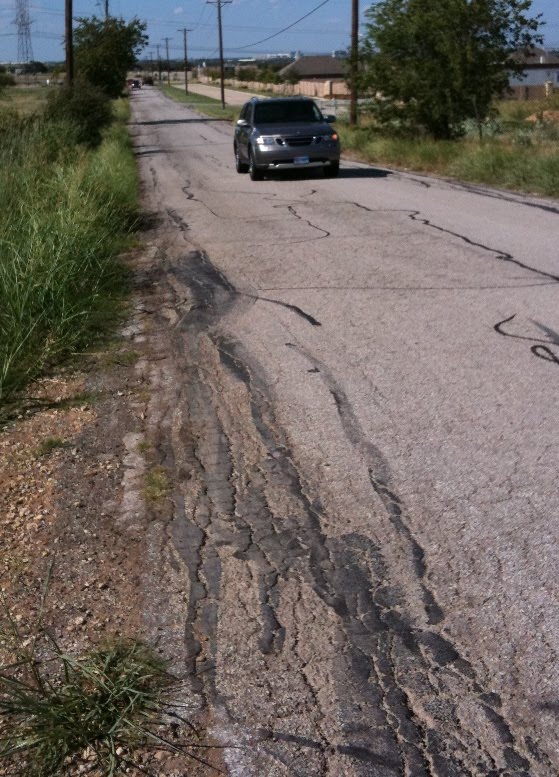
Mostly, this is a pretty simple task. The rules of the road are a simplified way for road users to communicate with each other and accomplish everyone's task of getting places with no crashing noises. However, sometimes it gets a little messier, like when a road is gradually getting beaten back into the earth by a combination of heavy use and patchwork maintenance. Old Denton Road in the far Northwest corner of Fort Worth is such a situation. It is like nothing in Effective Cycling. All in one place, the road dynamically functions as either a two-lane road with really narrow lanes and a brutal shoulder, or as a one-lane road with a lane wide enough for sharing.

This Pavement is Pretty Sad, as You can Judge
by the Shadow of the Wheel
I would be THRILLED to see how various people of BOTH extremes would ride up this road. You see, I don't think I have found any lane position that will consistently avoid close passes. Going DOWN the hill is easy - just ride far enough left that you get the sweetest smooth pavement, while allowing oncoming traffic enough room to avoid a head-on collision, and ride like hell. Any other lane position will result in some sort of ugly event whether motorists are in the vicinity or not. If you're lucky, you'll only break a wheel.

Going up, as you may see from the photos, Old Denton Road has become effectively narrow enough that it is almost a single-lane road. If I ride in my usual "line of sweetness," anyone passing will wind up hitting broken pavement with his/her left wheel, and I'll get close passes as a result. Broken pavement under the left wheels make motorists even more nervous than an assertive cyclist. As I observed this, I tried moving right, so that I was riding toward the right edge of the unbroken pavement; about four feet to the left of where the right edge of the road would normally be. It's where the left edge of the right tire track would be if everyone didn't just drive down the middle. This improved things, but NOW I get close passes from motorists that are, understandably, trying to avoid running on to the broken pavement to their left. I suppose I COULD just ride through the broken pavement myself, but that pavement is broken because people continue to go through it, breaking it down further. I think I'd rather shoulder the bike and walk up the hill than try to ride through that crud on a bike with skinny tires.
Riding Further Towards the Road Center Would Actually Give the White Car a Choice
Between a Close Pass or Venturing into the Broken Pavement on His Left (or Just Not Passing at All)

What would YOU do? Now, before you say "I'd take a different road," you should know there are really only three road choices to the east and south for Fort Worth Alliance Airport. One is Westport Parkway which I have talked about in prior posts, such as "Stinky Road." One is the Alliance Gateway Freeway, which I DO ride on the way TO work, but it represents a bit of a detour to go home, and it also has a lot of traffic in the afternoon. Old Denton Road is the third. One GOOD thing about this stretch is that I always feel like I've accomplished something when I reach the crest of the hill. At that point, it turns into a massively overbuilt four lane road with a median, right after I turn off to head east. The four lane portion has the same 45mph speed limit.

The SUV is Just a Skosh Towards the Center of Where Most Motorists Would Choose When Passing a Cyclist
HE was only Passing a Cyclist Standing off the Edge of the Road Shooting Photos.
I'm Pretty Sure this Big Boy Would Have
Been a Foot or Two Further Left Had I Actually Been ON the Road

Another Shot of the Pavement Nearing the Ridge. Up Ahead, SMOOTH Pavement. YAY!
and Things Get Simple Again

Looking Down on the Tricky Part. Going Down, I'm usually About Six-Eight Feet Left of the Right
Road Edge and Accelerating. Prevailing Wind Helps the Downhill Run

Wednesday, July 7

Bike Guy Ahead

I’ve often thought that a useful part of a cyclist’s education should be to drive a motor vehicle on local streets; deliberately examining the motorist/cyclist interaction from behind the steering wheel, so as to better understand that interaction when cycling. I think better understanding of what an overtaking motorist sees and experiences helps the cyclist’s confidence and safety in traffic when riding. It’s something we practice in our family Driver’s Ed program, described here. I’ll often say – “there’s a cyclist up ahead where that sign is; what do you do?” Mostly, the correct answer is “make a full lane change to pass.” Maximum clearance is safest for both the motorist and the cyclist. It's also simple and easy to remember.

Serendipity Leads Me to Follow a Bike Guy
Today, I drove to work. After yesterday’s thunderstorms followed the forecast 30% chance of rain, a 60% chance this morning left me thinking it was a good day to drive. It turned out to be a blessing, because I encountered a guy on a bike on Cheek Sparger Road. Cheek Sparger is part of my commute route. It’s a quintessential North Texas, suburban, narrow, two-lane road, with a double yellow stripe down the middle and no shoulder. I have never encountered anyone before on a bike when driving on Cheek Sparger. One of our managers told me he partly had his job because his predecessor was killed on a bike on Cheek Sparger. No details. Just bike and killed.

Cars Ahead Pass
This morning, I saw a line of three cars up ahead. Then I saw the bike guy, in his spandex uniform, riding between the RH tire track and the white line at the edge of the road. One by one, the cars in front of me passed him, as I watched in fascination; taking mental notes on the interactions. Two of the cars passed him by making a full lane change across the double yellow line (not legal in Texas). I wished my daughters were along so I could say “see, those motorists did it right.” The third one made a straddle pass, giving him about four feet of clearance. The bike guy, on the other hand, was more or less stuck on course, probably just kind of hoping he wouldn't get smacked and hoping his intended courtesy would be appreciated. By this time, we were nearing a rise that obscured whether or not traffic was approaching from the other side. I’ll confess that the thought ran through my mind that I would probably only need to go a bit over the line to give him three or four feet of clearance. Doing so would have saved me nearly a second of time. However, I fell back on training. DON’T PASS UNLESS YOU CAN SAFELY MAKE A FULL LANE CHANGE TO PASS, AND ALWAYS MAKE THAT FULL LANE CHANGE, NO MATTER WHERE THAT GUY IS IN THE LANE – OR SHOULDER. As a motorist, it is unwise to depend on a bike rider to clearly send that message, because mostly bike riders don’t. So I hung back, accepting the one second of delay, until I could see what was coming from the other side of the rise.

My Turn Comes
When I verified it was clear, actually passing bike guy was simple and low stress, and I felt no guilt about breaking the law by crossing across the double yellow line. Recalling my momentary notion of NOT making a full lane change, I wonder what bike guy was thinking – was he really ignorant that he was instilling conflicting thoughts in following motorists, or did he somehow think it was safe for someone to pass him without a lane change? Maybe he swallowed the "three feet please Kool Aid." Perhaps he needed to practice a little motoring to clarify things. Either way, it reaffirmed the sense of helping motorists clearly understand how to best pass on such roads. Motorists do not practice such things, and do not encounter cyclists on such roads often enough to become proficient. Uncertainty is NOT a good thing to reside in an overtaking motorist's mind.

Better Advice for Motorists
But that’s not all. In Bike League LCI educational material, the confusion is compounded by BAD ADVICE for motorists. It advises them to slow down when passing a cyclist. As I wrote to my LCI instructor, it would make me a little NERVOUS if a motorist slowed down as he/she passed, and would be physically impossible if that motorist had slowed to my speed BEFORE the pass. She agreed that particular advice might not be well considered. Sure enough, when I passed the guy on the bike, I accelerated smoothly while passing, so as to complete the pass quickly and safely; leaving the cyclist lots of clearance as I moved back into the line of travel. The principle was exactly the same as when passing any other slow moving vehicle, and is consistent with Driver’s Ed. Perhaps whoever wrote this Bike League advice for motorists ought to do a little motoring practice of his/her own. Or maybe retake Driver’s Ed. Better advice to motorists would be: "accelerate smoothly while passing, and make a full lane change to keep yourself and the cyclist safe."

Tuesday, May 4

Shoulders Make a WORLD of Difference

Texas Highway 170 as it Exists - Eye Line is About Where
I Ride - Following "The Land Rover Rule"
This Riding is OK? It's Either This or a Hike Through the Buffalo Pasture!
I see a lot of discussion about the shoulder on Texas 287, and whether or not Reed Bates AKA “ChipSeal” should have been riding on it. These discussions neglect the way Texas and its citizens treat these highways and “Farm to Market” roads, many of which are built to similar standards. In truth, the presence or absence of a shoulder makes a difference to any cyclist traveling on a high speed road right of way, regardless of his or her choice about where to ride within that right of way. This post does not address whether a cyclist should ride on the shoulder or in the traffic lane, on a high speed road, when that road HAS a shoulder. My personal opinion is that circumstances vary, and the safety call should remain with that of the person whose butt is on the seat. THIS post addresses how the presence or absence of a shoulder changes things in a real and tangible way.

I ride the Alliance Gateway Freeway each day to work. Texas Highway 170. The portion I ride is much like the high speed portion of Texas 287 Reed was ticketed on, except that it has evolved beyond where Texas 287 is today. Texas 170 has THREE lanes in each direction because its shoulder was converted into a third traffic lane.

Texas Highway Planning Includes Shoulders
Many suburban and rural roads in Texas, like Highway 287, are constructed with two traffic lanes in each direction, but with an improved shoulder wide enough that the road can be easily converted to three lanes in the future if traffic patterns make it advisable. This is frequently done on FM roads in suburban areas. For example, FM 1709, in Keller, has three lanes in each direction. It was converted from five lanes with a wide shoulder to seven lanes around 2007. FM 1938 was converted in 2008. Both are on my commute route, but both were converted before my new commute started so I can’t provide a clean “before/after” narrative.

If Ellis County continues to grow, and traffic outgrows the four-lane 287, it might be converted to six lanes in the future. If that had already happened, Reed would ride in what is now the shoulder without complaint, he would not have been ticketed, and there would be no heated Internet forum discussions. So, what’s really different? It seems illogical to presume that Reed would impede traffic LESS if there were no shoulder; it also seems illogical to presume that what USED to be a shoulder has suddenly become safer for him.

Four Reasons Why Shoulders Change Things for Cyclists
The first is that motorists are much more accepting of ANY cyclist (or other slow traffic) riding in a traffic lane if they do not see a “nice” alternative. I have NEVER been harassed in any way or honked at while riding on Texas 170. I have NEVER experienced a close pass while riding on Texas 170. There are two other bike commuters in my building that also ride that road. Their experience is identical. If the road suddenly acquired a “nice wide shoulder,” does anybody think I’d be able to say that if riding the traffic lane and NOT that shoulder? I never claimed my motorists are entirely rational.

So, what ABOUT that shoulder/lane? At the instant the shoulder is converted to a traffic lane, changes take place. The most obvious is that motorists start to legally use the new lane. These motorists keep it swept free of debris. It also causes some cyclists to experience nostalgia for the “good old days” if they previously preferred to ride ON that shoulder. Given a choice, some might decide to take alternate routes.

The third change is less obvious – at the moment the shoulder is converted to a lane, it enters the primary attention zone of crossing and overtaking traffic as PART of the roadway. If you are a motorist looking to cross such a road, your strongest attention will (and should be) focused on the traffic lanes, because those are where the danger lies. Any shoulder gets less attention, because traffic is only rarely ON the shoulder. In truth, this affects ANY cyclist riding on a right-of-way with a shoulder, because he has a choice between riding on the shoulder, where people have a reduced attention focus, or the lane, which people pay a lot of attention to but where they have been conditioned to expect a cyclist will not ride given a “nice” alternative. The perception of these relative risks, along with the debris, is why different cyclists will make different choices and why those may change with differing traffic situations. In truth, there truly is NOT one answer that is correct for all situations, which is partly why the law provides discretion TO the cyclist. I hate to say it, but Texas lawmakers DO get things right some of the time. It’s also why veterans survive better than new cyclists.

The fourth change is subtle. When a shoulder is converted to a traffic lane, maintenance changes as well. The traffic people now must keep that former shoulder up to a standard compatible with the rest of the road. Road users get really NASTY if two lanes of a three lane road are smooth and nice while the third lane shakes their teeth out, or it suddenly becomes a turn lane with no warning signage. Cyclists riding between Waxahachie and Ennis are rare enough that flats and discomfort on a shoulder do not get politicians thrown out of office. While I have not done any formal study, I suspect shoulders used in the HH100 receive a LOT of attention in the weeks prior to that event.

Aggies Say “Break ‘em Off!”
So, how might Texas “fix” Highway 287 and make it safer for cyclists? Well, one solution would be to simply amputate its shoulders by converting it from a four lane road to a six lane road. Texas does not do this for one simple reason – traffic volumes on Highway 287 south of Waxahachie do not justify that expense. Given the distances in rural Ellis County, dedicated cyclist infrastructure is not a real practical notion. I guess the other solution would be to figure out how we can all share the road harmoniously. I will leave THAT to the cycling forums!

Texas 170 if it Were Striped the SAME WAY as Texas 287
Where ChipSeal was Ticketed - Exact Same Riding Position
In What Way is Traffic Impeded Differently by the Cyclist?

Monday, May 3

Daily Mistakes

Anita, Ready to Turn Left on FM1709
Both Photos from Google Streetview
In my post, here, I mentioned that I make mistakes every day on my commute. Recently, I was northbound on Anita in Keller, waiting in the left turn lane for the light to change at the intersection of Anita and FM1709. While waiting, I didn’t hang my left arm out to dispel possible confusion amongst the southbound left turning motorists across the intersection about my intent. When the light changed, the lead motorist hung back a bit, knowing that cyclists will often behave unpredictably. Making the best of my failure to confirm my intentions ahead of time, I made my left as obviously and quickly as possible.

The same day, as it turned out, I had to come home early. On the way home, I encountered a lot of “pick the kids up from school in the car” parents that I rarely encounter. Adjacent to one elementary school, I had to make a left turn. I had my left arm out (not wanting to repeat the morning mistake). It took me several extra minutes to make my left due to the repeated “nice” people that wanted me to turn left in front of them, and who were reluctant to exercise their right of way. Perhaps it was the elementary school context, though I am pretty clearly not an elementary school student. Eventually, there was enough of a break in the traffic for me to turn without giving in to the “cyclists never follow the rules” stereotype, and before those behind me decided to try passing on the right out of frustration. The next morning caused me to reflect on that decision, and its relationship with “the Land Rover Rule.”

That morning, it was wet and misting. I elected to drive the Land Rover to work, and stopped by an outlet of a major coffee chain. Leaving the parking lot, I waited to make a left, and was waved on by someone in a Toyota Land Cruiser. I gracefully went, mentally noting the comparison to me NOT going yesterday afternoon on the bike. Had I been riding my bike, I’d have waited, waving the lady on, and maybe even have put my foot down if necessary.

The point is, it is sometimes difficult to know what is the right/best thing to do and what is overreaction. It can be a fine line between being a road user that is clueless and one with a chip on one’s shoulder.

Woodland Springs Elementary School Intersection
Lots of Parents Oncoming when School Lets Out!

Tuesday, April 27

Follow Up Report on Yetiness

Back here, in March, I made a report on the 20 minutes it really took to get across the basic points regarding safely operating in traffic in a vehicular manner. The cyclist, we'll call her "Linda A," has now been riding this way for better than a month. Following is her follow-up report, in her own words:

Okay, here is my report on a convert to vehicular bicycling. Is that what it is called? Anyway,

I notice that when I actually drive, er, I mean ride like a bonafide vehicle on my bike the cars actually move out of my way. I feel safer, kind of. I still have fears of getting rear-ended, but those are offset by no longer fearing getting broadsided by some car coming from my right out of a side street as I'm cycling in the glass and dirt-filled gutter, er, I mean bike lane.

I learned to ride my bike in the traditional ways, way back when Seattle was a sleepy town and traffic was reasonable. On the side of the road. What I've noticed since I've gone vehicular is that when I am actively doing it I am much more alert. When I slip into the other mode I kind of space out. In my younger days I actually rode into more than a few parked cars, and collided once with someone's car door as they opened it up on me while I was riding down University Way, along the side of course.

I have to relay one experience; the other day I was riding vehicular, fully occupying the lane and feeling much more on top of things when a truck passed me, and the passenger yelled something very nasty out the window at me. I didn't feel defensive or angry. I actually felt calm and in charge because I knew I was doing the right thing and following the rules. At the stop light I caught up with the truck, and then passed him later. The passenger never yelled anything more, and there was no incident. I think it was because they realized I was not a problem or threat -- simply trying to get somewhere just like them, and not taking that much longer either!

So, we will see as time progresses. But I love being able to make my left hand turns more easily, and I feel a lot less like I am in traffic limbo. I also have more control over avoiding potholes, and my tires will probably last longer not being in the bike lane where all the road grit and broken glass accumulates.

So that is it for now. I'll keep you posted. Thanks Steve, I think it really has helped.


Linda
 
SO, what's this about these collisions? HMM? I must say I admire the restraint "Linda A" showed in her experience with the truck. I'm working on dealing with rude drivers pleasantly (even THEY are my motorists), but the rare rude motorist still riles me up a bit, even though I KNOW the rude ones are outnumbered a thousand to one. Overall, I think this supports the hypothesis that cycling CAN be fun and safe! And yes, those tires WILL last longer. One of my Contis is now closing in on 5000miles.

BTW, Linda, I had a close call on Admiral Way in Seattle back in 1974. A car shot out of a driveway. Today, I'd have a lot more time to react and the motorist would be more likely to SEE me before darting out into the street.

Sunday, April 25

Eyes of a Motorist

Even Standing on the Corner, I Couldn't See Those Eyes!
I frequently see cyclists advised to “make eye contact” with motorists. I also see cyclists relate stories of a collision that occurs immediately after “the motorist looked straight at me.” Personally, I think “eye contact” advice is in the pretty useless category. Collisions occur because two objects have a course that intersects a given point at the same instant. Should such a situation occur, whether the two parties are making eye contact is irrelevant.

Considered carefully, this would seem to be pretty obvious. All good road users look at LOTS of different things as they proceed down any road. We look at the car ahead, we do head checks and mirror checks. We scan the side streets and the occupancy status of parked cars. There is a lot going on, and it behooves us to be aware to be safe. When I took driver’s ed, I was taught to keep my eyes MOVING.

Because there is a lot going on, IMHO, one should not depend on the results of an apparent “eye contact” as a primary indication of what a motorist intends to do next, and especially not if you are moving along the road when this “eye contact” occurs. Certainly, I try to pay attention to what the eyes and heads of motorists that may affect me are doing, but I find it is usually only one indicator, among many, of what the motorist is going to do. When it’s dark, or I’m moving quickly, it is not usually even that. If I were to come up with my own oversimplified advice, I’d say “watch the wheels.” It’s much easier to tell if a car’s wheels are turning and moving, than to glean similarly useful information from a motorist’s glance. Best, of course, is to look at the total situation, and adjust your actions to protect against possible choices that can put you or your motorist at risk.

PS: Had I actually been riding, instead of standing and taking photos, this might have been a situation in which a "Quick Turn" might have come in handy. "Quick Turns" are a skill which can be acquired in Traffic 101, but which isn't used in daily riding. You might never need to make one on the road, but it is a skill that might save your life. I periodically practice "Quick Turns" in an empty parking lot.

Monday, April 5

Never Take the Lane

I hear the phrase "take the lane" often. I only hear that phrase in conjunction with cyclists. I DON'T ever "take the lane." Taking the lane, to me, sounds like petty theft. I ride where I ride, and the principle of "first come first served" is observed by myself, and the other users of the road. The lane I'm in is mine while I'm there. I don't need to "take" it. Yes, sometimes I allow motorists to "Lane Split" a lane I'm in if it's a wide lane or boulevard. That's my choice, and is made in accordance with the law, the rules of the road, and what is safe for myself and the motorists in the vicinity.

Really, it's pretty simple. Traffic is not a war. Traffic is a dance (good link, though I HATE the picture, with its sloppy signal). It's a cooperative endeavor. I DO take the lead, because I have a lot more experience dealing with motorists than motorists have dealing with cyclists. That's probably going to remain the case for many years to come.

Below is the preferred vehicle if traffic were otherwise. I don't think many motorists are truly ready for "might makes right."

My Vehicle of Choice if Traffic is War Instead of Cooperation. Just Pass the Ammo...

Friday, April 2

Cyclist Choice


Here and here, I talked about parking lots that I ride through on my route from home to work. With the ChipSeal Highway 287 thing, I’ll reveal that, at least one place along my route to work, I usually ride on a shoulder. What’s more, I’m not ashamed to admit it. I even discussed it with Chip, and I came away convinced he supports my right to ride on it in accordance with Texas Law. Actually, now that I think about it, given my current route to work, I could sound more dramatic to simply state that, on my route to work; I ride the shoulder at every possible opportunity. More to the point, just as Chip does on his rides, I make the choices that work in my riding circumstances, and I'd rather not be second guessed by others. It is my butt on the saddle.

In the photo, you can see the shoulder I ride on. It’s the only shoulder actually ON my 20 mile route to work (which is why I can say I ride on it at every opportunity). It is the shoulder of the northbound I-35W Service Road between Cabela’s and Westport Parkway, near Fort Worth Alliance Airport. It exists because there is a “right turn only” lane behind the photographer; facilitating entry into Cabela’s. In addition, a couple hundred yards back up the hill, there is a four way stop, so traffic coming down the hill is unlikely to drift onto that shoulder, having been woken up by the stop sign and the right turn lane. The stop also results in a debris-free shoulder. What’s more, the shoulder turns into a third traffic lane well before Westport. There are no driveways or crossing traffic anywhere. Off to the right is a large buffalo pasture. Anyway, there is little danger, whether I ride on the shoulder, or the right hand traffic lane. The left hand traffic lane is more hazardous (it would actually be legal for me to ride there since I’m usually the only one on this road), because traffic exiting I-35W can be merging into it at a high rate of speed. Anyway, my usual sequence is to turn right from Cabela’s, coast down the hill on the shoulder, making a head check shortly before the shoulder disappears into the new right lane. Shortly thereafter, I move left into the rightmost of the two hand left turn lanes as I approach Westport. I delay the leftward move until I can be sure I will not be endangered by people exiting I-35W. While it may seem odd, this overtaking traffic actually has the right of way over those they overtake. Some places emphasize this by posting “Yield to Ramp” signs. Basically, I treat the shoulder as just another traffic lane. Except on the rare occasions when trucks are parked on the shoulder, there is no discernable safety or other advantage to me to ride in that right hand traffic lane. On the other hand, I can’t imagine anyone would be terribly upset to actually see me riding in that right hand traffic lane, because I rarely see motorists in ANY of the lanes other than those exiting from I-35W. By the time those motorists see me; I am usually in the middle lane, looking left, and waiting for the ramp traffic to sweep by before changing into that left turn lane. This is a location I use extra caution with my left turn signal, because I do not want a motorist, flying down that ramp, to alter his/her course or actions. I flip the left turn signal out ONLY after the motorist has committed to an intended course of action (left, straight, right). Then we communicate so each of us get where we want to go with no fuss or muss.

Yes, I agree that riding shoulders is not something that is wise in the abstract, but like many "all or nothing" positions, I think the best policy really depends on circumstances. What's more, I believe the Texas Legislature agrees with me, which is why they used "may" in their wording about cyclists and shoulders. Some cop wants to charge reckless driving against ChipSeal for NOT using the shoulder. I'll oppose that strongly, and some might claim I oppose it beyond any rational point. Some ideologue that wants to attack me FOR using the shoulder, I'll oppose that too. Either way, I want to hear the facts and data that say why I am wrong, and they are right. This is a country that was purposely set up to support minorities and avoid extremes. I like that. And THAT is part of the point of THIS post. Yeah, I DO stand with Chip, and I think he stands with me as well.

Wednesday, January 13

Common Thread

Since New Year's, my commute has been uneventful. An uneventful, albeit long, commute gives me lots of time to think of different things to post about. Today, I pondered posting about how I fixed a wiggly Cateye headlight, or how it takes longer to get ready to ride on cold mornings, or posting about the motorist who last week passed very slowly, but otherwise safely (though illegally across a double yellow line), with his wife rolling down the window in freezing weather and pointing off to the right, saying something unintelligible; no doubt warning me against moving over too far towards the "Cyclist Pit of Doom" if I unaccountably abandoned the "line of sweetness." I also considered posting about some positive reinforcement I got this morning, or about how a comment by "cycler" almost tore my heart out. But it all came together in common threads.

First off, CommuteOrlando has an active discussion, here,  about "Roadway Terrorists." Next, I talked with a motorist who passed me this morning on the way to work. He joked about how I was hard to miss. I inquired if, seriously, there was something about my riding that made it difficult for him to decide how to proceed or if my riding made it harder for him to get where he was going. After consideration, he answered that, no, my intentions were crystal clear to him, he understood my signals, and knew exactly what I planned to do and how to drive to avoid any conflict or delay whatsoever. I quipped that if I understood him, the only way I was hard to miss, then, was if he was actually TRYING for an impact. He agreed that was the case. It was a morale boost that says I'm riding well when non cyclists don't have to ponder what I'm up to. Finally, came the item that made it all come together. In it, "cycler" commented:

"I got followed in a threatening way for about 6 blocks today by a dump truck pulling a trailer who was p-o'd that I was taking the lane because we were going down a smallish residential street with parking on both sides and an icy shoulder. He kept gunning his engine. I didn't have to look back- I could hear him, and it was very stressful for me. It didn't matter to him that I was going traffic speed- he wanted me out of his way, and as soon as I got into the bike lane further down the street, he passed me relatively closely and at a speed inappropriate to the size of the street.

"I basically agree with you I think about vehicular cycling being the best way, but I've gotta say it takes a lot of experience and a certain mental toughness to do it. I doubt we're ever going to get serious growth in bicycling if we can't provide some kind of infrastructure that doesn't require people to brave that kind of situation regularly, especially when they're getting started."

I first read the comment when I stopped at a store of "a major coffee chain based in Seattle" on the way home. It disturbed me, and I thought about it the rest of the way home. I considered that "cycler" did the right thing in not trying to move right - the trailer could have easily dragged her under its wheels, and the driver would not have appreciated the attempt at courtesy in any event. I also considered that the statement about experience is NOT correct - I made the final switch to riding vehicularly  in a single day. What it takes is an epiphany, which can occur with no experience or maybe never. Certainly experience can prepare one for vehicular cycling, but it does not lead to it. I know fairly new cyclists that ride vehicularly, and I know others that have ridden for a half century that do not. Those that have not experienced the epiphany are certain to be skeptical. I certainly was - until April 10, 2009.

Anyway, here's the common thread - jerks on the road get a lot of attention from cyclists, and, more seriously, psycho motorists are a weakness of vehicular cycling - being predictable is not a good thing when a motorist is determined to kill the cyclist - the predictable cyclist is easier to hit. BUT, the overwhelming majority of motorists are good people, that just want to go along, and get along, as is the case with cyclists. THAT is a common thread that unites road users of disparate types, and is a big factor in what some might consider "mental toughness" in me. If the crazies were anything more than a newsworthy but extremely rare fringe element, John Forester would not be alive today. This is really something to remember if an occasional jerk decides to try to push you around. If the jerk's a bully, he/she will back off if you avoid escalating the situation - which is something "cycler" avoided as much as she could - a "Keri Wave" might have helped or it might have made things worse. If the jerk's a serious criminal, the cyclist is in real trouble, since the jerk has abandoned all the rules of the road and of human decency. It might be small comfort, but a criminal might just as likely go after the cyclist on a sidewalk - or even out in an empty field.

Different people feel differently about various infrastructure for cyclists to use, and revised laws that may or may not help cyclists. It behooves us to remember that bad infrastructure and bad laws can always be removed later. What we all have in common is we want to get from point to point, and the public roads are what they are. Some motorists are ignorant, but almost all are well intentioned. As a cyclist, my suggestion is never to forget that your best defense when riding is to always ride the best you know how, wherever you happen to be riding. Make it easy for your motoring friends, and remember that the jerks are notable because they both rare and stressful. Thanks, "cycler."

BTW, your blog is pretty cool!

Wednesday, January 6

Motorist Lane Splitting

Motorcyclists Sharing a Lane with Motorists,
Commonly Called "Lane Splitting."

From Wikipedia

I can't say I'm a fan of the term "lane sharing" or "shareable lane" when it comes to cycling. It's applied almost universally, but, in reality, we're talking about a two abreast situation with one of the vehicles being a car and the other being a bicycle. Since, in most cases, this results in the passing automobile creeping at least onto the lane dividing line(s) to the motorist's left, this situation is precisely the reverse of the situation when a motorcycle passes a car without making a full lane change. THIS is commonly called "Lane Splitting." Yes, I've been diligently studying my "Proficient Motorcycling: The Ultimate Guide to Riding Well." According to wikipedia, which is where the photo came from, Lane Splitting is also called Lane Sharing. Hmm.

Words may not matter, but motorist lane splitting sounds a lot less friendly and safe than sharing. It also reflects the reality that splitting or changing lanes is the decision of the motorist unless the cyclist rides so that being split is not an option (as in the "Line of Sweetness"). Maybe it's because I grew up before Sesame Street. Anyway, going a bit further, all those "Share the Road" signs ought to be "Split with Caution."

I imagine other terms might be both accurate and descriptive, but "Lane Splitting" has the benefit of already being a commonly applied term. In the photo, if it were the motorist passing a bicyclist, indeed people would refer to it AS lane sharing.

BTW, people on bikes frequently lane split as well. Typically, it involves riding up along the right side of stopped traffic (with or without a bike lane), hoping nobody is going to turn right at the intersection or into a driveway. I know of nobody that thinks this is perfectly fine, unless there IS a bike lane. Somehow, that makes it all OK.

The multimillion dollar question is: Why is it illegal (except in California) for a motorcyclist to share a lane with a motorist but bicyclists are cited for not encouraging motorists to lane split?

Stepping back down off my soapbox...

Sunday, January 3

Where I Ride and Why

A long time ago, in a blog far away, in a post about riding in a Texas traffic lane less than 14 feet wide, I noted that as long as I rode AT LEAST as far left as the right-hand tire track, motorists ALWAYS altered course and gave me good clearance. ChipSeal, in his blog, suggests the superior place to ride is in the LEFT tire track, though he never actually addresses my own favored lane position. He noted it was a bit rougher in many places in the exact center of the lane.

Absent particular situations such as Boulevards, covered here, I rarely ride in the above lane positions. Instead, I ride in "the line of sweetness." In the "honk project," I refer to it as the "LC" position. Specifically, it's at the far right side of the Left-hand tire track. More or less. This is not rocket science.


Why do I prefer riding LC? Besides smooth pavement, it's very simple. It derives from "The Land Rover Rule." When I drive the Land Rover, my eyes align directly with the LC position. Seeing and reacting to a cyclist IN that position requires me to have no peripheral vision whatsoever. Should I (IN the Land Rover, of course), be texting, or putting on makeup, or simply daydreaming, LC is the position I am MOST likely to notice. At night, I'd see the annoying cyclist a full mile back. By the time I'm a half mile back, there will be no doubt I need to make a full lane change to pass the guy. UNLIKE the full left tire track, there will be no temptation to pass on the right, and it'll be easy to give him lots of clearance without running off the road on the LH side. I don't know about YOU, but I see a LOT of motorists chatting on their cell phones. I don't know about YOU, but I think the safe place to ride is where such people are likely to see and react to me early, not where the guy in the video below rides. It calls into question my previous assertion about the safety of that RH tire track. While all motorists may alter course, some alter course less that they should.


LC also accrues benefits when it comes to the more serious hazard of crossing traffic. In a more visibile position, a motorist crossing my path is much more likely to notice me when I'm where I'd be if I were driving the Land Rover. This pays dividends repeatedly, most recently on one of my last commutes of 2009, when a motorist, ahead and to my right, began to pull from a side street to make a left turn. Had I been further right, it could have turned into a close call - or worse. As it was, a simple yell from me alerted the motorist and, with extra space and time, we all avoided any unpleasantness or need for evasive maneuvers. I don't want close calls on my bike. Not ever. An occasional fall due to loss of traction might be tolerable, but nothing more serious than that.

There is also advantage with oncoming traffic. When I ride down the narrow two-lane roads around here, I occasionally encounter spandex mafia types riding the other way down the fog line. Often, they're trailed by a line of cars. I find these encounters stressful. The first thing in my mind is that if a motorist decides to pass that spandex guy, I'm at risk of death via a head-on because of the durn gutter bunny. In this situation, the advantage of LC is subtle, but very real. If I were riding at the right fog line, or even in the RH tire track, the oncoming motorists are MUCH more likely to pass, despite my oncoming presence. If I ride FURTHER LEFT, the motorists would not see me as easily as in the LC position, and I'd still be in trouble if they tried a straddle pass around the gutter bunny. Uncertainty is not something you should inflict upon the motorists YOU share the road with.

Anyway, that's where I ride, and why. So there. It seems to work, so I wonder why I have never seen anyone else (as in NEVER) along my commute route riding the same way. Mostly, I see people riding in the "cyclist pit of doom" position. My kids, here, claim I'm not completely alone, but there are a lot of people that believe in the Yeti. Few have seen one. Really, however, mostly this is a finer point (it really ISN'T rocket science!), because, unless you fall into the "Cyclist Pit of Doom," cycling really IS pretty fun and safe, despite what some might try to make us believe.

Friday, October 30

John Forester Talks Bike Infrastructure

Among other topics, he goes into the background of bike lanes, why Amsterdam and similar cities work for bikes, cycling on Seattle's Burke Gilman Trail, and other topics in a one hour talk at Google, with lots of Q&A. He's easier to listen to (talking mostly to an audience not previously exposed to vehicular cycling) than to read.


PS: Internet seems to be coming back - sorta anyway...