Showing posts with label motorist behavior. Show all posts

Tuesday, February 14

Try Traffic Engineering when Cyclist Solution Fails


Our garage equivalent of a painted cycle lane

Cyclists seem to delight in the notion that they can change motorist behavior with "education." Well, that might be so, but motorists are a powerful special interest and such suggestions go nowhere.


At my house, the motorists have trouble parking in the garage without hitting a post or straying over too close to the middle of the garage. I first tryed the cyclist solution of gently "educating" my motorists by installing a flower target for parking position as in the photo at the start of this post.


Well, the cyclist solution didn't work, so I took a "traffic engineer" approach and simply cut away the offending post. Fondly, I leave the flower in place as gentle encouragement. I think we won't see drywall on the front bumper any more...

Cutting away the post avoids problems (I hope)


Friday, August 14

Learning from a Non-Teachable Moment

This morning, I learned some things when I rode to get coffee. I didn't learn anything in particular from the ride, but rather from the fairly short wait in line at the drive-thru.

It started like this - I left for coffee here in Ocean Shores about an hour later than normal - at 7AM rather than 6. As a result, early-rising tourists were starting to line up.

As a result, I wound up behind a silver Chevrolet Suburban. Like many in line, the driver didn't think to turn off his engine while stopped. Perhaps he was afraid his engine wouldn't restart if he shut it off or maybe he was still a bit sleepy. Who knows? Anyway, it got beyond typical when his cigarette smoke also wafted back. It got even further beyond typical and created the "learning from non-teachable" when he tossed his half-smoked cigarette onto the curb near me close to the wooden siding of the coffee establishment in order to pull forward and order his beverage.

Not considering things fully, I inquired if he realized his cigarette was still lighted and if he wanted it back. As you might expect, the answer came back in the negative. Then I forgot about non-teachable moments and suggested he pick up his (expletive deleted) item. Before you knew it, his passenger came out of the SUV and said "I'll take care of the cigarette but don't cuss at my husband."

At this point, I memorized the SUV license plate number - something I should have done routinely.  This was my first learning from the non-teachable moment. I'll not repeat than number here other than to note the license plate holder was from Tacoma, despite the "Ocean Shores Cares" decal affixed to his back window. It's good to learn from such episodes to do something like routinely mentally noting licenses - just in case.

In my second learning I also learned that some people just think that we on bikes simply ought NOT to be in drivethru lines to start with, even if the walk-up lobby is shut due to a pandemic. Or perhaps they just don't think things through at all.

In my own defense, at least I had the presence of mind to not going beyond calling out that the Suburban shouldn't have been in the drivethru line either, and I also considered what I'd do if the Suburban backed up after getting coffee. Upon reflection, the notion that bikes should not be in drivethrus seems even more common than the notion that they ought not be on any kind of road. My third learning was what if the guy had a gun and even more anger issues? In other words, avoid escalation when dealing with a questionable stranger.

One thing I learned only after the SUV drove off - my barista noted that the SUV had an ash tray and if the driver was going to smoke in it he ought to use that ash tray. Golly, I hadn't thought of that as the passenger yelled at me about how bikes should not be in a drivethru.

Hmm...

Thursday, March 21

Bicycle Connections

Google Maps Satellite View of Where Patrick Francis O'Rourke was Killed on his Bicycle in 2001
As my loyal reader knows, Beto O'Rourke ("e" as in prounounced in the word "President," not "e"as pronounced in the Canadian word "eh') is from Texas and has announced a run for President. This post, however, is not about Beto. This post is about Beto's dad. 

Most people do not know that Beto's father, Patrick Francis O'Rourke, was an avid cyclist - AND a politician. Pat sent a "payment due" bill to Ronald Reagan's US Government in 1986 for reimbursement to El Paso, and was Jesse Jackson's 1988 Texas Campaign Chair. In his day, in his mostly Latino area, Pat was known as the "Tip O'Neill" of El Paso politics. Like our current President (and Ronald Reagan before him), Pat was a lifelong Democrat that became a Republican - in Pat's case, finding what he considered a better way occurred sometime before 1992. But I digress.

In 2000, Pat O'Rourke made a cross-country trip on his recumbent bicycle from Oregon to New York. Pat blogged about it on the Stanton Street Blog,  which Amy O'Rourke, (Beto's wife) sold in 2017. I was unable to find Pat's original bike posts, and a search on it for "bicycle" revealed nothing. Perhaps my loyal reader can find something. I will update this post if I make a later discovery. My loyal reader might also contact Stanton Street to see if they want to 'fess up and repost.

Unfortunately, Pat's cross-country bike trip is not the end of the story. After Pat got back to El Paso, he continued to ride until one day in early July 2001. On that day; a day like many others, Patrick Francis O'Rourke was riding his bicycle near Artcraft Road and Westside Drive. The intersection is about a block from the New Mexico border on the western outskirts of El Paso. Somewhere nearby, Pat was struck from behind by a motorist and killed. I don't know the crash details (newspapers called it an "accident" - some misnomers just continue on and on), and I will update this post if I find more details later.

The crash in which Pat O'Rourke was killed illustrates something that is not well understood within the cycling advocacy community, but SHOULD be. In my blog, I constantly issue the refrain that "the danger is from ahead" and my refrain is true - in urban areas that have intersections, driveways and other hazards, and even more so in these places when the cyclist is controlling his or her lane in accordance with good practice. However, My refrain is NOT nearly so true on high-speed rural roads, such as that where Pat O'Rourke was killed. Statistically, "from behind" collisions are rare, but they have a very high fatality rate because of the sheer energy with which the cyclist is impacted when hit by a heavy, high speed motor vehicle, or even a protrusion from a motor vehicle such as a side mirror.

Hit-from-behind collisions are more common than in the past because more cyclists take long, country rides - they don't like urban traffic. Shoulder riding on a highway reduces the likelihood of a collision because it can be avoided by the simple expedient of the motorist staying within his or her traffic lane, but all the reflective material on the back of police cars and fire trucks, and all the mirrors cyclists and motorists swear by, do not obviate the fact that any highway shoulder is a dangerous place, even if one arrived there in a heavy motor vehicle. Lots of cycling advocates and traffic engineers have  gotten enamored with the notion of "protected" cycling lanes to reduce "hit from behind" fatalities, but cones, lane dots, rumble strips, any of their variants, or low curbs won't protect a cyclist on a rural highway that is in the wrong spot at the wrong time. Protecting non motorized road users on high speed country roads is something that we, as a society, have not really even BEGUN to come to grips with. Even John Forester relates fearful journeys he made on such roads when traffic got heavy.

Beto doesn't speak about his father much in public, though his father was also a politician. Beto shares the middle name of "Francis" with his father, grandfather, and great grandfather, and his childhood nickname avoided confusion within the family. After Beto's rebellious youth, in which he acted more like George W Bush than any other recent President, he came back home to El Paso and delivered the eulogy at Pat's funeral. Two links to stories involving Pat may be found here and here. Patrick's grave memorial including his obituary may be found here.

From now on, when I hear people try to denigrate Beto by calling him "Robert" or even more, by calling him "Francis," I will inwardly smile at how they are ignorantly honoring his immigrant family, or his cyclist father. From a Facebook image at left, taken from one of the links above, you can see Pat and Beto.

Patrick O'Rourke's life is memorialized here. At that site, you can also trace his ancestry back at least into Ireland. Cycling may be fun and safe - but we should remember that there are unexpected occasions when it is NOT. Be especially careful on high-speed, narrow, country roads where at least SOME motorists do not expect a cyclist or anything else to "suddenly" appear in front of them...


Sunday, September 30

Sometimes They Act Like Jerks, Sometimes they Don't

One principle of staying safe as a cyclist, or as any sort of road user, is to keep your eyes and brain engaged. Last week, I was cycling along in Aberdeen, Washington. Suddenly, a lady ran a stop sign (there was no stop sign for me) without slowing and cut me off. Momentarily forgetting it wasn't a teachable moment, I yelled out the obvious as she zoomed by: "Hey, you just ran a stop sign!"

A few blocks later, another lady came up to her stop sign and I was able to proceed without any danger of impact. I waved at this second lady. The situations coming up to the intersection were pretty much identical in both situations. As the title says...

It was a fairly low stress reminder why you do not ride on autopilot. It is also a reminder of how cycling is fun and safe if you simply pay attention. I'd probably have been going ten MPH faster had I been motoring and avoiding the first collision might have been much more dramatic.

Sunday, January 28

Pay Attention to Motorcyclists

From Youtube

This morning, I saw a motorcycle video that has direct application for how we bicyclists can better operate more defensively (safely) on the road. The video is embedded at the top of this post. While I think the whole video is well worth a watch, it gets down to brass tacks about 2:07 in.

The video, at top, concerned how motorcyclists might operate in order to reduce the liklihood of a motorist up ahead pulling out or making a crossing turn (left turn for us in the US or right turn for our compatriots that operate on the wrong side of the road). I don't know if it might help with following traffic. I suspect not.

This accident is often called the "SMIDSY,' (Sorry Mate, I Didn't See You). The counter to this was termed the "SIAM" (SMIDSY Identification and Avoidance Maneuver." While cyclists ususally ride slower than motorcyclists, most of the other items in the video apply. I've experienced SMIDSY situations myself, such as one related here. The video does not address the greater probability of experiencing a SMIDSY in the dark. It DOES touch on high vis vests, noting that they might add to biker camaflage by breaking up the biker's outline. I'm not sure breaking up the outline really hurts visibility, but it's a point I'd never considered before.

At bottom is another video, focused purely on the SIAM - which the videographer calls the "SMIDSY Weave." The relevant maneuver starts just twenty seconds after the start of the video. It was made in the US so the sightlines are more what I'm used to seeing. It DOES help if we pay attention to motorcyclists!

Wednesday, August 31

First Time for Everything

Just when you think you've seen pretty much everything you can see from a bike, something new pops up. This morning, I was passed by a motorist as I rode to the espresso stand. What was unique was that I was passed as I came to a stop at a stop sign. In the motorist's defense, he DID make a full lane change to pass me at the stop sign. After my stop, the motorist was looking a little bit confused and I wasn't sure about the stop line protocol. Having stopped first, I probably had the right of way, but I didn't feel real good about making a left turn to the right of a salmon motorist even IF I was in the proper position. Luckily, the guy accelerated and removed the conflict.

What would YOU have done? No, I didn't think to get the license number of the white Toyota. Myself, it seems odd to pass somebody AT a stop sign...

Thursday, July 28

Global Warming From Behind a Windshield

Advice From Motorists Supposes YOU Also Motor
Recently, I’ve noticed two attempts at “being green” from sources that clearly seem to think that driving some sort of a motor vehicle to get things such as groceries is the only option people have. Not considering that much of the world still considers motoring as a luxury, it also neglects the obvious non-motorized way to get groceries.

Conveniently enough, Ocean Shores unintentionally makes it really simple to walk or ride a bike to get groceries or hardware, though few take advantage of the opportunity. Myself, I shop often or less often, combined with my daily rides to the local espresso stand. Today, I also stopped by the post office to pick up the weekly ads. However, I digress.

ONE of the “behind the windshield” pieces of advice came from a book whose author has a lot of good ideas in other areas of her book, entitled GORGEOUSLY GREEN. In it, the author states (on page 127):

“Trying to shop to fit into the ‘twelve items or less line,’ I’ll even shed a few items… Problem is, this type of shopping uses more gas, time, and tailpipe emissions, since you need to go to the store more often. Instead of aiming to get out of the store fast, do a massive shop in one session.” Later on, she states “At least half of the pollution that comes from transporting your food is from your drive to the store.”
 
I guess that might be credible if the only option we had was to DRIVE to the store. Cycling makes things an entirely different proposition. Instead of a “massive shop,” the criteria is “how much do I feel like carrying home for our near-term meals and what are the sales.” While I HAVE done a massive shop using our bike trailer during a really good "as long as things last" sale, that’s the exception rather than the rule. Mostly, I fill up a small backpack. When I go into Aberdeen, I use a bit larger backpack; originally designed for snowboarders.

The SECOND “behind the windshield” piece of advice came from the North Texas Clean Air people, who ignored the possibility of people using non-motorized means of getting their groceries when they stated via an email:

“Life can get so busy sometimes that it can be difficult to find time to plan a healthy meal and go grocery shopping. Luckily, with the growing popularity of online shopping, meal planning and grocery shopping can be a lot easier for everyone. There are many companies that offer different food delivery services. From grocery delivery service to meal-kit delivery service to ‘anything you want’ delivery apps, getting what you need without going anywhere is as simple as clicking a button.

“Ordering these services actually does more than just save you time and effort, it helps the environment. New research from the Oregon Department of Transportation shows that these delivery services can cut carbon dioxide emissions by at least half. The vehicles that are used to deliver your items are combining trips to multiple households and routing their routes more efficiently. Not only are these cluster-routed delivery services more convenient and time efficient than you going out of your way to go to the store, but they are actually helping our air quality.”


I suppose that might be true if you weren’t merely stopping to get groceries as a short side trip to your morning bicycle espresso run. The vehicle I use to deliver my items uses only the CO2 I exhale, which really isn’t much more than I’d exhale watching the morning news. The coolest aspect is that by the time I get back, I’m fully awake and ready for another beautiful day. No windshield required…

Friday, May 20

Battle of Cars

Readers that have ever perused the comments on pretty much any news article about bicycles has seen sentiments similar to “in the battle between cars and bikes, the cars always win.” Presumably, that gives some superior right to the road to those cars. Actually, more accurately, it gives superior rights to the operators of those cars. These commenters clearly have not thought things through very thoroughly, since in any battle between a car and an 18 wheeler, the car is always going to lose, just as it would if going into battle against an M1A1 Abrams Tank. Mostly, they forget that the roads are for all users. Not merely the fast (like Jaguars) or big (like giant trucks).

Moss Shadow of the Dear Departed Post Office Bike Rack
Earlier this week, I saw the outcome of a battle between a Toyota Camry and the Ocean Shores Post Office. The Camry, after jumping the curb and colliding with the slow-moving building, clearly was the loser, though the Post Office suffered significant damage as well. The BIG losers, as is sometimes the case when motorists lose control, are cyclists. You see, before hitting the post office, the Toyota completely obliterated the bike rack in front of the post office. It was not a very good bike rack – the wheel bender type. Had it been a solid “wave” rack, it might have saved the PO from thousands in damage. I have never used the rack, instead either parking my bike in the lobby, wheeling it inside, or simply parking it next to the entrance. I’ve never seen anybody else use the rack either. As an aside, while I didn’t meet the Camry owner, the car had a handicap placard. I was told that the driver had no license or insurance, though I have no way to confirm that. Tell THAT to commenters that want to require cyclists to get licenses and insurance even though they represent only a tiny danger to other road users.
                                                                                          

View of How Far the Toyota Made it Into the Post Office
Still, as I left the PO, I was unable to resist commenting – “I’m sure glad I didn’t have my bike parked at THAT rack!” The next morning, when I came back to take photos for this post, I also noticed a bit of motorist humor had been added to the carnage in the form of a note, complete with a smiley.

Proof that Even Motorists Have a Sense of Humor!

PS: The thought just occurred to me that when the Toyota as starting up, the safest place to be riding a bike was in the parking lot, right BEHIND the Toyota. Rantwick's mom would not be pleased...


Wednesday, January 21

Car Crazy in New Orleans

I'm really not sure how to characterize cycling in New Orleans. Unlike newer southern cities, there's a lot of it going on. It has its fair share of brain-damaged, door zone bike lanes, one of which makes a star appearance in one of this post's videos. The standard of how people ride is generally no better than elsewhere, with wrong-way sidewalk riding abounding, even when bad bike lanes adjoin the sidewalk.

Today, however, I'm going to talk about a small subset of cycling and car culture in New Orleans, namely the French Quarter. The French Quarter was the original part of New Orleans and was mostly built up in the 17th and 18th centuries. After the Americans came around, it expanded greatly, with places like the Garden District.

Sharrows seem to be the fashion statement as you enter the French Quarter. Note that there is car parking on both sides of the street.

One thing that really struck me was the way bicycles were attached to just about anything that made sense, and that cars were parked everywhere. I do not recall, however, a single purpose-built bike rack. What's more, almost all of the car parking was paid parking, even on the street. There were some private lots, and parking there was about $10 for two hours. Doing a little math, with on-street parking costing $1.50 per hour and five or six bikes (average) in a car parking spot, the city would have to charge about a quarter an hour to break even. Can anyone say "bike share?"


There did appear to sort of be a designated bike route of some sort, though I saw no evidence that any of the local cyclists paid any mind to it. Given a sign on the same street, I don't imagine cyclist safety was a high priority in route selection.

Crescent Corridor Sign

In the area around Jackson Square, bicycles were not so welcome. In the Square itself, I'm not sure a person walking a bike would be allowed. Even dogs are forbidden and you might be tasered for feeding a bird.


Despite all this, the French Quarter shows why people ride their bikes everywhere in places like the Netherlands, and why I entitled this post "car crazy in New Orleans." As you may see from the photo below, the purple zone is the French Quarter and there are cars parked all the way along almost every street. What's more, as the videos show, there are cars parked in the traffic lanes of many of the streets.

Four Blocks Stroll from a Parking Garage to the middle of the French Quarter
Now, for notes on the videos. In the first one, shot on Decatur Street on the side with a bike lane, you see a pair of people using the bike lane. While I'm not sure the bike lane does any more than make people feel better about passing on the right, it IS the fastest route along the street. Later in the video, you'll see a guy come the wrong way down the bike lane. Right before he appears, the traffic signals turn red so he's actually riding through a red light on the wrong side of the road. Still, he doesn't appear to be in overly much danger. The first video is 27 seconds long. The light turns red about ten seconds in and the "Gulf Salmon" shows up about 5 seconds later.

In the second video, you can see how the lack of a bike lane distorts things. That skateboarder would have not been allowed had a bike lane been present, and the SUV would not have tried to make a U turn either. BTW, as I recall, someone making a U turn is supposed to yield to all other road users. The second video is 29 seconds long. Originally, the skateboarder was one clip and the SUV was another until I merged them together. You can tell from the music that they were shot one after another.

IMO, this location almost CRIES to be a "nearly motor vehicle free" zone. Sure, delivery trucks need windows to deliver. There are people who have garages on private property who should be accommodated, and parking garages would have to be erected to get all those cars OFF the French Quarter street, but we need to give all those high-falutin' urban planners SOME sort of challenge. Heck, maybe they could put in some streetcars with all those parked cars gone and a bike lane would take on a WHOLE new meaning. How, one might ask, do you protect cyclists from pedestrians? I guess that's one reason they mostly ride slow in Dutch cities...

Looking East along Decatur Street

Looking West along Decatur Street

Wednesday, August 27

Slower and Faster Sights

Seagulls Trust People Walking a Lot More Than Those Cycling
I’ve often heard people, when writing about their cycling, exclaim over the things they experience that you simply miss when motoring about. That’s true, though I hear far less talk about the things you miss when you are either going slower (as in walking) or faster (yes, as in motoring about). 
Somehow, I'd Have Missed this Mushroom on a Bike
Back in Ocean Shores, I find myself going for walks much more frequently than I used to do in North Texas. In North Texas, when it is hot, cycling represents a good balance between cooling air and effort that you simply do not get when walking except in the early morning or in the evening. That is not the case in Ocean Shores where a “hot” day has a high temperature of around 70F in the dog days of August. When walking, you see a lot more flora and fauna about. Seagulls, for example, tend to take flight as a bicycle comes near. Similarly, you simply don’t go where mushrooms abound and don’t often notice them when you do. My OS house may have one of the lowest walkability scores I've ever seen, but walking is VERY enjoyable around here. By contrast, the particular locale in the photo below has a "practically perfect" walkability score." Go figure.


This Will NEVER be "Bike Friendly!"
On the other hand, some experiences are pretty much out of reach for those not motoring. “26 miles of driving beach” that is accessible from Long Beach, Washington, is one of those. For those not from Washington, beaches there are considered State Highways and driving them is a common activity. Who says that recreational travel is limited to cyclists? A 26-mile beach is a LONG way to attempt to travel by either bike or by foot. And, of course, motoring about can include watercraft. On such, you see an entirely different view than you would when travelling by ANY sort of shore-based mode.
 
I'm Not Sure I'd Consider Tubing a Form of Transport
 
I Also Don't Think the OSRR Had Transport in Mind...

Sunday, September 8

What's With Hit and Run?

In the Dallas Morning News blog, if you search HERE, you'll see LOTS of links to hit and run "accidents." A casual look at those suggests that more often than not, the victim is not in a motor vehicle. Is this the new way to escape responsibility?

Saturday, September 8

Stepping Down the Pyramid with Mirrors

My Own Dear Departed Mirror
In the last couple of weeks, I was prompted by a couple of events to think again about mirrors when using a bike. Namely, how might mirrors help a cyclist reduce unsafe ("at risk") behaviors; which are the base of the safety pyramid. Some of those behaviors belong to us cyclists. Other unsafe behaviorsbelong to our motoring companions. It isn't always easy to separate the former from the latter. To REALLY be safe, we need to find ways to reduce both.
The Safety Pyramid - You Want to Move DOWN IT!

FIRST EVENT
The first event was a long, drawn out discussion amongst Bike League cycling instructors about mirrors. One point that stuck with me was the inquiry by Khal of Los Alamos Bikes, namely:

"Question to those who strongly advocate mirrors. How often do you check mirrors in traffic, and does this give you adequate warning of a suddenly developing situation?"

It seemed to me that most of the ensuing discussion focused on feelings and faith rather than "what do we need to do."

SECOND EVENT
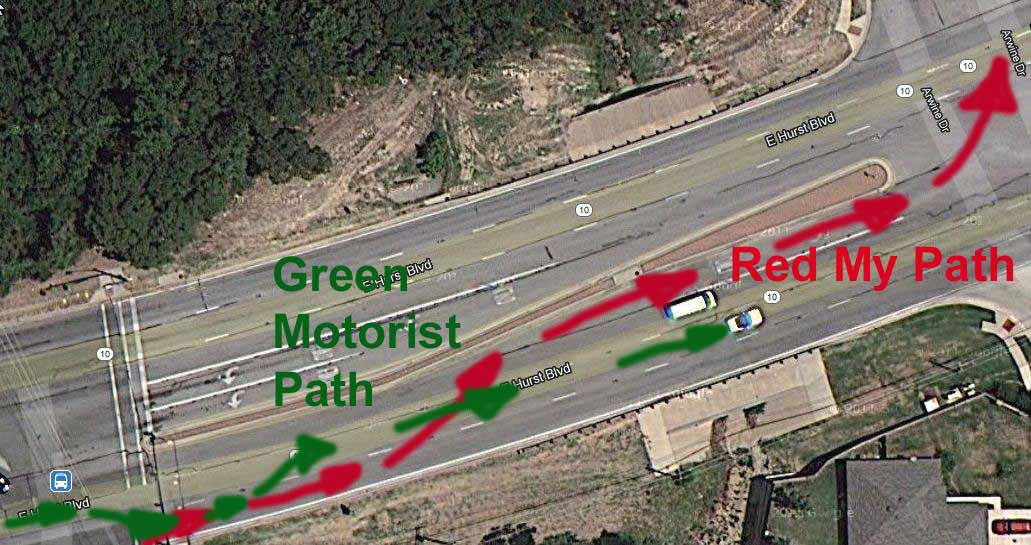
The second event was the rare "drama behind me." In it, seeing a motorist proceeding in the middle lane of three choices, and me planning to cross those three lanes prior to making a left, I initiated a right turn into the right lane (right turn on red). Normally, the motorist would have swept by and then I'd be up to speed and move over to make the left. I COULD have simply waited, but it seemed to be pretty simple. This time, however, the motorist swerved from the middle lane into the right lane - MY lane. What? Suddenly I was in a lane at about 10mph with a motorist directly behind, doing 50 and closing fast. I considered my options, not knowing exactly WHY this lady had swerved from a "clean and simpl pass" position into a "hit from behind" position; things didn't seem clear. As a result, I fell back on experience and hung a left turn signal while keeping close watch. If the lady was going to make a right, she'd see it and we'd be good. If she was wondering about my intent, she'd see it. Either way, I was definitely going to watch this motorist's wheels to see what would happen next. While my stress level edged up. At this point, anything other than "stay the course andO signal my intent" seemed to be a poor bet.

Well, as it turned out, the motorist then swerved left, back into her original lane, passed me with plenty of clearance (remember, I was signaling an intent to go INTO that lane she swung back into), and proceeded apace. After she passed, I exhaled, completed my leftward shifts and made my left turn; thinking about the safety pyramid and pondering how any mirror might have helped. Lest you think I'm simply being "dramatic," one of my engineers saw the event and said he was wondering if he needed to be calling 911. Lest you think I narrowly escaped death, the lady's closest approach was probably ten feet as she swept by in her original lane. I have no idea what the lady had in mind, other than she imagined I'd cross all the way across the street in front of her instead of following traffic protocol, and decided her best chance to miss the "idiot" was to swerve right. Assuming she was paying attention (she was NOT chatting on any mobile device), despite my concern, I was in absolutely no danger whatsoever UNLESS I'd done some ill-advised evasive maneuver at the last moment - mirror help or hurt? I guess my "proper" behavior simply fooled her. Who really knows. Regardless, as PM Summer once said: "no harm no foul."


Second Event - View from Google Maps - Arrows from Yours Truly
I'm neither a big fan nor opponent of mirrors. The one time I used one, it proved a useful added means to help in overall situation awareness. I think, however, that mirrors are a bit oversold, as are other safety things such as "high vis" and helmets. In the final analysis, our FIRST line of defense as road users (or on other public travel routes) is that our fellow road users know what we plan to do and what they in turn need to do to avoid disaster. That is the basis of traffic law.

Let us consider the actual USE of mirrors. Any mirror has three uses; the first is to see what is directly behind, the second is to see what might be developing in the lane to one's left when you might be considering such a shift, and the third is a similar function for a rightward shift. We'll consider them in order.

BEHIND
If you are looking to see what is going on behind you in a mirror, you are motivated by concerns about the general situation or you think you may want to send some message to following traffic. In the case of the "second event," what message would a mirror enable me to send? In reality, in such a situation, clear consistent operation seems to be the best principle when encountering another road user that seems to be doing illogical things. Even a wave or a "slow down" signal might confuse things for a distracted driver. What's more, for looking behind, we on bikes have no need for the "behind" mirror to keep from backing over people or stuff in the driveway. As you might see from the photo below. The rearview mirror is imperfect in that regard even in the MIGHTY LAND ROVER.


Mirror to Look Directly Behind. Mostly Useful for Backing Up
OTOH, a mirror is quite useful to look behind when one is wondering what happened to that motorist behind that should be ready to pass now. In the one day I had a mirror, it repeatedly answered such questions. No safety issue, but I, for one, dislike even short-term mysteries when riding. Score a point for mirrors.

SIDE (left or right)

LH Mirror - Aim it at the Lane to Your Vehicle's Left According to SAE
A mirror has definite uses when considering a left or right lane move in traffic. That is one reason that driver side mirrors have been required for cars starting in 1968 (prior to 1968, no side mirrors were required). They also became ubiquitous on the far (right) side of cars by the early 90's. In the case of a side mirror, it is "aimed" at the next lane over so you can see what will crunch you if you shift over. Such a mirror is clearly aimed differently than the "behind" mirror. Go HERE for a discussion on mirror aiming. Cyclists have an advantage in this regard over motorists because their head movements that effectively change mirror aiming are less than for their motoring brethren. Still, a mirror is either optimized to see behind or to one or the other sides. And THAT is a point mostly missed in the LAB discussions: if aimed behind, what action can you suddenly take that does not make you LESS predictable? If aimed to a side, how often does it really make a difference? While we are talking about SIDE mirrors, the reason RH mirrors came along much later is that they are a lot less likely to be really useful. Think about it. If you are on a bike (or in a car) and making a right turn, motorists on your right are a rare event. If you are making a lane shift to the left; much more likely. As for pedestrians, we on bikes really don't need mirrors to see them.

RH Side Mirror. Look HERE to Check Before a RH Lane Change. Objects are Closer Than They Appear!

OTHER FACTORS
If you are in a car, the side view mirror is much closer to the lane divider than it would typically be if you are on a bike - UNLESS you are riding a bit left of the LH tire track. This is simply due to the much wider width of a car. In my own experience, I get reduced passing clearance if I ride "close" to the LH lane edge. Things are much more congenial if I ride somewhere within the range of tire tracks. Personally, I like the "left center line of sweetness," but as with a lot in life, "it depends."

BOTTOM LINE
Very little of the mirror discussions I've seen address how mirrors are used for different purposes, nor exactly HOW you can reliably use a mirror for any safety purpose when considering traffic approaching from behind. For a movement you plan to the side - yes. From behind, not so much unless you are planning to jump on the brakes without warning.

MY VIEW (no pun intended)
A mirror can help in overall situation awareness. I'm going to get another mirror partly for this reason. What's more, it'll be a bar end mirror and NOT the one I already have that mounts on my helmet. A mirror makes a useful part of the "eyes moving" sequence of seeing what is all around (if that is any different than overall situation awareness) as long as it doesn't become an "end" in itself. A mirror can also help you prejudge a lane move. In this case, however, I'd never make a lane move without the "trust but verify" Ronald Reagan full head check. My kids were taught the same principle when motoring. NEVER change lanes without actually SEEING things are clear. In that regard, mirrors mainly help you know what to expect when the REAL look occurs.


"Trust, But Verify" Applies to Nuclear Weapons - AND Traffic (photo from Wikipedia)

ONE OTHER THING
All the above presumes you have normal vision or are farsighted. For those that are NEARSIGHTED, the mirror also helps them see what is happening back there and off to the side in conjunction with their eyeglasses. Otherwise, they are looking beyond the edges of their glasses.

JAGUAR CONSIDERATION
If you were wondering, NO, I have NO side mirror on my 1967 Jaguar. I have no plans to add one either - unless I find some of those that'll clip onto one's window but can be removed when one drives on to the show field. Just sayin'


No Side Mirror on THIS Vehicle!

Thursday, August 30

Reconciliation

Traffic Signals CAN be Tricky Even Under Good Circumstances
Usually, The CENTER Pavement Cut Would be the Place to Stop Here
The Induction Signal from the Bike Wheel Rim Would be Strongest There
Last week and this, I've acquired a traffic issue to reconcile and I've had an unexpected opportunity to observe motorist behavior in the wild.

The traffic issue is pretty straightforward - at least in theory. You see, the induction sensor that triggers a traffic light leaving work has stopped working. This occurred at PRECISELY the same time as a street resurface project has been underway. How do I know this? Well, the pedestrian button does not appear to do anything. My usual "sweet spot" has stopped working. The final straw is that my four-wheeled companions do not trigger the signal. Well, unless one stops coming from the opposite driveway in which case the signal changes normally. NORMALLY, I'd call to complain to the traffic department of the city in question, but THIS is a sensor on private property. Our guards simply give me a dumb look - clearly none of them have the corporate bullet on the day I talk to them. So I have adopted a new red light policy. If I stop behind other vehicles, I wait until all the motorists in front of me have run the red light. Then I follow my motorists' example when it is safe to do so. If, on the other hand, I happen to be the first to stop, I wait until at least TWO motorists are backed up behind me, and it has clearly been a really LONG time, in which case I lead by example after shrugging and doing some "what else should I do?" signals. Note to self - must bring in stop watch to collect data on how long motorists wait before running a red light. This is really a not "in the mainstream" data collection opportunity. Mostly, signals change quick enough that motorists really aren't sorely tempted to run red lights. In that way, they DO behave better than the typical dweeb on a bike. Still, in the last week, I have observed four motorist red light runnings. I suspect that some motorists are MUCH more patient than others.


Here's WHY I stopped on the Left Pavement Cut at that Intersection
A Traffic Camera that Was Blown a Bit to the Left by the Wind Was the REAL Signal Changer...
Stopping Where I did in the TOP Photo Registered My Pixels and Triggered the Left Turn Signal as Nice as You'd Want
AS LONG AS YOU HAVE LEARNED THE SECRET HANDSHAKE
I also had, what for me is an unusual experience - a "dooring" opportunity. I was inbound to work. It was after dawn. A motorist passed me, pulled over to the curb and opened his door as I was about 20 feet behind him. Conveniently, I was able to observe that there was absolutely NO sign of malice in his face. He simply didn't register he'd safely passed a cyclist only seconds before and that swinging his door wide open without looking might not be considered appropriate and MIGHT actually hurt one of his fellow humans. Luckily for him, I was riding about eight feet off his port beam or I might have had to apologize for putting a dent in the back side of his door with my body. Speaking of which, there's been a "dooring" in a commercial lately where a lady opens up her door and a truck simply whacks it off. My sympathy for her is pretty limited. For my loyal reader, simply STAY OUT OF DOOR ZONES! IMO, motorists simply "forget" there are others out there once they have done the appropriate thing. If that makes ANY sense at all to y'all.


Wednesday, August 1

Respectfully Meaningless

Sharrow on NE 75th Street in Seattle - one of the TOP Cycling Cities in the Entire USA!
I Watched - Every Person on a Bike I saw Rode About Where the Back Wheel Ends.
As "Linda A" Said - "Nobody Cares Where the Arrows Point"
This is a topic where I fear to tread. However, the "Institute for Sharrow Research" can remain silent no more. You see, sharrows are one of the subjects on which bicycle advocates MOST love to argue with each other. Which makes it dangerous for me to tread, for fear of being accused of ridiculing same. And hence the title of this post. I really DO mean that first word. I really like the post that Waco made over on Biking in Dallas - one of the best I've seen on that topic. He didn't get all officious on us. As Dragnet once said - "Just the facts, ma'am."

The problem with sharrows is that they're put in place to enable bicycle planners to claim they're connecting bike routes and making stuff better for commuters. Legally, they mean absolutely - NOTHING. Well, another problem with sharrows is that bicycle ADVOCATES seem to LOVE to argue about how far out the sharrow should be painted. Is this one far enough? Well, "AASHTO says" and so on. Perhaps that is the use for sharrows - it keeps ADVOCATES from further belaboring us with stuff that helps nobody.

Personally, I  find sharrows amusing. They come a close second to the "Share the Lane versus BMUFL" debate for useless futility. In either case, regardless of what the advocates decide when they argue with each other, most people on bikes ride close enough to the curb to scare such as me.

For myself, I'd like to see police simply understand the law as its already written - including the exceptions to the discriminatory "Far to the Right" (FTR) language. That'd be a MAJOR advance. So far, I have seen no evidence that the Bedford Police operate otherwise and I salute them. YOU GUYS ROCK! I hope that continues, because Texas law supports my right to ignore sharrows, "share the lane," OR "BMUFL" nonsense. My motorists ignore all that stuff too, so we're in solidarity - well except for a few rare idiots who most readers of this blog have encountered - or at least their cousins in spirit.

Tuesday, June 5

Shameless Plug


The Family's Youngest, in a Tree Well at Stevens Pass, Washington. "The Pouty Skiier"
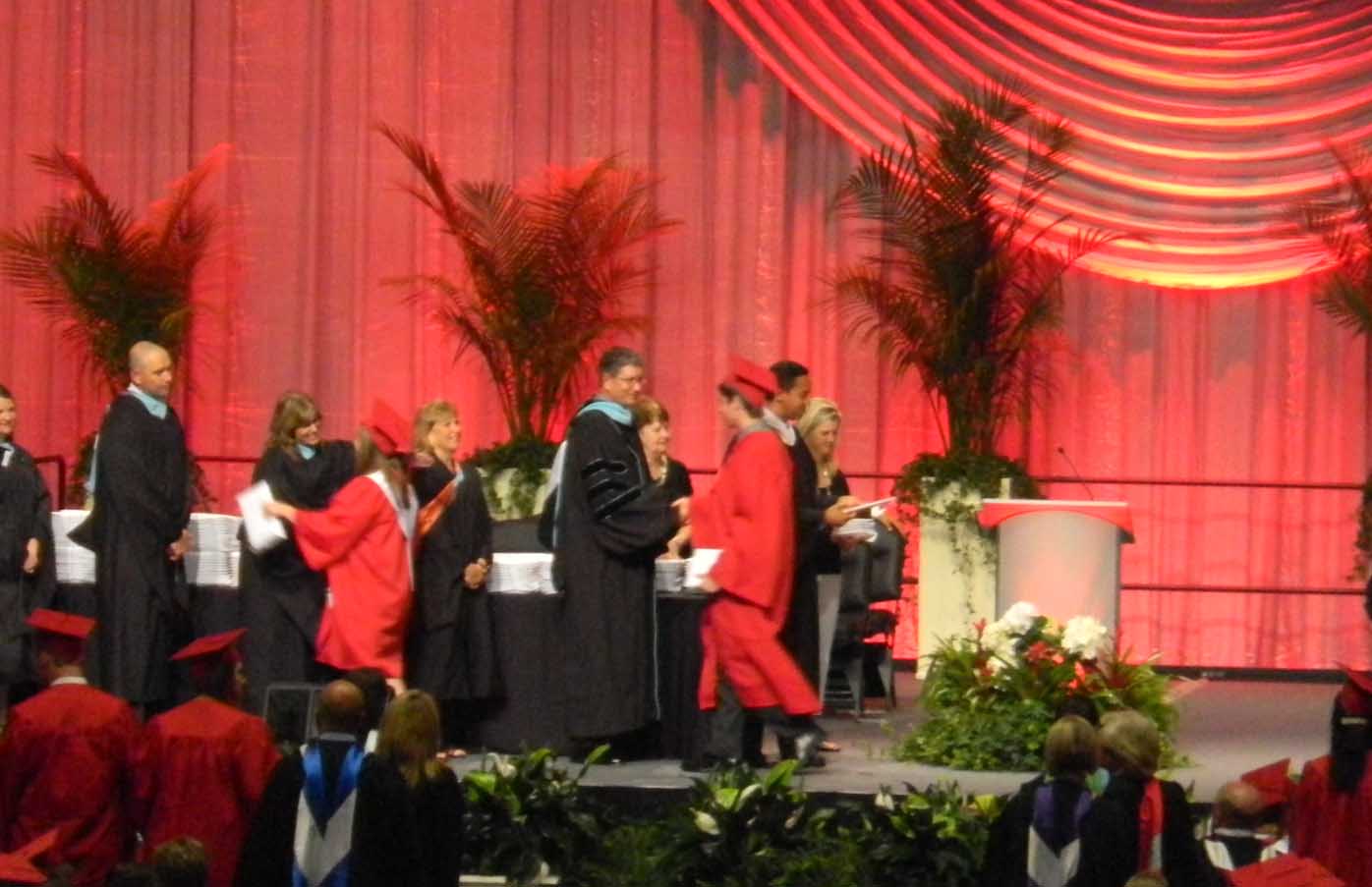
Mostly I write about cycling topics on this blog, but today I digress for a shameless plug. You see, a major family milestone was reached last week. Our baby graduated from Colleyville Heritage High School. I saw tears in my wife's eyes. Me too. Kudos to one we called "The Pouty Skier."

Three Sisters. The Youngest Just Graduated

YOU GO, GIRL!

The High Schooler Learns How to Pass Cyclists - "Make FULL Lane Change When It's SAFE!"
I Believe That Lesson Sunk Home and Will be With Her FOREVER

CHHS Drum Major

Graduates File In


Wednesday, May 23

Twenty to One and "The Lost Post"


Posts on other blogs can cause us to reconsider things. Andy Cline, at Carbon Trace, made a post about clueless cycling behavior. It wasn’t the post so much as the combination of the post and observations that cyclists disobey traffic controls even when they know better, that caused me to ponder. You see, elements of this appeared in comments guessing content of what became “the Lost Post.” I found the comments amusing at the time, but they tie to what JRA called “Total Cycling Support.” Even the “twenty to one” in the “Lost Post” gives clues.
There is truth to newspaper comments claiming that “roads are for cars.” If you doubt it, drop me an email and I'll do a "Gruesome Threats" post. But I'd rather not. People on bikes FEEL it and it bothers them. They FEEL it even if they don’t get honked at, or harassed by a motorist police officer while operating safely and legally. The roads really ARE optimized to accommodate a uniquely dangerous major use – four-wheeled motor vehicle operation. Because these motorists mostly kill and delay each other, and have lots of votes, other users are rarely considered seriously, and are almost never considered as part of “real traffic.” In effect, others are marginalized by design. The “Lost Post” showed that to be true – even though it EXCLUDED any safety elements whatsoever. People on bikes or walking are at a disadvantage. If you doubt it, go push just about any crosswalk signal button. While you wait, wonder why the signal is at the corner instead of midblock. Now imagine that motorists are making free right turns, and there are mud puddles, and it’s windy. Feeling vaguely disadvantaged, many bike riders and pedestrians try to compensate in some way. It isn’t just motorists that don’t want to wait. I’m sure you can think of many examples. If not, speak up and I'll do a "blood and gore" due to people trying to live around cars post. But I'd rather not.

I have a major advantage over most cyclists when it comes to legally avoiding delay due to motor-centric roads. I KNOW how to trigger all the traffic signals along my commute route. I KNOW where to turn to avoid most of the stop signs (especially those at the BOTTOM of hills) that exist only to stop motoring excesses. I KNOW how to safely interact with motor traffic. And I get delayed twenty to one. Think what a person without that knowledge does – so they don’t get delayed even more. Good road design balances the needs and, indeed, the DELAY that various types of users experience. Good road design is rare in the US today. “Shared Space” is considered radical. While the current state of “Complete Streets” might be poor, it is an attempt to restore balance. We need to do better.

I don’t suggest that people should start ignoring traffic signals, shooting through crosswalks without looking, riding the wrong way, or all the other idiotic things people on bikes do (I am NOT a victim!), but I do suggest good road design should take the characteristics of various road users into account and balance things better. It isn’t entirely “bad” or “ignorant” people that are the problem. Motorized traffic IS different than non-motorized traffic and there is no excuse to let the designers hide behind a “same rules” mantra. Twenty to one says non-motorized users are being treated worse.

So, I recovered “The Lost Post” and repeat it below. Consider it in the context of whether horrid behavior of many pedestrians and bike riders might be worsened by a road AND educational system that marginalizes them. Sometimes, looked at a second time, data suggests a different story than we intended. Twenty to one was pretty simple to discover in my case, but in many cases, things are far worse than twenty to one – and the total time gets bigger the further you go.
-----------------------------------------------------

"The Lost Post" March 2012

I apologize to my loyal reader, who wondered what I might be getting at when I posed the question:
"Has anyone out there really added up the time cost of stopping at a stop sign compared to nonchalantly riding through same?"

Perhaps noting that I had an ulterior motive got comments off on the wrong track. Perhaps I have been too strident in the past. For, you see, sometimes a question is EXACTLY what it seems. You see, this post is not hypothetical, as Pondero couched his theory. Then he and others talked about momentum lost and rhythm. Khal even touched on a hot button of mine when he used that "w" word. Well, all that goes into the hopper for a future post, but today, simply, this post is about who gets delayed - cyclists by motorists or motorists by cyclists.
What? You might ask, motorists are forever complaining about cyclists holding them up. Well, let's examine the facts.
FACT 1: Today, as usual, I didn't see any other cyclists or people on bikes on my commute. That means that any motorist that might have been delayed was only delayed by me. That keeps the motorist delay math simple. In total, we're talking about a second or less. If you live somewhere else - like Boston or Portland or Seattle, let's be generous and multiply the motorist delay by a factor of ten and count it as ten seconds.  (MAY update - COUNTING MOTORISTS waiting at stop signs for me, you might add as much as four seconds to my previous estimate - still a lot less than I bumped things up to. Ten seconds still seems safe.)
FACT 2: In saner moments, even most of the "more militant than average" motorists will concede that motorists are really more likely to get held up by other motorists than even the most offensive spandex mafioso. This is particularly true if you ask the motorist right after he/she comes off a freeway after a two HOUR stoppage.
CYCLISTS DELAYED
In reality, besides the question I asked, cyclists are delayed (even if they do NOT obey all traffic directions) by many motor-centric road features. I do not pretend to come up with a complete list here, but all of the following apply to the commutes or other cycling of a LOT of cyclists and all are caused by motoring:

Short and efficient routes where cycling is banned (freeways and other roads) or effectively banned because of heavy and fast traffic. Many of these roads are paid for with my property taxes and not any sort of user fee.

Stop signs and stop lights that are only needed to keep motorists from crashing into each other or into innocent bystanders, or, increasingly, in a mostly futile attempt to keep speeds down. While compliance by cyclists might be better, the delay is still real.

Alternate routes taken by cyclists in order to avoid harassment or otherwise lower their stress levels. Paths are a common refuge, despite being somewhat riskier for falls than even MEAN streets.Regardless, these longer routes represent delay due to motoring.

Seriously, Little Ol' Me Delays ALL These Guys or Do THEY and Their Infrastructure Delay Me?
COUNTING MY DELAY DUE TO MOTORING
This morning, I tried my best to note all these delays. Now, keep in mind that after I bump up the delay I create by cloning myself, it totals ten seconds. First, my quickest route would have used the 121 Airport Freeway for a mile. Between the construction to widen it and the lurid news stories about pedestrians run over by multiple motorists (some being on-duty police in high vis vests), I took a delay of about 30 seconds necessary due to the motorists. Next, I encountered ten stop signs along my route. In reality, NONE of them would have been there except to keep motorist animal urges under control. Counting five seconds of delay at each would put me behind by 50 seconds more. That puts me up to 80 seconds. Third, I made a few route detours that further lower stress. The extra 0.2 miles adds an extra 60 seconds since I average about a mile every five minutes (what can I say, I'm no spring chicken any more). Now we are at 140 seconds. Stop signs are a big time waster. I hit four of the eight stop lights red along my route. I confess I didn't time them all, but the ones I did time led me to conclude a 20 second delay at each red was about right for a total of 80 seconds more. However, in fairness, if there were no motorists, I'd probably want stop signs so we have to subtract 20 seconds off - and add 20 seconds on for the green lights; leaving us at 80 seconds for a total delay of 220 seconds in order to keep my motorists safe. Hmm, I didn't mention it, but I also had another 20 seconds of direct delay since the motorists are slow off the line at left turn signals when in a line.

BOTTOM LINE
I think it goes back to Pondero's note in a previous post - there are a lot of motorists and so that makes a lot of comments about road hog cyclists. Votes do count. The majority do, however, forget that much of what is put on those roads delays other users who would not need those devices at all if motor vehicles were not so dangerous. Four of those ten stop signs I encountered were before the first traffic light and two were within a block of my house.

I don't begrudge all these delays that exist simply so motorists can "rule the roads;" it is part of the cooperative network that forms our road system. HOWEVER, the next time I hear some whiny, er, "perturbed" motorist complain about BIKES holding him/her up, I'll think back on this post, and smile mysteriously about a "delay ratio"over over 20 to 1 AFTER I bump up the "1."


ORIGINAL COMMENTS ON "THE LOST POST"
cafiend said... I used to ride a route three miles longer, over a much higher summit, to avoid the highway on my ride home from work. The extra miles took longer than the same distance on terrain and pavement comparable to the highway. It was wonderfully peaceful but got me home too late for domestic harmony.
My two routes out of town even on the direct route are a big detour out a side road to avoid a section known for impatient motorists or a scoot out the rail trail with all its shortcomings, to reach the highway outside of town. All these delays have more to do with avoiding motorist friction than with a strong desire for more mileage or a particular enjoyment of the path.
On the UF campus in the mid 1970s, cars were forbidden. Masses of cyclists filled the streets between classes. Everyone just flowed. The only time I had a problem was when I created it by being a speedy jerk.
March 19, 2012 8:54 PM RANTWICK said... Great perspective. I think your plan to smile mysteriously rather than go on a rant along these lines is also a wise choice.
March 20, 2012 10:02 AM Steve A said... If traffic was war instead of cooperation, the vehicle of choice would be the one I posted about at: (photo of tank along my commute route omitted)