Showing posts with label utility cycling. Show all posts

Sunday, August 18

Load Limits and Towing Capacity

How Much Can I Tow in this Trailer? Mac & Cheese for the Local Food Bank!
Yesterday, I used my "free to me" trailer for grocery shopping - it's nice not to have to worry about fitting everything in a bag or even two, and backpacks can be a PIA. Starting out, however, cargo capacity became a question when I started out up a little slope in the parking lot to leave for home. Further on, I felt doubly privileged to shop in a place as flat as Ocean Shores, Washington.

In the motor vehicle world, load limits and towing capacity are pretty cut and dried. What's more, manufacturers publish their values, though these are not always highlighted when the numbers don't support selling vehicles to people.

Two major values include:
  • Gross Vehicle Weight Rating (GVWR) - this is the maximum amount the vehicle is rated which includes the vehicle itself, fuel and oil, and all payload (passengers, pets and luggage, including any roof racks and contents thereof). Our Subaru Outback has a GVWR rating of 4,695 pounds, since its empty weight is 3,600 pounds, that means we can carry a bit less than 1,000 pounds. If there are five people in the car, that doesn't leave a whole bunch leftover for luggage.
  • Maximum Towing Capacity - this is the maximum amount the vehicle can safely tow. Some so-called utility vehicles, such as the Vokswagen Allroad have no approved towing capacity at all. Our Subaru Outback has a rated towing capacity of 2,700 pounds.
There are lots of other ratings, such as "Gross Combined Weight Rating," but these are not so easy to track down. It appears that Subaru simply lets you tow 2,700 pounds whether the vehicle itself is full or empty.

How Does This Apply to Bikes?
In the bicycle world, these values are not so easy to find. It's pretty easy to find out the "empty weight" of most new bicycles, but payload - not so much. It's pretty clear some bikes have a lot more payload capacity than others - tandem bikes, for example, have uprated wheels to support the extra weight, but these values are NOT easy to find, though I have noticed that motorcycles and even electric scooters now specify a maxium payload (typically 240 pounds, and up to 400-500 for motorcycles). It gets even tougher when you start towing stuff with your bike. As in the case of cars, you can tow a lot more weight than the vehicle payload suggests. Our Subaru can tow nearly three times its payload. The Volkswagen that claims it is an Outback competitor can't tow anything. But how much is too much? Inquiring minds want to know! Does that spendy Trek Madone have a GVWR higher than the "Wallyworld Cheapie?" And what about that Dutch Cargo bike versus a Touring versus a Cyclocross bike?

I HAVE found a few items that relate. For example, here, they have a "calculator" and the site also lists weight capacities of 300 pounds for pretty heavy-duty looking trailers. Here, a site lists payload capacities for some bikes from major makers (sorry Surly owners, but no number for you!). Apparently, some manufacturers note that wheels are the weak link (Raleigh notes "All frames are tested to 550 pounds. It is the wheels that limit rider weight more than frames."), but there, the trail grows cold.

Harley Does it Different
While motorcycles are somewhere "in between," Harley Davidson uses a frame decal sticker with the GVWR on it. They also list the individual axle capacities. There's a discussion on motorcycle weight capabilities on Northwest Motorcycling Sound Rider, here. The link even has a couple of photos and discusses how difficult it was for him to find weight carrying capacity for some motorcycles.

Saturday, May 19

We No Need No Steenkin Trailers

Each month, the Ocean Shores IGA has a "Price Smashers" Saturday. This month, milk and eggs and various other things were on sale for "can't pass up" prices. Eggs were 99 cents per dozen and milk was $1.99 per gallon. As per usual, I went there on my bike (actually, I went there on my wife's bike). I discovered that my combined Arkel pannier and Burton backpack would carry 2 gallons of milk, 4 dozen eggs, and a wide variety of other things,with some room left over. I didn't even use two of the bags I brought and I didn't even bother attaching the Arkel handlebar bag to the bike.

OTOH, it's still early in the day...

Wednesday, January 21

Car Crazy in New Orleans

I'm really not sure how to characterize cycling in New Orleans. Unlike newer southern cities, there's a lot of it going on. It has its fair share of brain-damaged, door zone bike lanes, one of which makes a star appearance in one of this post's videos. The standard of how people ride is generally no better than elsewhere, with wrong-way sidewalk riding abounding, even when bad bike lanes adjoin the sidewalk.

Today, however, I'm going to talk about a small subset of cycling and car culture in New Orleans, namely the French Quarter. The French Quarter was the original part of New Orleans and was mostly built up in the 17th and 18th centuries. After the Americans came around, it expanded greatly, with places like the Garden District.

Sharrows seem to be the fashion statement as you enter the French Quarter. Note that there is car parking on both sides of the street.

One thing that really struck me was the way bicycles were attached to just about anything that made sense, and that cars were parked everywhere. I do not recall, however, a single purpose-built bike rack. What's more, almost all of the car parking was paid parking, even on the street. There were some private lots, and parking there was about $10 for two hours. Doing a little math, with on-street parking costing $1.50 per hour and five or six bikes (average) in a car parking spot, the city would have to charge about a quarter an hour to break even. Can anyone say "bike share?"


There did appear to sort of be a designated bike route of some sort, though I saw no evidence that any of the local cyclists paid any mind to it. Given a sign on the same street, I don't imagine cyclist safety was a high priority in route selection.

Crescent Corridor Sign

In the area around Jackson Square, bicycles were not so welcome. In the Square itself, I'm not sure a person walking a bike would be allowed. Even dogs are forbidden and you might be tasered for feeding a bird.


Despite all this, the French Quarter shows why people ride their bikes everywhere in places like the Netherlands, and why I entitled this post "car crazy in New Orleans." As you may see from the photo below, the purple zone is the French Quarter and there are cars parked all the way along almost every street. What's more, as the videos show, there are cars parked in the traffic lanes of many of the streets.

Four Blocks Stroll from a Parking Garage to the middle of the French Quarter
Now, for notes on the videos. In the first one, shot on Decatur Street on the side with a bike lane, you see a pair of people using the bike lane. While I'm not sure the bike lane does any more than make people feel better about passing on the right, it IS the fastest route along the street. Later in the video, you'll see a guy come the wrong way down the bike lane. Right before he appears, the traffic signals turn red so he's actually riding through a red light on the wrong side of the road. Still, he doesn't appear to be in overly much danger. The first video is 27 seconds long. The light turns red about ten seconds in and the "Gulf Salmon" shows up about 5 seconds later.

In the second video, you can see how the lack of a bike lane distorts things. That skateboarder would have not been allowed had a bike lane been present, and the SUV would not have tried to make a U turn either. BTW, as I recall, someone making a U turn is supposed to yield to all other road users. The second video is 29 seconds long. Originally, the skateboarder was one clip and the SUV was another until I merged them together. You can tell from the music that they were shot one after another.

IMO, this location almost CRIES to be a "nearly motor vehicle free" zone. Sure, delivery trucks need windows to deliver. There are people who have garages on private property who should be accommodated, and parking garages would have to be erected to get all those cars OFF the French Quarter street, but we need to give all those high-falutin' urban planners SOME sort of challenge. Heck, maybe they could put in some streetcars with all those parked cars gone and a bike lane would take on a WHOLE new meaning. How, one might ask, do you protect cyclists from pedestrians? I guess that's one reason they mostly ride slow in Dutch cities...

Looking East along Decatur Street

Looking West along Decatur Street

Monday, April 14

Potemkin Village

Front Street in Seabrook WA
A "Potemkin Village" is a made-up place intended to fool casual visitors. See Wikipedia. These can appear most anywhere. One such, IMO, is the "village" of Seabrook, Washington. It pitches itself as a "people friendly" location, contrasting itself from where I picked, Ocean Shores. Remember, Ocean Shores is a place with virtually no traffic and where I do most shopping by bike. Hmm. Did I perhaps make a mistake?


Bike Rental!

Golly, Seabrook even has bikes!


I didn't see Anyone in the Rental Tent
Above is the Seabrook bike rental location. While I never actually SAW anybody ride a bike there, I suppose sometimes some do. Certainly, Seabrook highlights their bikes, here.

Still, there's a phony air about the place. Kind of like if a tiny Disneyland had timeshares. This is a people-friendly place that no public transit or shuttle serves and which requires a four-hour drive from major cities. At least in "car-dependent" Ocean Shores, I can take the bus into Aberdeen or even Olympia. What's more, despite the Seabrook bike hype, it did not escape my notice that none of the businesses have bike racks. Not even the little deli that substitutes for groceries.

We spent 25 minutes there. It was plenty of time...


They Hide the Cars Behind the Buildings Mostly
Seabrook in Progress


Wednesday, March 26

Little Steps

Is Texas Food Local if You Buy it in Ocean Shores? Well, it's More Local than Chilean Produce
Chandra, in his excellent "Green Comotion" blog, recently made a post where he included much good information from Dr Mercola about the viability of our food and health aspects of food. That post was here.

One aspect of Dr Mercola's article could have been improved. While his nine recommendations are all very worthwhile, I'd suggest a few MORE for those of us that aren't in a position to go "all the way," but may have to motor a long way to get some of those foods while our local grocery is a short bike ride. For the vegans amongst us, you may want to close your eyes with regard to my final recommendation. I'll continue from where Dr Mercola left off, with an emphasis on "easy to do" items.

10. SHOP THE EDGES OF THE STORE
It is well known that most of the most highly processed foods are in the middle of the store. Hence, sites such as mass.gov recommend that you get most of your food around the edges of the store. They have a good generic diagram to show this which is reproduced below. Simply shopping the edges of the store will be a step in the right direction.

Your Store Will Probably Vary, but the Principles Still Work
11. TEXAS LOCAL IS BETTER THAN FURRIN STUFF
While in Ocean Shores, buying things like kale might be best if it comes from Grays Harbor County, it is still better to buy from Texas than from somewhere the produce must be airlifted.

12. SHOP BY BIKE
Dr Mercola failed to consider the effects of transport of the shopper on food usage. While the Ocean Shores IGA might lack somewhat in organic and other "good" choices, one wonders at the tradeoff between non-local produce bought locally, versus local produce bought non-locally. IGA is next door to the espresso stand and I bicycle by there each morning. The "local" source of Hoquiam produce is 30 miles away.

IGA - Official Grocery Store of Frankenbike and Kermit
13. SHOP A GOOD FARMER'S MARKET WHEN YOU'RE GOING BY
Ocean Shores DOES have a farmer's market on summer weekends. Oddly, little of the produce at this market is produced anywhere close to Ocean Shores. Still, I go there on my bike. See rule 12. However, we've taken to stopping by the Hoquiam Farmer's Market when we have occasion to motor over in that direction. Their produce is mostly grown in Grays Harbor County and there're a lot of organic items.


Hoquiam Farmer's Market Has No Decent Bike Parking and is a LONG Ways from OS, but has EXCELLENT Organic Produce
The Lettuce is Grown by the Grizzlies (Hoquiam High School)
14. DIG FOR ALL YOU'RE WORTH
Vegans please close your eyes now. The rest of you may read the newspaper headline below. 'Nuff sed.


Definitely "NON GMO" and Locally Sourced. For the Record, Clam Guns do NOT Have "High Capacity Magazines"
 

Thursday, June 30

Arrrgh!

The Staff at my Dental Office Gather for the World!
On occasion, cycling to work is a lot like going to the dentist. Wait, today, I actually WENT to the dentist. I'll call the office "Dr S." One neat thing about the v3 commute is that things like going to the dentist on the way home are actually practical. Back in the v2 commute, it would have been nearly a 2 hour ride to get there. Now, it is under 30 minutes, and is only a couple of miles detour from a direct route home. KOWABUNGA! My first opportunity, back in February, was interrupted by an ice storm, but today was a little warmer. It was a pleasant 98F or thereabouts.Warm enough to not get chills. I brought along some extra stuff so I could be presentable. Namely a towel and my "Ski King" t shirt. I'll admit, it's tougher to clean up when going somewhere one doesn't go every day, especially on a summer afternoon. Still, either everything worked or the staff was admirably polite.

Regardless, my friendly neighborhood registered dental hygenist, anonymously identified as "N" in the center of the photo, was my main contact at the dental office. As usual, she was unflappable and truly wonderful, despite my questions about dental picks and drawing blood by accident from patients, not to mention my suggestion about dying the water in her fountain red. I hate to say it, but I was more of a PIA than usual. It is amazing all the things that occur to a patient sitting in a chair and imagining stuff while he thinks about what he might say in a blog post afterwards.

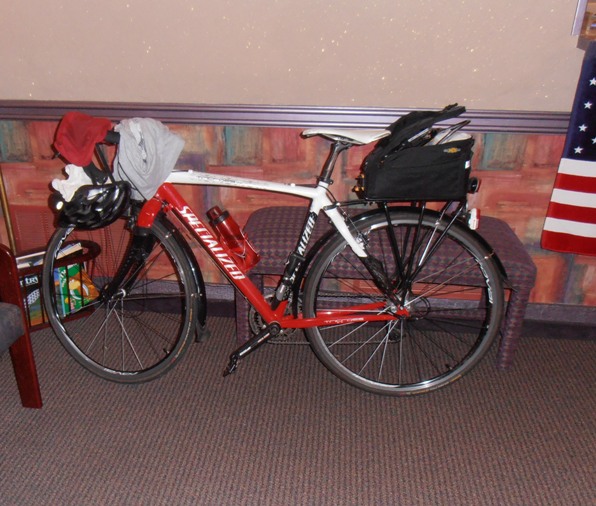
Before you knew it, I was on the road again and, conveniently enough, my local bike store beckoned on the trip home. I stopped in, mainly to see what was new in the world of cycling stuff one MUST spend money on. They had gobs of stuff, but nothing that really called out to me. I looked at saddles in particular, and my question to the sales guy resulted in a few warranty returns. Oops! Perhaps the recent spending spree on winter gear wore me out. Crimeny, I didn't even look at the price on the saddle. It was brown in any event. Can anyone imagine a brown saddle on the bike below? I certainly would consider it a bit tacky. White; definitely. Red; ditto. Black; maybe even a little TOO mainstream, but brown? Maybe Rantwick would applaud, but he liked that grey (sic in American but not in Canadian) water bottle on my red road bike.

Buddy, Waiting for my Return, in the Dental Waiting Room. You Can See the Flag at Right, Though It Probably isn't for Canada Day
Leaving, I saw people driving to their local bike store. It caused me to wonder about this driving to bike phenomenon. One day, I shall have to interview one of these species. I wonder how far they travel to visit the cycling store. I wonder why they don't simply ride somewhere directly from home. Are they cyclists or triathletes? Are their bikes broken and they don't have another to go get replacement parts? In most ways, it'd seem much simpler just to hop on the bike and ride. I guess I'm missing something.

Drive Your Bike to Your Bike Store?
The day ended well. I stopped for a little "almost home" refreshment of string cheese (lots of salt and electrolytes!) at an elementary school near home. Later, I went to my local library and, out of the blue, the librarian at the reference desk asked where I thought might be a good place to get a "vintage" bike fixed. I suggested Trinity, mostly because I think they'd treat her well. Perhaps I erred, but I'm willing to bet they know how to fix up an old three speed. I can't imagine why she'd think I know anything about bikes, though she might have been tipped off by my interlibrary loan request: Bruce Epperson's "Peddling Bicycles to America." Ya think?

Last Stop Before Home. In a "Drug Free, Gun Free, Anything Else Free" Summer Vacation Shade Zone

Wednesday, September 22

Loneliness of the Long Distance Yeti

Yeti Come in Various Forms. This One Doesn't Look Like a Cyclaris Vehicularis
I’m not a vehicular cyclist. I’ve said it before on this blog, though perhaps never quite so bluntly. I've also talked about various aspects of vehicular cycling (VC). Other than occasional recreational forays, I ride to get places – mainly commuting. When I ride on roads, I operate under the rules of the road that apply to people operating on the road. I ride consistently, assertively, and in a way that makes it as easy as possible for my motorists to understand and know what and where I am going to go next. That gives them the information essential for them to be able to safely and efficiently go where THEY want to go next. I do not violate the principles taught in Bike League cycling classes, in Effective Cycling, or Franklin’s book (well, except those Limey types ride on the wrong side of the road). It’s not hard. It took me a day or so to implement the fundamentals, though I continue to learn useful bits, just as I do when I drive the Land Rover. I’m not a vehicular motorist, either. I just use a vehicular approach when I drive the Land Rover on or around a road.

I have been watching carefully during my commute to Alliance Airport for well over a year to see others riding this way. I’m sorry to say I have never seen a single one in thousands of miles of my commute. I’ve seen people riding on sidewalks and shooting across intersections. I’ve seen people riding the wrong way on busy roads. I’ve seen people riding in the dark without lights. I’ve seen people make left turns from the far right edge of the road without looking first. I’ve seen people hugging the fog line or curb in lanes too narrow to share with any four-wheeled motor vehicle; sometimes while riding very quickly. I’ve even seen them hug the curb on a busy road while riding with no hands on the handlebars. And that’s not even counting the signal/sign violations that motorists complain about in newspaper comments. The more I see, the more I marvel that few people on bikes suffer painful and bloody deaths. It seems we underestimate the competence of motorists, or overestimate how aggressive motorists are towards cyclists. Perhaps we do both.

Cyclaris Vehicularis. Not in a Texas Summer
In fairness, I HAVE seen people ride the same way as I do. I’ve seen safe riding in bike school. I’ve ridden WITH a few Yeti (cyclaris vehicularis), and once, on a weekend, I saw someone assertively operating by vehicular rules. My daughters have seen people riding this way on three other occasions when I was not present. Rantwick managed to make a somewhat ambivalent video he claimed was a Yeti. Still, even if we accept these sightings as factual, they are few and the scofflaws are many.

IMO, the scofflaw majority seems to be a major factor why many motorists are skittish around cyclists. Mostly, motorists see people on bikes doing clueless, unpredictable, and dangerous actions. If I never see any operating according to best practices – and I’ve been looking, why would a motorist expect different? If you have never seen a cyclist stop for a stop sign or control a lane, it can be momentarily confusing as to what to do when one DOES. I consider it fortunate that the motoring majority “get it” and instinctively understand the “behave as a vehicle and be treated as a vehicle” principle. They just never see it. If they DO see it, it occasionally scares them.

Bike Education has a very long and steep hill to climb. If I criticize the Bike League education program, it is not for the content of the education, or the enthusiasm and ability of its instructors, but rather its failure to solve the problem of how to reach the masses of cyclists who could be helped.

Friday, September 3

What’s in YOUR Purse?

Steve's Purse, Complete with Rear Light and Stylish Shoulder Strap
This week, I realized I’ve started carrying a purse. I didn’t do it on purpose. It just happened. Some purses are made by Vera Bradley or Louis Vuitton. Mine was made by Topeak. Realization dawned when I went in to Starbucks on Tuesday and left Buddy outside. I unclipped my purse from the back and dug through it for my wallet. Then I dug out the cell phone and my glasses so I could look at a few blogs before the last leg home. Wednesday morning, on the radio, they talked about a survey of what women carry in their purses. Sunblock may not exactly be the same as makeup, but they are at least generically related.

Here’s what I carry in my purse:
  • AAA batteries
  • Badge
  • Cell phone
  • Coffee syrup and Cheese sticks
  • Extra Planet Bike rear light (they’re small and light)
  • Glasses
  • Gloves, if I’m not wearing them
  • Keys
  • Lunch
  • Plastic bags to keep stuff dry (if rain may start)
  • Seasonal clothing items during colder seasons
  • Spare tube, minitool, pump, tire irons, and patch kit
  • Sunblock
  • Sunglasses, if I’m not wearing them
  • Wallet
  • Whatever else needs carrying
Men's Purses Tend to Have Different Contents Than Women's Ones
How did all this happen? Well, as it turns out, I rode enough miles during August that I was getting a bit sore. This resulted in me departing from my norm and wearing cycling shorts. Yes, despite my usual practice of wearing real clothes for my commute, I DO own some specialized items intended for cycling. Well, there aren’t a lot of places to keep “stuff” in cycling shorts. Even if you wear a cycling jersey and a SPI Belt, it turns out you are well down on storage space compared to a good set of cargo shorts. So I use my Topeak purse.

Once you HAVE the purse, it simply makes sense to carry everything in it, including the SPI Belt.

After rereading this post, I decided to get into a ruthless weight savings mode. This morning, I left the extra Planet Bike light at home. Two rear lights and a rear reflector ought to be enough. Iron discipline...
Showing the Purse in Travel Mode Gives me an Excuse to Show the Gratuitous Shot of Buddy Again!


Friday, January 1

Utility Cyclist

Photo taken by Praktica film camera
in May, 1986. Scanned in 2010


Seen in the West of Ireland, near Shannon, by Steve. It's just the handy thing to ride home after dropping the cows off for the night. I'd like to see you do THIS in a car!

Note the step-through frame. You'll also note that this cyclist is obstructing traffic. I don't recall if any bulls were in the herd, but I doubt any following motorist would be inclined to honk at him.