Thursday, March 31

Spring Comparison


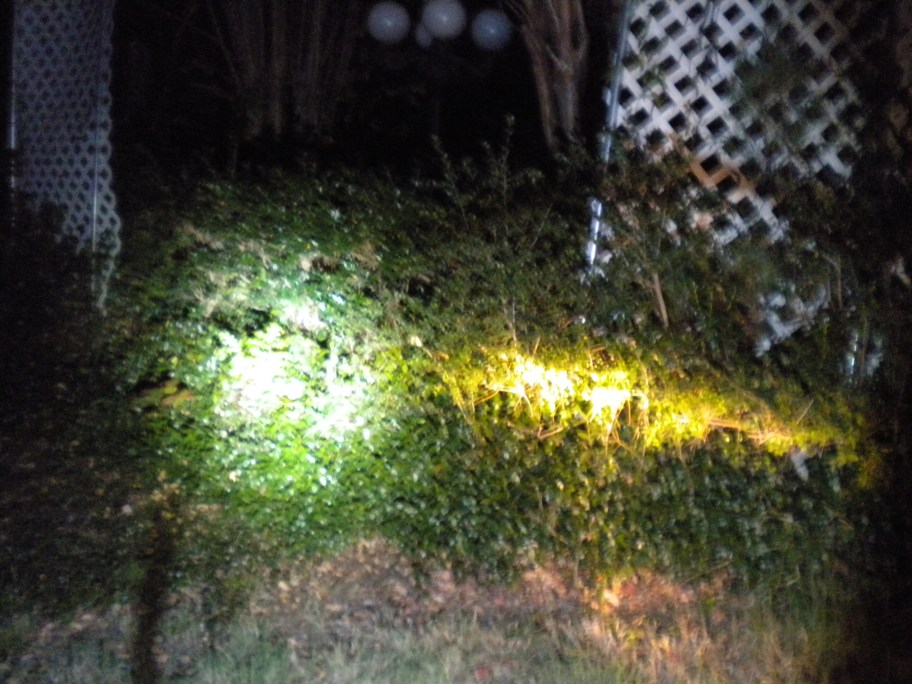
"High Vis" Wild Flower in Seattle - Skunk Cabbage in Bloom
I've been in Seattle for a bit. Soon, you can expect to be regaled with a story about my first bike, and the way it got ridden. In the meantime, take a look at "High Vis" stuff seen in Seattle compared with the same around DFW. I've not seen a single wild flower of a growing nature down here as of today.

"High Vis" in Bedford, Texas - John Deere Marker


Thursday, March 24

LCI Reflections


Preston Tyree Shows Us Communication Skills in the Classroom
I was privileged to attend the Plano LCI Seminar the last weekend of January. Chandra and I carpooled. For those that do not know, LCI stands for “League Cycling Instructor.” What that means is that the League of American Bicyclists has concluded that you are qualified to teach bike education courses to its curricula and have the skills to develop other education consistent with the principles embodied in the LCI Seminar. The LCI Seminar is three days in length, with a mix of classroom work and on-bike exercises. It is assumed that LCI candidates have skills well beyond those taught in “Traffic 101” and this was the case with the candidates in our seminar. What we needed to learn were ways to more effectively teach students in the classroom, in parking lot drills, and on the road. As we progressed, candidates were continually asked to assess things they and others did well, and where improvements might be made.

The Curriculum
Regina Garcia Teaches My First Seminar
On Friday, we were treated to a review of the LAB cycling program and were asked to make impromptu presentations. This part of the curricula was different for me than for Chandra in that it represented the one portion of the LCI program where I was repeating ground that had previously been covered. In my first course, Regina Garcia presented and in the second course, Preston Tyree presented.

On Saturday, we had the opportunity to make team-teaching and individual presentations, and did practice parking lot and on-road teaching. Saturday was a very long day and things wrapped up with a short night ride where we got to see what cyclists looked like in the dark.

On Saturday, We Practiced Setting Up Parking Lot Bike Skill Drills
On Sunday, we were put through our paces without being guided, and the LCIs that were assisting quietly made notes as to our abilities and shortcomings. We also heard more lecture about other teaching situations, including the teaching of non-league curricula such as the CyclingSavvy program. Things wrapped up with a short report-out on how we did and things we need to work on.

LCI Seminar Organizers Quietly Discuss the "Good, Bad, and Ugly" Regarding Candidates
Rather than a blow-by-blow review of details and nits of the program, I’ll instead summarize three things I thought it did well, three things it might have done better, and a few takeaways.

Three Things the LCI Seminar Did Well
Time Discipline – Both Regina and Preston were very impressive in their ability to stick to the curricula and finish ON TIME. EVERY TIME. What’s more, I think the point was not lost on any of us grasshoppers.

Consistent Content – I was very impressed with the consistency between what Regina attempted to impart and what I heard from Preston. Each used their own words and examples, but it left me convinced that an LCI candidate gets exposed to the same teaching regardless of where and who is involved in that teaching. Getting to hear the material a second time was not like watching a rerun of an old TV show, but it was somewhat like watching a good remake of an old movie.

Cynthia Hoyle, from Champaign Urbana, Explains Why and How We'll Do a Parking Lot Drill
Clear Message on What to Teach – I was impressed and relieved to find that, regardless of mixed messages that might occasionally be sent out by the bike league and various advocacy groups, there was no ambiguity in the subject matter, nor in what the bike league expected its instructors to do. As Preston explained, if asked an awkward question about a situation about where a poorly conceived law required a cyclist to ride unsafely, our obligation was to explain the statute, explain what and why a safe action(s) was, and don’t editorialize about the whole thing. IMO, it is what bike education SHOULD be about – teach what and how to ride, and don’t preach about the way you think things OUGHT to be.

Three Things the LCI Seminar Could Have Done Better
Improve Feedback to Candidates – When we made presentations, there was a video camera going in the back of the room. I believe it would help candidates to get a copy of their own teaching and maybe even the teaching of other candidates. Advances in digital media make this more practical than it was in the past. For an example of an LCI Candidate presentation that WAS made available, see youtube - I've seen one candidate lecture there, but I can't seem to locate it again. Our class was more fortunate than many, because Gail Spann took thousands of photos and posted them all in a Facebook album. One such is shown below. Yours truly is the "less visible" cyclist. Certainly, this photo shows other differences between the two cyclists as well. Note, for example, how they differ in their foot position while waiting for the left turn signal to turn green. Less obvious in this photo is the difference in hand position. I keep my cross top brakes applied when I'm stopped.
 
Photo by Gail Spann - Facebook Caption of it States "Teaching moment, see how the yellow jacket stands out?"
Accelerate Technology Implementation – Let’s face it. Listening to even a good speaker gets old after a while. I probably noticed it more than most of the LCI candidates because I was getting a reprise of the Friday night material. What’s more, different students learn different ways. I was happy to hear about web-based approaches beginning to be used in league bike education, at least for T101, but it is only a first start. Even substantive portions of the LCI Seminar might benefit from adaptive web-based approaches and social network sites.

By Sunday Afternoon, You Can See "Lecture Fatigue" Starting to Accumulate
Better Integrate Assisting LCIs – In both Seminars I attended, a single seminar leader taught the bulk of the material, with LCIs present to assist and advise. I felt this resource added greatly to the class and is consistent with the message that team teaching WORKS. I wondered, however, if I might represent an abnormal viewpoint since five of the assisting LCIs were either co-students at my first LCI seminar or assisted at both. Had I been one of the three candidates travelling from Illinois, not knowing any of the assisting LCIs, it might have seemed more daunting. As a model for how things might be improved, those assisting LCIs took on an entirely different nature for the practical demonstrations than in the classroom. IMO, they could have benefitted some of the classroom work in a similar fashion. Each seminar leader has been through things many times before. Many of the assisting LCIs represent a recent experience viewpoint of what the candidates can expect to go through as they attempt to transition through their first classes. I, for example, would have appreciated Gail Spann describe the trials and tribulations of BikeDFW attempting to re-establish a viable bike education program in the DFW area.

Three Takeaways
Get Teaching – If you live in the US, visit the bike league website and pull up a list of LCIs in your area, you may find many that are fairly close by. I don’t have a precise count, but when I count the courses offered and the LCI count, it is clear to me that there are a lot of LCIs there that never teach. Y’all may not have noticed, but I have been known to occasionally slip educational tidbits and snippets into my blog posts. I’d like to think that some of it has helped others ride safer at least once in a while. Preston noted that if you don’t teach early, you never will. And that is truly sad because there is a WORLD of people out there that could benefit from a little more knowledge.

We ALL Have Things to Learn – Throughout the seminar, I heard little snippets of useful things I could apply in my own riding; from those that led the seminar, and from other candidates. Personally, I even learned from bad examples. “I’ll never do THAT!” Yeah, right. Something good, something to improve on, tell why, explain how, demonstrate – All principles we got drilled into us repeatedly, proving that even I can absorb things.
 
Chandra, Intently Learning Stuff About How to Teach Children
The League You Don’t Hear About – Bike Ed is a different bike league than the public image. It is an entirely more serious league. I knew the serious league existed before taking the seminar and even long before I took T101, but I’d also heard (and continue to hear) many claims the league had forgotten its essence. Make no mistake about it. Riding your bike every day, whether on dedicated facilities or in traffic, is a deadly serious business, just as driving your car should be taken seriously. It is no coincidence that the safest riders are the ones that DO ride every day. Personally, I think it goes more towards explaining any “safety in numbers” effect than attempting to explain it as changing motorist behavior. The bike league does a lot of PR and bicycle “feel good” stuff. That’s appropriate and necessary, and certainly reinforces the message that riding a bike is fun and safe, but in the final analysis, just as political parties have their “base,” so does the bike league, and successful organizations always keep their base in mind, even when reaching out to a larger public. If there is any question as to what that base consists of, the league has now certified over 3000 LCIs. Total membership is around 16000.

This is the Serious Bike League? Well, We JUST Finished Up. Photo by Preston Tyree

Monday, March 21

Smart Business

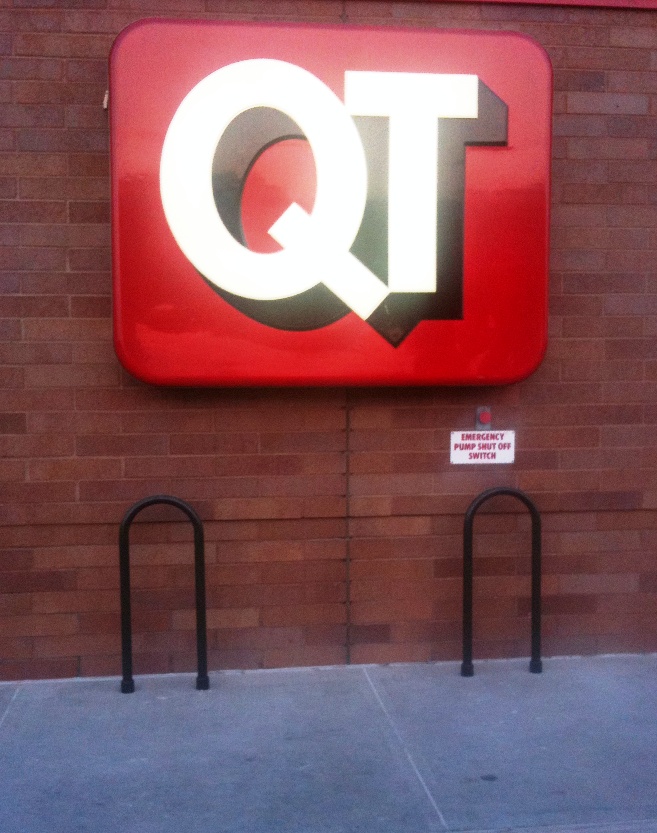
These Guys are SMART - Maybe They Noticed Cyclists Coming in to the Store for Snacks
Last weekend, I saw something I've not noticed anywhere else. I saw a GAS STATION with bike racks. Specifically; the QUICKTRIP in Bedford, Texas at the intersection of Industrial and Harwood. They added these racks AFTER the station had been operating for some time. One might wonder WHY in the world a gas station would want to put in bike racks? Well, these guys seem to have a knack for making a buck. Cyclists stop by their store to get snacks. Snacks, as in something that is MUCH higher mark up than gas. I'll occasionally take advantage of their "two for $2" hot dogs. These guys have free air, too. As long as one has a Presta-to-Schrader adapter, what more could a cyclist want for a refreshment stop? Why would I go to "Racetrac" when "QuickTrip" has locking facilities? More to the point, even if I were to buy gas, guess which place would be MY gas station of choice?

QuikTrip Would be MY First Choice About Where to Get Gas for the Lawnmower
One wonders why MORE businesses don't find a way to sneak in a bike rack around their premises. Bike racks don't cost much, or take up much space, and cyclists may well have more disposable money since they don't have to spend as much feeding their motoring habit.

Buttermilk Cafe in Bedford May Not Have Good Facilities, But a Good Attitude Helped in the Predawn Friday
Even without proper cycling locking facilities, some businesses still get gold (or at least brass) stars for having a positive attitude about cyclists. One such is Buttermilk Cafe, where they told me they'd be thrilled to have me lock up my bike right next to their front door and would even seat me near the window so it'd be easy to keep an eye on things.

Friday, March 18

Doughnuts Bedevil a Cyclist

Four Sets of Doughnuts Have Slipped in Two Years
I'm sure I'm only one of many that has the problem outlined today. I don't recall the subject being treated at bicycle school. SLIPPERY DOUGHNUTS. The symptom is illustrated in the photo above. No, these aren't the kind of doughnuts you eat, but the kind that are SUPPOSED to keep your exposed brake cable from messing up the paint on your frame. After a ridiculously short period, instead of remaining in place on the cable, they work their way back to the rear end of whatever cable they are sitting on. After only a brief time more, they work their way back within a block of being set where they belong. Before too much longer, they simply disappear from the cable altogether, one at a time.

Buddy originally came with some classy white doughnuts. They slipped pretty much within a month. When I had to change out the rear brake cable, I put the first set of black rubber ones on. THOSE lasted nearly six months. Now, my third set of black rubber doughnuts routinely vibrate to the back of the cable run, even without any brake application.

The question is: does anyone have a practical solution for this other than increasing the cable housing run or simply doing without? If the cable were BELOW the top tube, I'd be inclined to simply give up rubber doughnuts for Lent, but it's easy to damage the paint with a cable running ABOVE the tube. I've considered a drop of super glue on each doughnut, but somehow that seems like it might not be a brilliant solution, particularly if I accidentally glued a doughnut to the frame. A small dab of tire patch glue? I am NOT going to try WD-40.

Thursday, March 17

Down the Slot

This Road Encourages Faster Riding
Monday, I encountered the conditions in the photo above upon departing from a coffee store of a major chain based in Seattle. Up UNTIL Monday, this was an exceptionally pleasant street to cycle on. It has four lanes, traffic isn't particularly heavy, and the pavement is smooth.

Monday, I rode down the right lane, as usual, in "the line of sweetness." However, it just wasn't the same. While I didn't delay any motorists as much as a single second, at THE OTHER END of this stretch, "the slot," so to speak, my heart rate was noticeably higher than when I usually commute. When riding to work, I rarely try to ride full speed, but rather "comfortably fast" in order to get there quickly without saving those last couple of minutes. If more roads were like this, I'd be in better aerobic condition because this road not only makes passing impossible, but there aren't many places to pull over. "The slot," other than the short stretch in the foreground is level to slightly uphill, and in contrast to last summer's construction, I ride this stretch at rush hour on a weekday. It might just be coincidence, but this is the same jurisdiction. Unlike the previous "slot," there are more decent alternate routes, which mainly make this an irritating road condition rather than a serious conflict situation.

Tuesday and Wednesday, I took advantage of the short commute and local knowledge to avoid all this nonsense and ride a quarter mile further. I thought about calling Bedford to complain about the lack of consideration for cyclists this construction lane marking showed. However, I think they simply wouldn't have understood, even if they cared. Even a lower speed limit would have sufficed. If, instead, they'd simply turned the street into two bike lanes and no car lanes, what do you imagine the motorist reaction would have been? They COULD have suggested a lower speed limit while the construction was ongoing. All they would have had to do is turn on the "school zone" flashing lights and advise people to go slow in the construction zone.
 
No Phone Number on the Contractor's Sign for Anyone that Might Think They Could Have Done Better

Tuesday, March 15

Straight Talk About Bike Locks


OnGuard Mini U Lock and Cable. Frozen Full-Size OnGuard in Background
This is Classic "Sheldon Brown" Technique. The ONLY Down Side to it
That I Have Noted is Modern Bikes Often Don't Have Much Clearance Between
The Rear Tire and the Seat Tube, Particularly With Fenders Installed
In my post about my OnGuard lock getting frozen into immobility when a “hard freeze occurs,” I noticed a wide variety of thoughts in the comments. While not as impassioned a subject as discussions about helmets or “high vis” wear, locks are a subject near and dear to many of us. This post summarizes some of the better information I’ve seen.

First off, it is widely recognized that a U-lock provides superior theft resistance for a bicycle, combined with a reasonable weight. Cable and chain locks tend to be weak, heavy, or both. Combination locks also tend to be vulnerable. I own two combination cable locks that I use frequently. I do not depend on either for more than casual security while I pop inside to pick up a coffee or similar action. They are “just a minute” and “I forgot my real lock” locks.

There are two widely available U-lock manufacturers that sell quality products in the US; Kryptonite and OnGuard, with Master Lock also offering some products that might be good, but which are less prominent. You may read reviews of locks such as Abus, but you’ll have a harder time finding such a lock unless you happen to be in Europe or are buying online. Most of the other locks readily available in the US are either made by one of the companies above, or are some “no name” knockoff that might be good and might be worthless.

While many U-locks are sold alone, it is wise to extend the protection of a U-lock with a cable in order to extend protection to expensive items that might be easily removed from the main frame (like a front wheel or a saddle). Cables alone are either weak or extremely heavy, but they make a good supplement to a U-lock. A cable won’t keep your bike safe, but it probably DOES act as a deterrent to someone simply walking off with your front wheel.

For locking approach, a variation on the approach recommended by Sheldon Brown, discussed here, is sensible. I lock the way Sheldon recommends, except that if my lock is big enough, I capture both the rear wheel AND the seat tube with the U-lock. IMO, capturing both makes the cyclist feel better and accrues the real benefit of making the lock a bit harder to leverage.

Once you have decided to get a good U-lock, you need to decide two things. First, do you get a “good enough” one or “the best” one, and do you get a full size one or a “mini.”

In making this decision, you need to consider a few factors:
  • Will you regularly be carrying the lock with you?
  • Is your bike going to be left unattended for long periods and be the most expensive/desirable target, and are you willing to keep your bike even if it got damaged extensively during an unsuccessful theft attempt?
  • Is the solid object you attach your bike to simply too big to accommodate the “Sheldon” locking method with a Mini U?
If the answer to the first question is “yes,’” I suggest you might want to forgo some of the more glamorous full size locks and get a mini/cable combination. Serious minis are much lighter than the serious full size locks and, in tests, are comparably secure to full size locks that cost much more. For a given level of protection, wouldn’t you rather lug around 2 pounds rather than 5? In most cases, a good mini U and a cable weighs less than half the weight of a full-size U without a cable. Certainly, it’ll take up less room. Don’t take it from me, Sheldon recommends the same thing.
 
The OnGuard Mini U With Cable Locks Both Shackles Separately, a Good Feature for Security
If the answer to the second question is “yes,” you might want to reconsider your bike choice, but also you will need the best possible security. This means MORE than just the U-lock that performed best in test, it means you ought to consider that MULTIPLE locking schemes provide superior security. You’ll need to use that top line U-lock, and also a chain/cable. Still, keep in mind that a strong lock and multiple locking schemes will be stronger than your bike frame (the frame may get bent when a lever attack is attempted), and will not protect most of the components. Those SRAM Red shifters and derailleurs are valuable and easy to remove. Brooks saddles are also attractive theft targets.
If the answer to the third question is “yes,” you’re stuck with a heavier and probably more vulnerable full size U lock. I have found few bike racks that would not work with a Mini lock, however.

The two best discussions of American Market locks that I’ve seen are on Slate, and on BikeForums. Some of the comments in the BikeForum post are also good, but some are less useful.
OnGuard Mini U Lock and Cable as Sold at Wally World
After digesting all this, and much more, I decided to get a Mini U Lock with a cable. I picked OnGuard over Kryptonite because the package included a cable, which comparable Kryptonites did not, and because it was available at a price and location the Kryponite was not (Wally World). Don’t get me wrong, the Kryptonite is a fine product and I would have taken the Kryptonite had circumstances differed. I also notice that Kryptonite now seems to have started including cables with some of their U locks lately. Arguably, the best Kryptonite locks may be better than Onguard, but either is a lot better than what most people use. Neither was available at my LBS. My LBS stocked a “Trek” lock, which appeared to be a relabeled mid-line Kryptonite, but it did not include a cable, it wasn’t a Mini, and it cost twice the price of the better U lock I purchased. I actually got a Trek cable lock that is a POS relabeled ski lock. The cable was too short to run through the frame and front wheel, which should have caused Trek to reconsider putting their name on an inferior product. I ordered the Trek lock from my LBS after my previous lousy ski lock, which did have sufficient cable length, broke. Had the LBS had the Trek cable lock in stock, I would have seen the cable was too short and would have kept looking for a better choice. Still, the Trek lock works wonderfully well AS a ski lock. As a bike lock, it is a bit better than nothing at all. As for the LBS, Tracy Wilkins talked about LBS not having what he needs here. He's not alone. I should have done better research - ON THE INTERNET. Regardless of where I made the final purchase. My LBS, like many, has limited choices available in stock. It's a reality of the current market.
  
"Trek by Kryptonite" - This is a Ski Lock but it'll last a Minute and Guard Accessories
It'll Also Fit in a Pocket and Weighs Very Little. Hardly Worth Leaving Behind.
It's Far Better Than the Total Security Many Bikes Get - Nothing at All

A weight comparison of various choices follows:
  • OnGuard Mini U Lock and Cable 931g
  • Kryptonite “Fahgettaboudit” U lock from “Slate article” 2090g without cable
  • Trek “Just a Minute” cable combo ski lock 96g
  • Schwinn “Not Good Security” cable combo lock 652g
  • And I could go on for much longer, but you get the idea.
IMO, the Trek lock, bad as it is, is light enough to warrant carrying around all the time, and it’s better than nothing at all (though not as good as simply taking Buddy inside a store with me, which is the best security of all). It fits into a bicycle seat bag or a pocket. While the cable is too short to extend through both wheels, it will at least cause a thief to have to walk back to the car to get a pair of snippers. Moving up from the Trek, I favor the mini U lock if I have to carry a lock. I reserve the full size U lock for work, where I leave it on the rack and don’t lug it around.

Schwinn "Not Good Security" Cable Lock. Still, It's Longer than the Trek Cable

Monday, March 14

A World of Difference

Dawn Comes Late This Time of Year. THAT Means Sunset is Also Getting Later
Last year, making my v2 commute, I bemoaned the return of daylight savings time. Last year, it meant I returned to the period of total darkness for almost the entire hour and a half ride in to work. I don't mind riding in the dark, but a long ride in the dark, every morning, gets me a little down.

THIS YEAR, the return of DST was an entirely different situation. Between the shorter commute time and the mighty P7 light, a dark morning commute is quite different. THIS YEAR, the return of a dark commute means extra daylight AFTER work and THAT means I can do extra exploring after work in full daylight. The TRE train, in particular, beckons. In contrast to last year, where the TRE was a full hour's ride from work, now, it is just across the street from work and down the block.

P7 Bike Light to the Left, VW Jetta Lights to the Right
7:40 was the hour of dawn this morning. I'd been at work the better part of an hour. The TRE beckons!

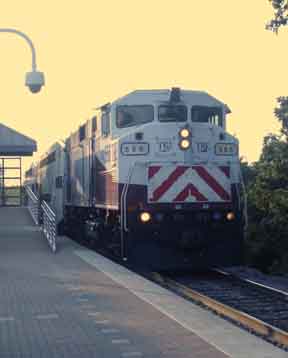
The TRE May be a Waste of Taxpayer Money, But I'll Ride It!


Sunday, March 13

Tim Horton and a Cyclist's Impression of Quebec

Tim Hortons, Saint Sauveur des Monts, Québec. The Closest Tim Hortons to Dallas is in Kentucky. I Wish it Was Otherwise
The Ski Hill is Up on the Right. Québec Snow in Late February is Much Icier than BC Snow at the Same Time
OK, OK, it isn't enough to talk about Tim Hortons in comments about a post that actually SHOWS a photo of a bike rack at a restaurant of a chain that has its world headquarters in Des Plaines, Illinois. Tim didn't have bike racks. I looked. Tim also didn't have free wi fi, as did that place with the maple leaf grafted on to its arches. Free wi fi is highly desirable when you get a message from ATT telling you that your unlimited data does NOT apply and you'll get stuck for  $15.36/MB.

In many ways, Québec was infused with bicycle indications. The first of these came when I arrived at Montréal's Trudeau Airport. Right in the area where we arrived at customs, there was - a bicycle cop. She was outfitted much the same as the Fort Worth bicycle police officers, but I'm not sure exactly how useful a bicycle would be in a crowded terminal. About as useful as a Segway, I'd guess. Do Segways have locks? Regardless, the bike would be good to get to the other end of the terminal but then you'd capture the scofflaw on foot, or so I'd imagine from having watched too many movies.

The airport was lacking in some other bicycle amenities, however. There was no place to rent a bike at the terminal, nor did they seem to know where I might go locally to rent one. There also appeared to be no practical way to depart the airport by either bicycle or even by car. Fortunately, the GPS in my rental car eventually got me out of the airport, where soon I noticed that all the freeway onramps had signs posted to let me know that no bicycles or pedestrians were allowed on these limited access roads. This is different than Texas, where cyclists are not, technically prohibited from any but a few toll roads. Montréal's freeways in the city center were more logical than those in Vancouver, but neither place made paving over the city center the priority it would have been in an equivalent US city.

In the morning, I got to my business meeting and noticed that one intrepid cyclist had tracked through the snow and ice to work. Later on, I talked to an engineer that knows the cyclist and noted that he lived fairly close by. I can empathise. I was also told that cyclists were catered to by the businesses around Québec. This time, I didn't have a chance to spend much time around downtown Montréal. Perhaps in a future trip. I shall try out those separated pathways for myself, though the local reports I heard were less glowing than what you read in the press.

I also searched for some Jakeman's syrup, but all I saw was the stuff in maple leaf bottles. You know, the stuff that Rantwick showed in his very initial FARATS post. I didn't buy any because it's readily available here in Texas at TJ Maxx for less than half the price. Rantwick chose wisely when he elected to pick Jakeman's instead.

Airport Syrup - Same as Texas TJ Maxx at Twice the Price
Snow is No Big Deal at Trudeau Airport

Friday, March 11

Myth 4 - Bike Helmets

There is an ongoing battle of mythology about helmets. One side is dominated by a “more safety is always better ethos” whereby people are castigated or even criminalized (in places like Dallas and Seattle) for not wearing helmets to ride their bikes, and a less well defined faction ridicules helmets as worse than worthless. Both extremes stoop to inaccurate and misleading claims. In the real world, helmets are unlikely to help a cyclist avoid injury in the event of a high-speed crash. I have seen no evidence to indicate that professional cyclists are injured or killed less now that helmets are universally worn than they were back in the day of hair nets. On the other hand, helmets ARE likely to help in the much more common event of a low speed impact. I wear a helmet when I ride to work. Occasionally I forget, but when I forget, I don’t make a special trip back to get it.


Contrary to Cycle Chic's Claims, Helmets for Motor Vehicles Have Been Available for Many Years. THIS ONE is Mine.
Helmet Deniers
Yup, I Wear Cycling Gloves Even More Than Helmets
In my life, riding my bicycle has led me to hospitals on two occasions. Both of those occasions occurred last year, documented here and here. In neither case did wearing a helmet help in any meaningful way. ON THE OTHER HAND, during the DFW ice and snow episode last February, I hit my helmet hard at least a half dozen times on one commute. In none of those episodes was I traveling above about 5mph at the time and, in at least a couple of them, I was attempting to stand back up after falling on my bike. Looking back, EVERY fall in which a helmet might play a role I’ve had - EVER - has been a low speed fall. In most of those falls, the helmet did not hit anything. Personally, I’d rather keep it that way, because the denigrators of helmets rightly point out that bicycle helmets are of limited benefit in a high speed crash. If you wish to crash at higher speed, you should select a SNELL certified motorcycle or automobile helmet, and get one with good facial protection. The naysayers conveniently fail to mention that low speed crashes are FAR more common than the high speed crashes the helmets were not designed to withstand. In context, helmets are useful, just as gloves are useful. I usually wear gloves too. Helmets are also helpful to pedestrians in slippery conditions, and I wore mine last February when walking on icy pavement, EVEN THOUGH PEOPLE SNICKERED AT ME. Less clear is the extent to which helmets might mitigate or exacerbate injuries in the event of a higher speed collision. IMO, not wearing a helmet because you are afraid that it may make things worse if you crash with a car is like not wearing a seatbelt in a car because you are afraid of burning up in a car wreck because you can’t get the seatbelt off. Helmets DO help in the common sorts of bike crashes. Those are the common sorts here in the US and in Europe. Of course, these common crashes are not the ones the “cycling is dangerous crowd” try to scare us about.

My Automotive Helmet Complies With the Jaguar Club's Requirement for a Snell 2000 Rating
Scared to Death
Mount Avila in Quebec Advocates Helmets
The scare merchants, on the other hand, cite old studies claiming 80%+ injury reductions (see mythical pro helmet references). In the case where I wound up in ICU, the hospital staff eventually, and incorrectly, concluded my injuries were due to no helmet (I DID have a helmet on; properly worn, and there’s still blood on the strap to prove it). Liberal city councils and Canadian Provinces have gone so far as to criminalize the simple act of riding a bicycle on public property without a helmet. The United States CPSC, in one attempt to extend regulation to other activities, looked at ski helmets and concluded that 11 lives a year could be saved by mandating ski helmets. Woopee Doo! No, I don’t wear a ski helmet, and turned down one recently in Montreal when I skied at Mount Avila. All of this has been done in the name of making us “safer.” IMO, if helmets were the wonder devices their proponents claim, nobody would have to distort the evidence to support those claims, and more research would be getting conducted on how to improve the effectiveness of helmets. Some of the research that HAS been done suggests that helmets fail to provide adequate facial protection and that the protection may not be well matched to real-world impact locations.


This Was the Extent of Helmet Damage When I Went into ICU for Two Days
It Was Another Low Speed Crash. IMO, the Helmet Damage Was Irrelevant to My Injuries
The Hospital Staff Concluded I Hadn't Been Wearing a Helmet - How Else to Explain Getting Hurt?
Local Rules
Unlike some other things the “culture of fear” attempts to scare us to DO (select neon clothing) or AVOID (wearing earphones), helmets have largely become institutionalized in North America. To participate in most bicycle rallies, or in Bike League education, a helmet is mandatory. No doubt, insurance considerations and potential liability in a litigious society play a role. Just as when I drive my Jaguar at a track (helmet and current tetanus shots required – and sometimes a roll bar as well), I either follow the rules or do something else. At my house, I do not attempt to force my kids to wear a helmet to ride a bike. I DO set an example that they are free to follow or not, or even to exceed. In truth, riding a bike is safer than most ways they can get healthy exercise. There’s another whole body of exaggeration when it comes to how safe riding a bicycle really is. But the danger or safety of cycling is another whole myth.

Wrap Up
Now, if this was a typical “helmet wars” post, comments would fall into one of two categories. The first would be along the lines of “you’re a fool if you don’t wear a helmet and I don’t want to pay to feed you through a straw,” or else they’d accuse me of child abuse for not forcing my kids to wear helmets in order to ride a bike. The second comment category would be along the lines of “helmets are worthless and discourage cycling.” I hope my dear reader can rise above such oversimplified nonsense.

I wear a helmet as a personal choice, based on my first-hand observations and as part of setting an example for others, along with the gloves. Since it IS my choice, it clearly doesn’t discourage me from cycling, and, on occasion, I DO ride without a helmet. Seriously, I can’t see how others, seeing me ride, would conclude that I consider riding my bike a dangerous pursuit requiring “nerves of steel,” regardless of the 2008 claims of BUYCYCLING Magazine. I oppose mandatory helmet laws, whether those apply to bicyclists, motorcyclists, skiers, or even snowboarders. I am less likely to ride in or through a jurisdiction with such laws, even though I’m wearing a helmet. Our big government has intruded on our liberties and restricted personal choices entirely more than is appropriate, on evidence that is all too often flimsy or even nonexistent.

Ham flagged an interesting recent video that mostly ridicules helmets. It makes many good points, but others get lost in the anti-helmet tirade. Particularly amusing is the notion that helmets for cars need to be developed. Apparently, the lecturer is not an auto racing fan. Tazio Nuvolari wore a helmet when he drove for Alfa Romeo back before WW II. The video is below. I think some will find it interesting regardless of whether or which helmet mythology they subscribe to.

References
Semi-Sensible
Well, you pick one. My own choice is the one from Bicycle Coffee Systems, though it edges perilously close to getting mythically pro-helmet, which becomes a problem when the author then opposes mandatory helmet legislation.

Mythically Anti-Helmet

One Might Wonder Whether THIS Video is Mythically Anti-Helmet or Merely an Overreaction to "The Culture of Fear"
The "Motoring Helmet" Nonsense Starts at About 8 Minutes. I Can Loan Him Mine
Mythically Pro-Helmet
CPSC Page
Another CPSC Page (a pattern develops of YOUR GOVERNMENT OF THE PEOPLE AT WORK - and IF YOU DON'T LIKE IT, YOU SHOULDN'T COMPLAIN IF YOU VOTED FOR MORE GOV'T)

Thursday, March 10

Different Danger

Occasionally, the Danger DOES Come from Behind, Prompted By Something Ahead
In this blog, I've often noted "the danger comes from ahead." Mostly, that is true. Cyclists are rarely hit directly from behind in an urban or suburban environment. Even most news articles that so claim fail to note that the cyclist "hit from behind" was actually sideswiped by a motorist that didn't notice the cyclist off to the far right side of the road. This morning, however, I was reminded that danger can come from behind, and I was reminded that such danger can be more visceral than other dangers simply because the cyclist has no good way to know what is coming next.

I’ve been fortunate in my commutes, because they have generally avoided locales where I had to ride east, directly into the sunrise on westbound roads with heavy, high speed traffic or into the sunset in the same kind of traffic. I was reminded this morning just how fortunate I’ve been, when unusual circumstances led me to ride into the sunrise on eastbound Trinity Boulevard in east Fort Worth.

Motor traffic travels about 50mph along Trinity. It’s a four lane road with no shoulder or bike lane. It is the type of road I ride frequently with no problems whatsoever. What made it scary this morning; was many motorists did not slow down appreciably when the morning sun reduced their ability to distinguish objects (such as cyclists) up ahead. Thrust into this situation, I felt very vulnerable indeed, because my margin of safety was reduced – and by an unknown amount. Sure, I was able to see well enough to avoid any obstacles up ahead, but it was not clear that one of "those motorists back there" might not get blinded by the sun. As it turned out, this morning, everyone was watching well enough that things did not get ugly and there were no close calls or hard braking, but I have to say I breathed a sigh of relief when I made my left turn and headed north. The motorists were scary because they were unpredictable, or so it seemed to me. While they were every bit as courteous as MY motorists and drove well and politely, they were not MY motorists. They were dangerous. I could FEEL it.

I like roads and conditions where motorists see and notice me a mile or two before they need to pass. Such roads and conditions almost universally apply in North Texas, and in most urban areas where motorists can actually drive at high speeds. Even if a motorist is distracted or impaired, distance, and a cyclist riding where the motorist is going to LOOK gives the motorist lots of time to react without any drama or fuss. My riding lane position contributes to early motorist recognition and reaction. During the entire time of “the honk project,” I was never honked at due to a motorist being surprised by my presence. Honking was invariably due to misguided irritation at my mere presence, or due to a misguided attempt to let me know someone was going to go by. Knowing what my motorists behind are going to do allows me to focus most of my attention on the principal danger – hazards ahead of me.

Thinking back upon my misspent youth, four motoring circumstances where a properly and legally operating cyclist ahead of my car might have been most at risk included:
  • When it was foggy – driving too fast for conditions
  • When the windshield was partly obscured by frost or rain – driving too fast for conditions
  • When sun obscured my vision – driving too fast for conditions (and this most recently occurred last week, though I was driving less than 10mph at the time. If you can't see, you CAN'T see)
  • On twisty roads where a cyclist up ahead might be obscured – driving FAR too fast for conditions
None of these circumstances depended on my absolute speed; merely that the conditions mismatched the speed at which I was travelling. In all honesty, my conduct did not endanger cyclists any more than other road users; I was fortunate that no one happened to be in the wrong spot at the wrong time.

As a cyclist, I’d rather NOT need to be lucky. I cycle defensively and conservatively; albeit assertively. Route planning and knowing local conditions, like weather and light, help me avoid many sticky situations. Experience and training help a lot, as do modern satellite maps. Viewed rationally, the situation this morning was not risky enough that I felt it necessary to simply get off the bike and walk. It was, however, stressful enough that I didn’t feel my fellow road users were MY motorists. Instead, I was sharing the road with a scary truck operator I wasn't confident could clearly see what’s straight ahead. It was a reminder of what many people riding bikes experience on a daily basis. They are out amongst road users they see as dangers rather than simply fellow road users trying to get from point to point safely. I would not ride in such circumstances unless I had no other choice. This morning was a good reminder. I’ll try not to repeat it any time soon. It has increased my sympathy for people unused to cycling on regular streets with no special cycling infrastructure. Feeling secure, even if such a feeling is illusory, makes a real difference.

Wednesday, March 9

Spring Cleaning

Last weekend, it seemed that spring was in the air. Winter may be mild in North Texas, but that doesn't mean that things don't slip a little during the winter. With a big, fresh bottle of Eezox Cycle Tune-Up, a sunny day, the afternoon to myself, and a gallon of Simple Green, it seemed time to do a little bike spring cleaning.

Buddy Might Like to be Dirty, but it Also Likes Getting Cleaned Up
First, I cleaned up Buddy. While I haven't ridden Buddy to work much this winter, Buddy got taken exclusively on the worst days of the winter. Rain. Ice. Snow. I paid special attention to the minor damage, such as the scratches on the chain stay, and removing the failed chain catcher. While not shown in the photos, I also removed the water bottle. As located, it makes locking to the bike rack at work more difficult. I don't have an inside office door to park this bike any more ,so it'll have to get a little tougher. While still a very sweet ride, this bike will probably approach 10,000 miles this year, so it's no longer a precious item to be babied so much as it was two years ago.

The Paint Chips on the Chainstay are the Biggest Manifestation of My September Crash

Chain Catcher Broke. You Just Can't Rely on Unreinforced Plastic for Jobs Like This

After getting Buddy all cleaned and lubed, I did the same with my wife's bike. I rode it nearly a thousand miles last year with no more maintenance than chain lube. I went with Eezox for this chain as well. When I asked her when she'd last overhauled the bottom bracket, she replied "you're supposed to do that?"

Apparently, some more work is due on this 40 year-old Nishiki before too awfully long. Among other things, those "suicide levers" will be going and the ancient, plastic bar tape will get replaced by some excellent Fizik tape. I'm afraid to ask how old that chain is. All I can say is that the friction shifting works as well as one might ask for on the bike, so maybe there's been maintenance done on the bike she never knew about. The lock holder got removed after this photo and I'd love to replace the stem shifters with downtube shifters. Campy shifters would look wrong on this bike, but they shift so sweetly!

My Wife's Bike Also Got Some Attention

Tuesday, March 8

Jack of all Trades

Shimano PD-A530 SPD/Platform Pedals After the First Pedal Strike - Left Side Pedal
I've had new Shimano SPD/Platform pedals on Buddy for the better part of a month now, and some things are starting to emerge about them for anyone considering using them:
  • If you are used to using single-sided, clipless pedals, such as the Wellgo magnesium models I have on the road bike, these will work as well as any others for that purpose. They are not optimized for racing, however. Get eggbeaters or some other four-sided pedal with good mud tolerance for cross racing. THESE are pretty tolerably good commute pedals.
  • I experienced a pedal strike last week when pedaling through a left turn while using the pedals clipless. You can see where the aluminum was ground away due to the pedal strike at the outer right side of the pedal in the photo (the front outside lower edge when riding clipless). I can't recall the last time I struck a pedal on the ground except when making an instant turn. This is no doubt due to the generous platform area
  • I found the platform mode somewhat clunky. This is because I almost invariably ride with either toe clips or with cleats, so a pedal that doesn't simply move where I move my foot is unusual for me. Sometimes, I'd have to encourage the pedal up into the "power position" by nudging it upwards with my toe. Superglue would fix this problem with conventional shoes, but that cure might be worse than the problem. I have not figured out how to use it in platform mode with toe clips and that would no doubt make any tendency to strike the pedal in turns much worse.
  • Upon reflection, I cannot recall any time with these new pedals, in EITHER mode, that any of my toes has gone numb. I shall watch for symptoms, as the third toe on my left foot has tended to go numb with clipless pedals, AND with platform pedals. It's been worst with wool socks, but happens even with thin socks. Hmm, might these pedals contain magic?
All in all, I'm quite happy with these Simano SPD PD-A530 pedals so far. They work well with cleated shoes and work acceptably with whatever shoes I've happened to throw on. Unexpectedly, they don't seem to make my left foot go numb. Comparing them with the Ritchie pedals they replace; the double-sided Ritchies weighed 370g per pair. These new pedals, with their added flexibility, weigh 384g per pair. In real terms, that's just under a half ounce weight difference per pair. Actually, come to think of it, that weight difference was BEFORE I ground away part of the left pedal. Now, these puppies probably weigh just the same as the Ritchies and I haven't hit the right side yet. For comparison purposes, my "Costco Court Classic" shoes weigh 62 grams more than my Sidi shoes - WITH cleats.

Monday, March 7

Guns, Bikes, and Chains

 Despite where I got this product from, and my occasional thoughts, expressed on CycleDog that "open carry for cyclists" might be the ideal jersey in order to make motorists ponder the wisdom of harassing any cyclist, this post isn't really ABOUT guns. Instead, it's about a product I've seen little about; applied to bikes. More specifically, this product is applied to bike CHAINS. This was prompted by the WD-40 controversy about the use of WD-40 as a bike chain lube. Comments about that led me to look further into far-ranging discussions about WD-40, which led me to THIS SITE and THIS SITE, which led me to wonder about this "Eezox." Before you knew it, I discovered that Eezox made a cycling-specific chain lube product. So that nobody confuses it with their gun products, they call it "Eezox CYCLE tune-up." Thank goodness that they resisted the temptation to make hay with the notion of bicycles "shot from guns."

My eBay Source is Circled
And there you have it. To make a long story short, Eezox wasn't available from any local bike shop. What's more, around DFW, it didn't appear to be readily available from anyone else. In all honesty, I didn't spend a day cruising gun stores, but nobody locally advertised the stuff in a web search. I wound up getting it from eBay. I don't think the primary market for this vendor are cyclists. But, "they had the good stuff." Actually, I would have preferred something to get dripped on the chain and cassette rather than a spray bottle, but that wasn't an option.

As with many lubes, the toughest part of applying the Eezox is getting the existing chain clean. Simple Green, water rinse, and elbow grease in several cycles does the trick. The actual application is simplicity itself; simply spray on the inside surface of the chain and on the cassette. Let it all dry. NOW comes the interesting part; namely how does this stuff last and can you simply do a "wipe and apply." For the record, the chain I applied the Eezox to has about 1500-2000 miles on it and the cassette has 6000 miles. It is a ten-speed SRAM chain and a Shimano cassette.


Is this the Wonder Product that Actually DOES What Some Hope WD-40 Might Do?
Stay Tuned. If it is Worthless, Take Comfort that it is Also Hard to Find Accidentally


Friday, March 4

Sometimes God is My Copilot

Gerald Ball, God's Messenger to Cycling Instructors
Not always, but sometimes my copilot places earthly signs along my commute route to provide inspirational messages. These messages take many forms, but sometimes the signs are, literally, signs; such as this sign from one of His messengers to remind me how I should ride if I wish to best teach cycling technique. Might God ride a bicycle, or even instruct cycling? Whether yea or nay, it's a good message to contemplate over the weekend. It probably applies to other forms of teaching as well. You may see some signs yourself!

Wednesday, March 2

Filter or Permeate

Proceeding Through This Intersection, Filtering Seems Like the Only Alternative to a LONG Wait, Stuck in Amongst Motorists

First off, two "cycling" terms:
  • Filter - The practice that many cyclists adopt when coming upon a lot of motorists waiting at a red light. It consists of moving forward past all the motorists waiting in line for the light to change. A variation on this practice, which is considered smarter, is to stop one or two cars BACK from the front of the line so as to avoid inadvertently getting hit when the light turns green.
  • Permeable - An area that presents lots of route choices for a cyclist. Grid street arrangements are typically great for permeability. Geographic obstacles such as rivers like the DFW Trinity River or lakes greatly reduce permeability. Some road arrangements also greatly reduce permeability even when no geographic obstacles exist.
Way back when, until April of 2009, I rode my v1 commute. The return home usually included a segment northward on Bedford Euless Road that crossed the Airport Freeway (Texas 183) at the bottom of the hill described here. That intersection is the one shown above. The photo, shot today, is more or less typical. My practice at that time was to "filter" forward until I stopped one car back from the front of the line. That would get me across the intersection and into the right lane when the light turned green, where all the motorists that made it through the light would pass using the left lane. The main risk of doing this was that, occasionally, a scofflaw in the right lane would proceed straight through the intersection rather than obey the RT Only markings. Such outlaws were only a minor problem for me, as my routine head check would invariably alert me to the onrushing lawbreaker, and I could simply delay my move to the right until the cheater passed to my right. I try to show the situation with arrows in the photo below, during a break in the traffic. This situation only arose on the ride home. On the ride to work, in the opposite direction, this intersection invariably proved trouble free and I always get through on one light cycle.

The Basic Intersection Arrangement When Traffic Clears Out

However, when I began my v3 commute last November, I that permeability is much nicer than filtering for providing a pleasant ride home. That notion was reinforced earlier this week when, just for the heck of it, I elected to proceed on the old route. Unlike the olden days, I'm a lot more reluctant to filter. Among other things, my motorists can get a little snippy if they have to pass a cyclist for a second time, though the availability of the second lane after the intersection makes doing so pretty simple and most of the motorists are fairly tolerant. Mostly, I don't filter due to changes in me. Maybe I've internalized the "Same road, same rules," and all that. Maybe I'm simply getting all soft.

Well, to make a long story short, after sitting through two light cycles, I bailed out and moved into the RT Only lane and then made a free right turn onto the Airport Freeway Service Road. That got me back on track, with only a frustratingly long minute delay. If you want to see how long a minute can seem, watch a video of a full traffic light cycle change from red, through green, and back to red. It reminded me of how obstructive a cyclist can seem to a motorist. Even a few seconds SEEMS like forever.

Mostly, nowadays, in my v3 commute, I take a different route, shown below. It is an alley behind the mini mall and bypasses the intersection entirely. What's more, there is no cross traffic, and I rarely encounter any vehicle of any sort in the alley. It's even got smooth pavement. It is, simply put, "permeable." It is possible that Rantwick's mom might approve since it avoids any parking lot nonsense while also getting the job of getting places done. It illustrates the advantage of permeability over filtering. I'm not the only one that has discovered such cool route variations. PaddyAnne discovered a permeable route option here, Keri discovered one here, and even I have discovered such alternatives here and here. On the other hand, as here, not all these permeable alternatives will work out.


Instead of Stressing Out at the Intersection Above, Nowadays, I Just Cruise Down This Permeable Alternative
The Photo Shows Above Normal Traffic at Rush Hour - Usually, There is No Vehicle Parked Behind the Distant Stereo Shop

"How do I get in on the good times?" you might wonder. Well, ask your fellow commuters is one means that might work. Another is to look at Bing's aerial view and Google's satellite view. They may reveal alternatives that will make your commute sweeter and possibly quicker and safer as well.

As for me, does my "permeable" alternative speed things up? Well, actually no. It has the downside of routing me directly past the coffee store of a major coffee chain and slows me down by a full 20 minutes. More if there are interesting blog posts on the free Wi Fi. It IS low stress, at least unless I take advantage of a free refill. Still, one must make sacrifices!

UPDATE - UNFILTERED CAN RAISE AWKWARD QUESTIONS
Today, looking down Bedford Euless, I saw a traffic-free red light. Seeing a rare opportunity, I made an unfiltered dash to the light where I was legitimately right at the front of the line, and then swept home via the quickest route. Actually, THAT was a source of an awkward question: "Why did you get home so early, dear?"  "Uh, I rode home really really fast just because I love you, sweetheart. Yeah, that's it."

I didn't let on that I find the combination of a trafic-free intersection and a quick route to be even more irresistible than a cup of coffee from a major chain based in Seattle. Absence of that cup of coffee accounted for most of the early arrival. Some things are better left unsaid.